
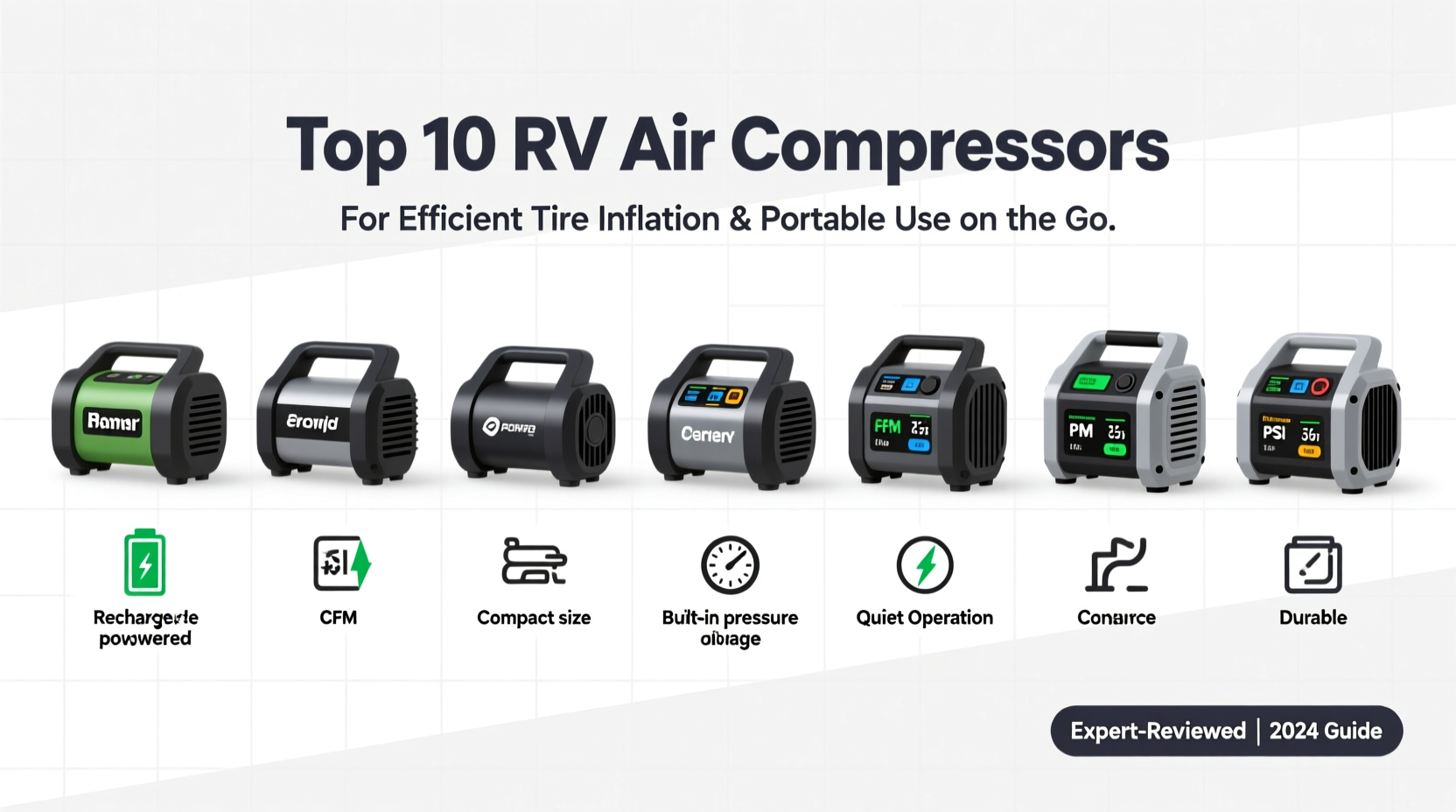
For full-time RVers and weekend adventurers alike, maintaining proper tire pressure and powering pneumatic tools on the go is essential. A dependable RV air compressor ensures safety, improves fuel efficiency, and enhances off-grid capability. Unlike portable models designed for quick car tire fixes, the best RV air compressors deliver sustained performance, durability, and integration with onboard systems. This guide reviews the top 10 models tailored to RV needs—balancing power, portability, noise level, and ease of use.
Why Every RVer Needs a Quality Air Compressor
Tire blowouts are among the most common mechanical failures in recreational vehicles, often caused by underinflation due to temperature shifts or long periods of inactivity. The U.S. Department of Transportation estimates that underinflated tires contribute to over 200,000 crashes annually. An onboard air compressor allows immediate correction without relying on gas stations or external help.
Beyond tires, modern RVs use compressed air for leveling jacks, slide-outs, air horns, and even air-powered tools for maintenance. Having a robust compressor system reduces dependency on shore power and increases self-sufficiency during boondocking.
“An integrated air system isn’t a luxury—it’s part of responsible RV ownership.” — Mark Delaney, Senior Technician at RoadReady RV Systems
Key Features to Consider When Choosing an RV Air Compressor
Selecting the right model requires understanding your usage patterns and technical requirements. Here are the most critical factors:
- Duty Cycle: Continuous run time before overheating. Look for 50% or higher for frequent use.
- CFM (Cubic Feet per Minute): Measures airflow output. Higher CFM fills larger tires faster.
- PSI (Pounds per Square Inch): Must exceed your tire’s recommended pressure (typically 65–80 PSI for Class A motorhomes).
- Noise Level: Measured in decibels (dB). Below 75 dB is ideal for residential campgrounds.
- Portability vs. Permanent Installation: Portable units offer flexibility; fixed systems provide automation and higher capacity.
- Power Source: 12V DC is standard for RVs, though some high-end models use 120V AC or dual-voltage setups.
Top 10 RV Air Compressors Reviewed
| Model | Max PSI | CFM @ 40 PSI | Noise (dB) | Installation Type | Best For |
|---|---|---|---|---|---|
| Viair 450P-RV Automatic | 150 | 3.3 | 72 | Permanent | Full-time RVers needing reliability |
| BESTEK 300W Dual Cylinder | 120 | 2.8 | 78 | Portable | Quick tire top-offs and tools |
| RoadPro RPAC1200 | 125 | 3.0 | 75 | Permanent | Class A and fifth wheels |
| POWEK 12V Quiet Dual Tank | 150 | 3.5 | 68 | Permanent | Quiet operation near living areas |
| SchraederPro 12V Portable | 120 | 2.0 | 80 | Portable | Occasional users and emergencies |
| ARB Twin Motor 480C | 150 | 4.8 | 76 | Permanent | Heavy-duty use and large tires |
| Firestone F4025 Ride-Rite | 150 | 1.5 | 70 | Integrated Suspension | Air helper springs and leveling |
| Puma JS1028-000 | 130 | 3.2 | 73 | Permanent | Balanced performance and price |
| Husky 12V Portable Pancake | 120 | 2.6 | 79 | Portable | Compact storage and light tasks |
| DeWalt DXCMPA3800 | 160 | 5.0 | 90 | Portable/Workshop | RV maintenance workshops |
Notable Highlights from the List
The Viair 450P-RV stands out for its fully automatic operation, built-in pressure switch, and rugged aluminum housing. It's widely used in aftermarket RV air systems due to its reliability and compatibility with auxiliary tanks.
The ARB Twin Motor 480C, originally designed for 4x4 vehicles, excels in high-demand situations. Its dual motors allow rapid inflation of large RV tires—ideal for those traveling through remote terrain where service stations are scarce.
For quiet performance, the POWEK 12V Dual Tank uses advanced sound-dampening technology, making it suitable for installation under beds or within storage bays near sleeping areas.
Step-by-Step Guide to Installing a Permanent RV Air Compressor
If you opt for a fixed system like the Viair or RoadPro, follow this installation process for optimal results:
- Choose Location: Select a well-ventilated, dry area away from heat sources. Common spots include basement storage or beneath the driver’s seat.
- Mount the Compressor: Use rubber isolators to reduce vibration and noise. Secure with stainless steel brackets.
- Wire Power Supply: Connect directly to the house battery via a fused circuit (30–40 amp fuse). Use 8-gauge wire for runs over 6 feet.
- Install Pressure Switch & Gauge: Set cut-in/cut-out pressures (e.g., 100 PSI on, 130 PSI off) to avoid over-pressurization.
- Add Air Storage Tank (Optional): A 2–5 gallon tank provides reserve air for quick use and reduces compressor cycling.
- Plumb Air Lines: Use nylon or polyurethane tubing rated for 200 PSI. Route lines away from sharp edges and moving parts.
- Test System: Inflate tires and check for leaks using soapy water at all fittings.
Real-World Scenario: Preventing a Blowout on I-40
Tom and Linda were driving their Class A motorhome across New Mexico when the TPMS alarm sounded. One rear tire read 58 PSI—12 below the recommended level. With no service station for 70 miles, they pulled into a rest area and used their installed Viair 450P-RV to re-inflate the tire. The entire process took six minutes. “We avoided what could’ve been a catastrophic failure,” Tom said. “That compressor paid for itself ten times over.”
This scenario underscores how having immediate access to compressed air isn’t just convenient—it’s a safety necessity.
Essential Maintenance Checklist
To ensure longevity and consistent performance, follow this monthly maintenance routine:
- ✅ Check oil levels (for oil-lubricated models)
- ✅ Drain moisture from tanks (if applicable)
- ✅ Inspect hoses and connectors for cracks or leaks
- ✅ Clean intake filter with compressed air
- ✅ Verify pressure switch responsiveness
- ✅ Test automatic shutoff function
- ✅ Lubricate O-rings on quick-connect fittings
Frequently Asked Questions
Can I leave my RV air compressor running unattended?
No. Even models with thermal protection should be monitored during use. While automatic shutoff prevents damage, unexpected blockages or electrical faults can occur. Never run a compressor longer than 20 minutes continuously unless specified by the manufacturer.
Do I need an air tank with my RV compressor?
It’s not required but highly recommended. An air tank stores pressurized air, allowing quick deployment for leveling jacks or emergency inflation without waiting for the compressor to build pressure. It also reduces wear by minimizing frequent start-stop cycles.
Are portable compressors sufficient for large RV tires?
Most portable units lack the CFM and cooling capacity for large RV tires. They may stall or overheat trying to reach 80+ PSI. For anything beyond minor top-offs, a permanent or heavy-duty portable system is preferable.
Final Recommendations and Action Steps
The right RV air compressor transforms your travel experience from reactive to proactive. Whether you choose a quiet permanent unit like the POWEK dual-tank model or a powerful portable like the ARB 480C, prioritize reliability, adequate airflow, and ease of integration.
Start by assessing your primary use case: occasional tire checks, regular tool use, or full air system support. Then match your needs with a model that offers headroom in PSI and CFM. Install permanently if you frequently travel off-grid; opt for high-output portables if space is limited.
“The best RVers prepare for problems before they happen. A good air system is silent insurance.” — Sarah Nguyen, Overland Travel Safety Instructor




 浙公网安备
33010002000092号
浙公网安备
33010002000092号 浙B2-20120091-4
Comments
No comments yet. Why don't you start the discussion?