
Creating a handmade pop up card is a delightful way to add surprise and personality to any greeting. Whether it’s for a birthday, anniversary, or just because, a well-crafted pop up card can leave a lasting impression. The best part? You don’t need advanced crafting skills or expensive materials. With just paper, scissors, glue, and a bit of imagination, you can design stunning three-dimensional cards that unfold with charm. Below are ten accessible yet effective techniques that bring depth and movement to your homemade cards.
1. Start with the Basic V-Fold
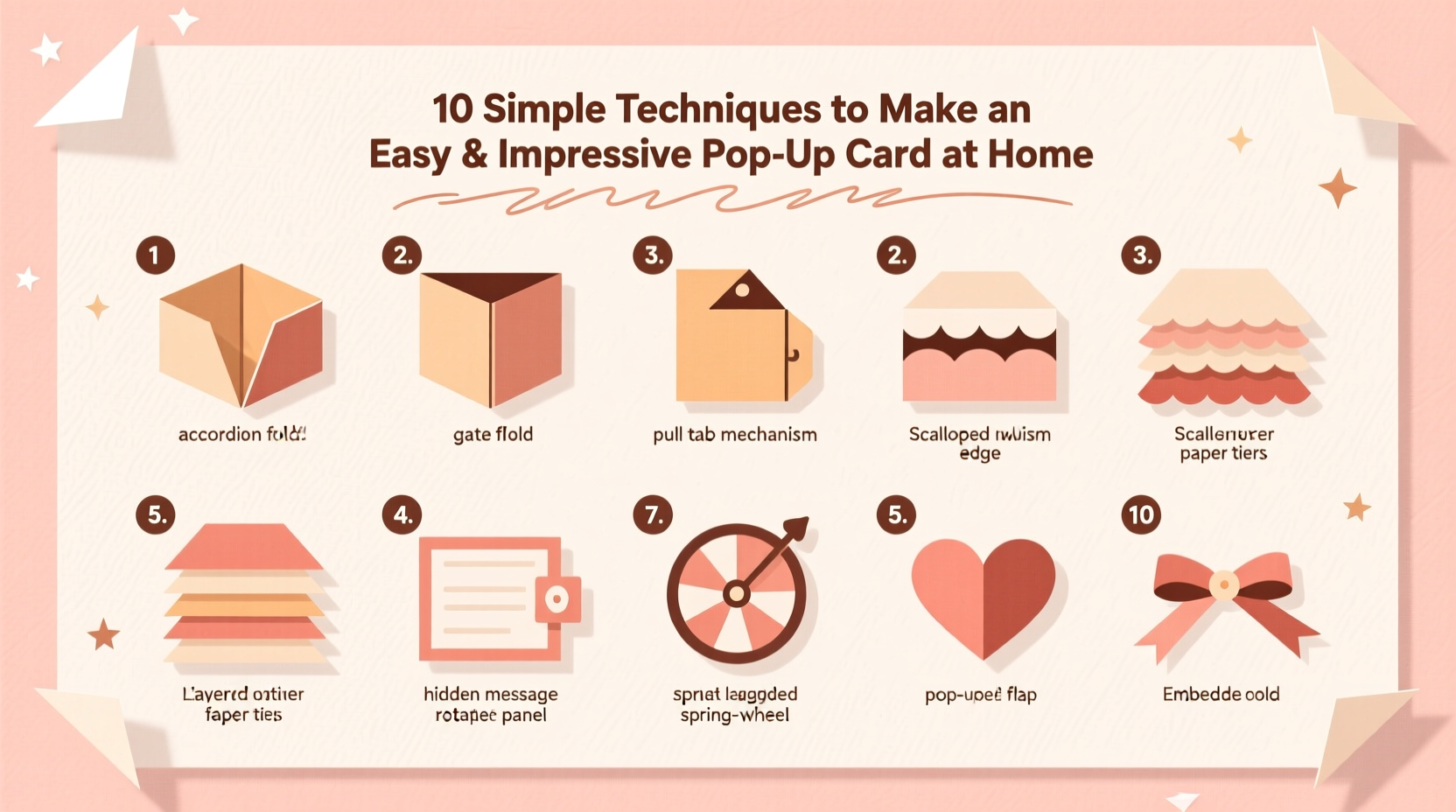
The V-fold is the foundation of most pop up designs. It creates a clean, symmetrical lift when the card opens. To execute this:
- Fold a rectangular piece of cardstock in half to form the base of your card.
- Cut a straight line perpendicular to the fold, about 1–2 inches from the folded edge.
- Fold the resulting flaps inward so they meet inside the card when closed.
- Glue a small shape (like a heart or star) across both flaps. When opened, it will rise vertically.
This technique works especially well for centerpieces like flowers, balloons, or messages that should “jump” into view.
2. Create Layered Depth with Step Folds
A step fold adds dimension by stacking multiple rising platforms. Each layer activates at a slightly different point as the card opens, creating a cascading effect.
- Cut several rectangles of varying heights from lightweight cardstock.
- Attach each rectangle along one long edge to the inside of the card using double-sided tape or glue dots.
- Align them so the tallest is farthest from the spine and shortest closest to it.
- Decorate each tier with drawn or pasted elements—trees, mountains, or cityscapes work beautifully.
The illusion of distance makes this ideal for scenic or narrative cards.
Do’s and Don’ts of Pop Up Card Assembly
| Do’s | Don’ts |
|---|---|
| Use acid-free glue to prevent yellowing over time | Overload layers with heavy embellishments |
| Test mechanisms before final gluing | Make cuts too close to the fold, weakening structure |
| Sketch your design lightly in pencil first | Use thick cardboard—it won’t fold smoothly |
| Leave space around moving parts for clearance | Forget to let glue dry fully before closing the card |
3. Try the Box Platform Technique
For a stable, elevated centerpiece, build a box platform. This method supports heavier decorations and allows full 360-degree viewing.
“Even children can master the box platform—it teaches spatial thinking while delivering dramatic results.” — Linda Tran, Paper Engineering Educator
To assemble:
- Cut a square or rectangle from cardstock (e.g., 2x2 inches).
- From each corner, cut diagonal slits toward the center, stopping halfway.
- Fold alternate tabs upward and glue them to the inner back cover of the card.
- The remaining flat surface becomes your display stage.
Add a tiny figure, photo, or origami creation on top. The result feels almost sculptural.
4. Incorporate Pull Tabs for Interactive Movement
Enhance engagement by adding a sliding tab that moves an element across the scene. This works well for playful themes like racing cars, flying birds, or opening doors.
Steps:
- Create a horizontal slit near the bottom of the card’s interior.
- Attach a small vertical strip of paper to a movable character or object inside.
- Thread the other end through the slit to become the external slider.
- As the tab is pulled, the attached piece glides side to side.
This interactive feature delights younger recipients and adds whimsy to adult cards alike.
5. Use Spiral Twists for Dynamic Motion
Spiral twists create rotational animation. A butterfly’s wings can flap, a windmill can spin, or a dancer can twirl—all powered by the opening motion.
How to build:
- Cut a spiral shape from thin paper (about 1.5 inches wide, coiled tightly).
- Flatten slightly and attach one end to a static base inside the card.
- Glue the other end to a rising platform (like a V-fold).
- As the platform lifts, tension causes the spiral to twist.
Pair with drawn guides (e.g., circular arrows) to emphasize motion. Works best with light paper such as vellum or tissue.
6. Combine Techniques for Maximum Impact
Impressive cards often blend two or more structural methods. For example:
- A central V-fold heart rises while a pull-tab sends a message balloon across the sky.
- Step folds create hills, topped with a box platform holding a miniature house.
- A spiral-twist sun rotates above layered clouds made with accordion folds.
Plan your layout on scrap paper first. Sketch where each mechanism will sit and how they’ll interact without colliding.
Real Example: Maria’s Anniversary Surprise
Maria wanted to celebrate her parents’ 40th anniversary with something meaningful. She combined a V-fold with a photo of their wedding day mounted on a rising platform. On either side, she added pull-tabs labeled “Then” and “Now,” which revealed matching photos of them at ages 25 and 65. The card opened to reveal the words “Still in Love” in bold letters. Her parents called it “the most touching gift they’d ever received.” No fancy tools were used—just precision cutting, patience, and personalization.
7. Decorate Strategically for Visual Appeal
Structure alone isn’t enough—details elevate the experience. Consider these decoration tips:
- Use metallic pens or washi tape for elegant accents.
- Add texture with fabric scraps, lace, or pressed flowers.
- Incorporate handwritten notes directly onto moving parts.
- Write messages that play on the pop-up theme: “You mean the world to me” beneath a globe, or “Let’s soar together” next to a bird in flight.
Remember: less is often more. Avoid overcrowding; let the mechanics breathe.
8. Essential Materials Checklist
Before you begin, gather these basics:
- Cardstock (assorted colors)
- Scissors or precision craft knife
- Ruler and pencil
- Double-sided tape or glue stick
- Eraser (for smoothing creases)
- Optional: markers, stickers, ribbon, hole punch
9. Troubleshooting Common Issues
Even experienced crafters encounter hiccups. Here’s how to fix frequent problems:
- Pop-up doesn’t rise fully: Check if glue has sealed moving parts. Reapply only to fixed areas.
- Card won’t close flat: Reduce layer thickness or trim excess bulk from attachments.
- Elements wobble: Reinforce bases with extra adhesive or use sturdier paper.
- Slit tears during use: Reinforce edges with clear tape or widen the opening slightly.
Always test the mechanism five times before finalizing decoration.
10. Store and Present Your Cards Properly
A beautifully made card can be ruined by improper handling. Once complete:
- Place between sheets of wax paper inside a rigid envelope to protect raised elements.
- Avoid bending or stacking under weight.
- If mailing, mark “Do Not Bend” and consider extra postage due to stiffness.
“The magic of a pop up card lies not just in its movement, but in the thought behind every fold.” — Daniel Kim, Papercraft Artist
Frequently Asked Questions
Can I make pop up cards with kids?
Absolutely. Start with pre-cut templates and focus on V-folds and pull-tabs. Supervise scissor use and encourage drawing their own characters to attach. It’s a fantastic way to develop fine motor skills and creativity.
What kind of paper works best?
Standard 65–80 lb cardstock offers the ideal balance of flexibility and rigidity. Printer paper is too flimsy; chipboard is too stiff. Lightweight colored construction paper can work for decorative layers but avoid using it for structural parts.
How long does it take to make one?
A simple design takes 15–20 minutes. More complex ones with multiple mechanisms may require 45–60 minutes, especially with drying time. With practice, speed increases significantly.
Bring Joy One Fold at a Time
There’s something profoundly human about receiving a handmade card. In an age of instant digital messages, taking the time to fold, cut, and assemble a physical surprise speaks volumes. These ten techniques give you the tools to transform ordinary paper into moments of wonder. Whether you’re celebrating love, friendship, or achievement, your effort will be remembered far longer than any store-bought alternative.




 浙公网安备
33010002000092号
浙公网安备
33010002000092号 浙B2-20120091-4
Comments
No comments yet. Why don't you start the discussion?