
In an age where digital payments dominate, cash still plays a vital role in everyday transactions—especially for small purchases, tips, or exchanges at local markets. While the $1 bill is one of the most circulated denominations in the United States, its widespread use also makes it a target for counterfeiters. Though rare, fake $1 bills do exist, and accepting one can result in financial loss since banks typically won’t reimburse counterfeit currency.
Fortunately, the U.S. Bureau of Engraving and Printing has embedded multiple security features into modern currency designs. Even the humble $1 bill contains subtle but effective anti-counterfeit elements. Knowing how to spot these features empowers you to verify authenticity quickly and confidently. Below are five practical, field-tested methods to determine whether a $1 bill is genuine.
1. Examine the Security Thread and Color-Shifting Ink (Myth vs. Reality)
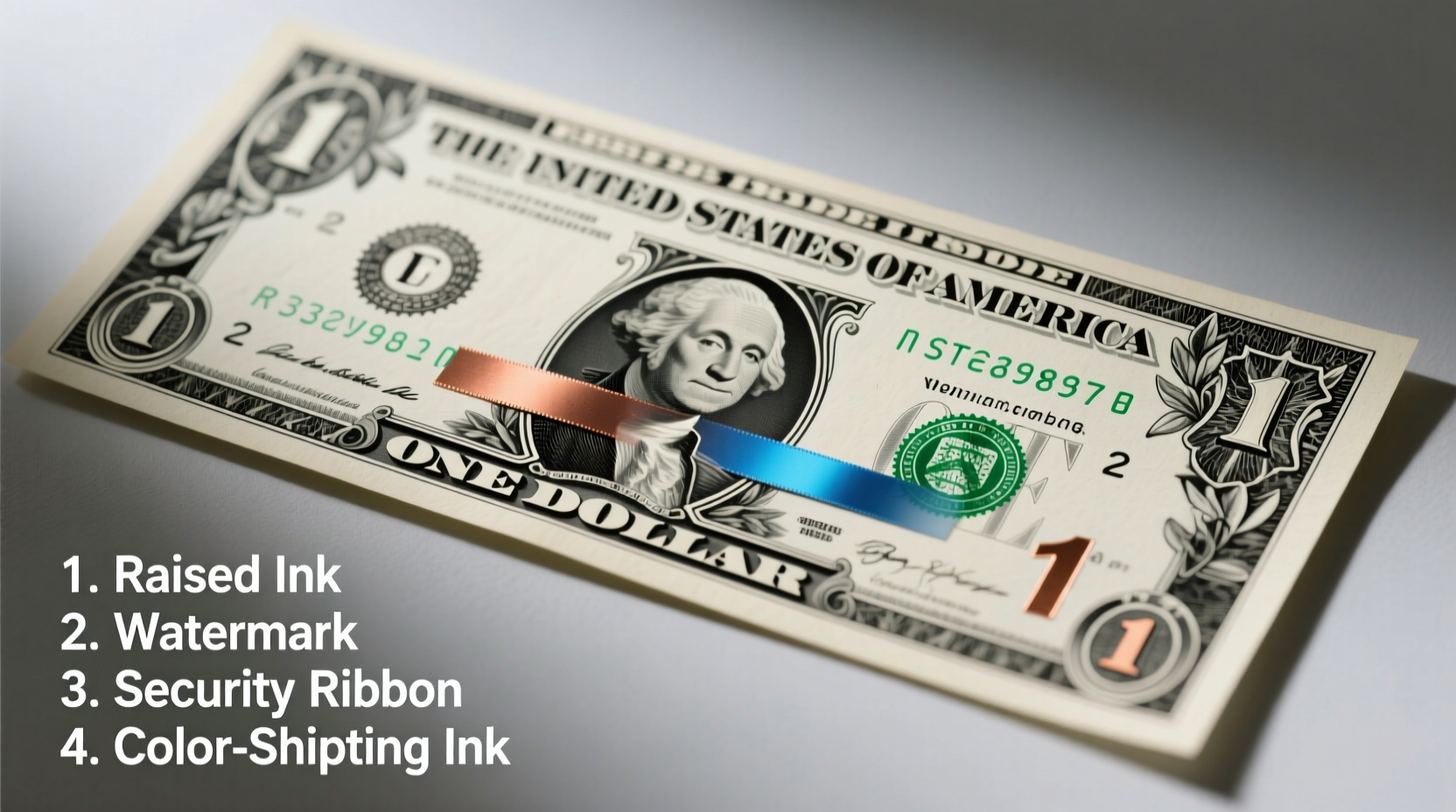
A common misconception is that all U.S. dollar bills contain advanced security features like color-shifting ink or embedded security threads. In reality, these features are reserved for higher denominations ($5 and above). The current design of the $1 bill, first issued in 1963 and updated with minor revisions since, does not include a security thread or color-shifting ink.
This absence doesn’t mean the $1 bill lacks protections—it simply relies on more traditional anti-counterfeiting measures. Understanding what *shouldn’t* be present prevents you from being misled by overly “fancy” fake bills that try to mimic high-denomination features.
2. Check the Quality of the Paper and Texture
U.S. currency is printed on a unique blend of cotton and linen fibers—approximately 75% cotton and 25% linen—giving it a distinct texture unlike ordinary paper. This specialized substrate is durable, slightly rough, and resistant to tearing compared to standard printer paper.
To test this:
- Feel the surface of the bill. A genuine $1 bill should feel crisp and fibrous, not smooth or flimsy.
- Bend the bill gently. Real currency snaps back with resilience; counterfeit paper often stays creased or feels too thin.
- Hold it up to light. Authentic bills show no transparency—no watermarks other than the faint portrait shadow in newer series, which was introduced as a minor enhancement.
Counterfeiters often use regular office paper or low-quality stock, which lacks the stiffness and durability of real currency. Over time, even worn bills retain their fibrous structure, whereas fakes degrade rapidly.
3. Inspect the Printing Details and Microtext
Authentic U.S. currency is produced using intaglio printing, a high-pressure technique that leaves raised ink you can feel. On the $1 bill, this is most noticeable on Lincoln’s portrait and the inscriptions around it.
Use your fingernail to lightly run over the president’s face. You should detect a slight tactile bump—this is the hallmark of genuine engraving. Most counterfeit bills are printed using offset or inkjet methods, resulting in flat, smooth surfaces.
Additionally, examine the fine print details:
- The words “UNITED STATES OF AMERICA” along the border of the Treasury seal contain microtext visible under magnification.
- The seals themselves—the red Treasury seal and green Federal Reserve seal—should be sharp and evenly colored, with no smudging or bleeding.
- Check the serial numbers. They should be evenly spaced, consistent in font, and match the color of the Treasury seal (red).
| Feature | Genuine Bill | Counterfeit Red Flag |
|---|---|---|
| Serial Numbers | Red, uniform spacing, sharp edges | Black or mismatched color, uneven alignment |
| Seals | Crisp, solid color, no blur | Fuzzy edges, pixelation, color bleed |
| Microtext | Legible under magnifier | Solid lines instead of tiny text |
| Ink Texture | Raised on Lincoln’s face and key text | Flat, glossy, or rubbery feel |
4. Use Ultraviolet (UV) Light to Detect Anomalies
While the $1 bill does not have a UV-reactive security strip like higher denominations, it should not fluoresce under ultraviolet light. Genuine U.S. currency paper is specifically treated to resist glowing under blacklight.
Here’s how to perform the UV test:
- Turn off room lights to reduce ambient glare.
- Shine a standard UV flashlight (blacklight) on the bill.
- Observe the reaction.
If the bill glows blue, green, or white, it likely contains wood pulp—a clear sign of counterfeit paper. Authentic currency will remain dark under UV light, with only the ink potentially showing minimal reflection.
“Even though the $1 bill isn't equipped with the same tech as larger notes, basic forensic tools like UV lights can still reveal fraud.” — James R. Holloway, Former Forensic Document Examiner, U.S. Secret Service
5. Compare Against a Known Genuine Bill
One of the most effective verification methods is side-by-side comparison. If you have access to a bill you know is authentic, place it next to the suspect note and inspect the following:
- Color balance: The green tint of the front and the pale beige background should match precisely.
- Alignment: Borders, portraits, and text should line up in size and positioning.
- Font consistency: The typeface used for “Federal Reserve Note” and the denomination is proprietary and hard to replicate accurately.
Digital counterfeits often suffer from scaling errors or resolution loss, making fonts appear thicker or thinner than they should be. Photocopies are especially easy to detect—they usually appear darker, lack texture, and may show grid patterns from scanning.
Mini Case Study: The Coffee Shop Incident
In 2022, a small café owner in Portland, Oregon, began receiving multiple $1 bills that felt unusually thin. At first, she dismissed it as wear and tear. But after noticing inconsistent serial numbers and blurry seals, she used a UV light during her inventory check. To her surprise, several bills glowed bright blue under blacklight. She alerted local authorities, who traced the source to a group using home printers and standard paper to produce crude fakes. Thanks to her vigilance, the operation was shut down before spreading further.
This case underscores how simple checks—texture, UV response, and visual inspection—can prevent losses, even in low-stakes environments.
Quick Verification Checklist
Use this checklist whenever you receive a $1 bill and suspect foul play:
- ✅ Feel the paper: Is it crisp and fibrous, not smooth or flimsy?
- ✅ Test the ink: Can you feel raised printing on Lincoln’s portrait?
- ✅ Check the seals: Are the colors solid and edges sharp?
- ✅ Inspect serial numbers: Are they red, evenly spaced, and consistent?
- ✅ Shine a UV light: Does the bill remain dark, or does it glow?
- ✅ Compare side-by-side: Does it match a known genuine bill in size and color?
Frequently Asked Questions
Can I get reimbursed if I unknowingly accept a counterfeit $1 bill?
No. Once you accept counterfeit money, you bear the loss. Banks and law enforcement do not reimburse individuals for counterfeit currency. Always inspect cash carefully, especially in high-turnover environments.
Are older $1 bills still valid?
Yes. All U.S. currency remains legal tender regardless of issue date. However, extremely old designs (e.g., silver certificates from the 1950s) may be worth more to collectors than their face value.
Do vending machines detect fake $1 bills?
Many modern machines use optical sensors, magnetic readers, and size detectors to identify counterfeits. However, basic models may not catch sophisticated fakes, which is why businesses still need manual verification protocols.
Stay Alert, Stay Protected
Verifying a $1 bill doesn’t require special training or expensive tools. With a little knowledge and attention to detail, anyone can protect themselves from counterfeit currency. The key is consistency—make inspection part of your routine, especially if you work in retail, hospitality, or any cash-handling role.
By mastering these five methods—assessing paper quality, checking print details, avoiding false security features, using UV light, and comparing against known genuine bills—you gain confidence in every transaction. Counterfeiting may evolve, but so can your awareness.




 浙公网安备
33010002000092号
浙公网安备
33010002000092号 浙B2-20120091-4
Comments
No comments yet. Why don't you start the discussion?