
In an era where digital payments dominate, cash still plays a vital role—especially in large transactions, small business exchanges, or face-to-face deals. Among all U.S. currency, the $100 bill remains one of the most frequently counterfeited notes due to its high value and global circulation. Whether you're a cashier, small business owner, traveler, or simply receiving change, knowing how to spot a fake $100 bill can save you from financial loss and legal complications.
The U.S. Bureau of Engraving and Printing has embedded multiple advanced security features into modern $100 bills—particularly those issued since the 2013 redesign. However, counterfeiters are also evolving, producing increasingly convincing fakes. The key to protection lies not in memorizing every detail but in mastering a few reliable verification techniques used by banks and law enforcement.
1. Check the 3D Security Ribbon
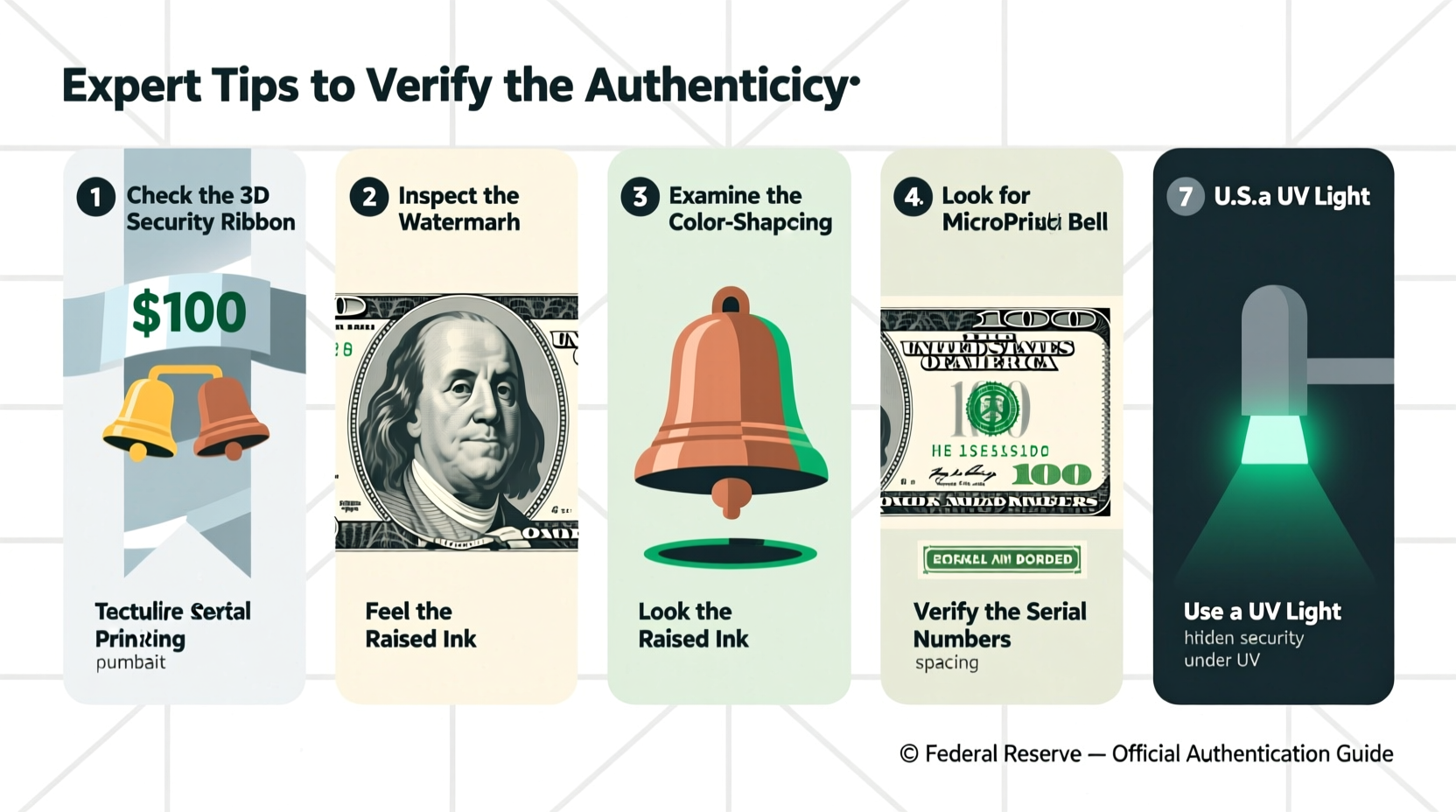
One of the most distinctive features of the post-2013 $100 bill is the blue 3D security ribbon woven into the right side of Benjamin Franklin’s portrait. This isn’t printed on the surface—it’s embedded within the paper itself.
Tilt the bill back and forth while focusing on the ribbon. As you move it, the images of bells and 100s should appear to move and shift across the ribbon. The bells transform into 100s and vice versa, creating a dynamic optical illusion. Counterfeit versions often fail to replicate this motion accurately; instead, they may show static images or poor-quality printing that doesn’t shift realistically.
2. Examine the Color-Shifting Inkwell
Directly below the portrait of Benjamin Franklin is a copper-colored inkwell containing a bell. This feature uses color-shifting ink—a technology difficult for counterfeiters to reproduce accurately.
Tilt the bill and observe the inkwell. The bell inside should disappear and reappear as the color shifts from copper to green. On genuine bills, the transition is smooth and distinct. On fake notes, the color either doesn’t change at all or changes inconsistently, often appearing more orange or dull.
“The color-shifting inkwell is a hallmark of authenticity. It’s not just about color—it’s about precision in transition.” — James R. Carter, Former U.S. Secret Service Forensic Analyst
3. Look for the Watermark Portrait
Hold the bill up to a light to reveal a watermark of Benjamin Franklin. This image appears on the right side of the printed portrait and should be visible from both sides of the note when illuminated. The watermark is not printed—it’s created during the paper-making process by varying the thickness of the paper pulp.
A counterfeit version might print a faint image meant to mimic the watermark, but it will lack depth and clarity. Genuine watermarks have soft edges and subtle gradations, similar to a photograph. If the watermark looks too sharp, dark, or flat, treat the bill with suspicion.
4. Inspect the Microprinting Around the Collar
Under magnification—or even with careful naked-eye inspection—look at the collar of Benjamin Franklin’s shirt. Encircling it is microprinting that reads “THE UNITED STATES OF AMERICA.” On a real bill, this text is crisp and legible only under magnification. To the unaided eye, it appears as a fine solid line.
Counterfeiters often struggle with microprinting. Fake bills may show blurred, broken, or smudged text, or the words may be entirely missing. Using a simple magnifying glass or smartphone zoom can help confirm whether the microprinting meets federal standards.
What to Look For: Microprinting Checklist
- Text must be continuous and clear under magnification
- No gaps, smears, or misalignments
- Appears as a solid line without magnification
- Only present on genuine post-1996 redesigned bills
5. Feel the Raised Printing Texture
Authentic U.S. currency is produced using intaglio printing, a method that leaves ink slightly raised on the surface. Run your fingernail over Franklin’s shoulder or the Federal Reserve seal. You should feel a distinct texture—almost like fine engraving.
Fake bills, especially those made with standard inkjet or laser printers, lack this tactile quality. The surface will feel flat and smooth. Even high-quality counterfeits struggle to mimic the precise pressure and depth of intaglio printing.
6. Verify the Security Thread with UV Light
Embedded vertically to the left of Franklin’s portrait is a security thread that glows pink under ultraviolet (UV) light. This thread is woven into the paper, not printed on top, and contains the repeating text “USA” and “100” visible under magnification.
To test this, use a small UV flashlight (available inexpensively online). In a darkened room, shine the light on the bill. A genuine note will display a bright pink glow along the thread. Many counterfeit bills either omit this thread or place a printed line that doesn’t fluoresce.
| Feature | Genuine Bill | Counterfeit Red Flag |
|---|---|---|
| Security Thread (UV) | Glowing pink vertical line with \"USA 100\" | No glow, wrong color, or printed on surface |
| 3D Ribbon Movement | Bells and 100s shift with tilt | Static images or no movement |
| Color-Shifting Inkwell | Copper to green transition | No shift or inconsistent color |
| Watermark | Clear, soft-focus Franklin profile | Missing, too dark, or printed |
7. Use a Currency Detector Pen – But Know Its Limits
A common tool among retailers is the counterfeit detection pen, which uses starch-sensitive ink. When marked on genuine currency (made from cotton-linen blend), the ink remains yellow or pale. On wood-based paper (common in counterfeit prints), it turns dark blue or black.
However, this method has limitations. Sophisticated counterfeiters now use paper that mimics the chemical composition of real currency, fooling the pen. Additionally, older genuine bills may react unpredictably due to moisture or aging. Therefore, the pen should never be your sole verification method—only a quick first check.
Step-by-Step Verification Process
- Look: Check the 3D ribbon and color-shifting inkwell under natural light.
- Feel: Run your finger over the portrait and seals to detect raised printing.
- Tilt: Move the bill to see motion in the ribbon and inkwell transformation.
- Hold to Light: Verify the watermark and security thread alignment.
- Use UV Light: Confirm the pink-glowing security thread.
- Cross-Check: Compare with a known authentic bill if possible.
Real-World Example: A Cashier’s Close Call
Sarah, a convenience store clerk in Ohio, once accepted a $100 bill for a $20 purchase. Something felt off—the texture was too smooth. She ran her nail over Franklin’s shoulder: no raised print. She held it to the light: the watermark was faint and misaligned. Finally, she used her UV flashlight—no pink glow. She alerted her manager, who contacted local police. The suspect had already left, but the bill was sent to the U.S. Secret Service. Later, they confirmed it was part of a regional counterfeit ring using modified home printers. Sarah’s attention to detail prevented further losses.
Frequently Asked Questions
What should I do if I receive a counterfeit bill?
Do not return it to the person who gave it to you. Instead, contact your local police or the U.S. Secret Service. Note the details of the transaction and the individual involved. Hand over the bill only to law enforcement—never destroy it.
Can ATMs dispense counterfeit money?
It’s extremely rare. Banks use advanced currency sorting machines that detect anomalies in size, weight, magnetism, and UV response. If a counterfeit bill reaches an ATM, it’s typically due to human error during cash loading. Still, always inspect large bills, even from trusted sources.
Are older $100 bills still valid?
Yes. All U.S. currency remains legal tender regardless of issue date. However, pre-1996 bills lack many modern security features and are more vulnerable to counterfeiting. Businesses may scrutinize them more closely or refuse them due to risk.
Final Thoughts: Stay Alert, Stay Protected
Verifying a $100 bill doesn’t require a forensic lab—just awareness and a few practiced habits. By combining visual, tactile, and technical checks, you can confidently identify suspicious notes before they cost you. These seven expert-backed methods are used daily by banks, retailers, and law enforcement for good reason: they work.




 浙公网安备
33010002000092号
浙公网安备
33010002000092号 浙B2-20120091-4
Comments
No comments yet. Why don't you start the discussion?