
Purchasing or inheriting a 925 silver ring is exciting, but counterfeit jewelry is widespread in today’s market. Whether you bought it online, received it as a gift, or found it in an old collection, confirming its authenticity protects both your investment and health—some fake metals can cause skin irritation or tarnish quickly. The good news: you don’t need a lab or expensive equipment to test your silver. With a few household items and careful observation, you can confidently assess whether your ring is genuine sterling silver.
Understanding What “925 Silver” Really Means
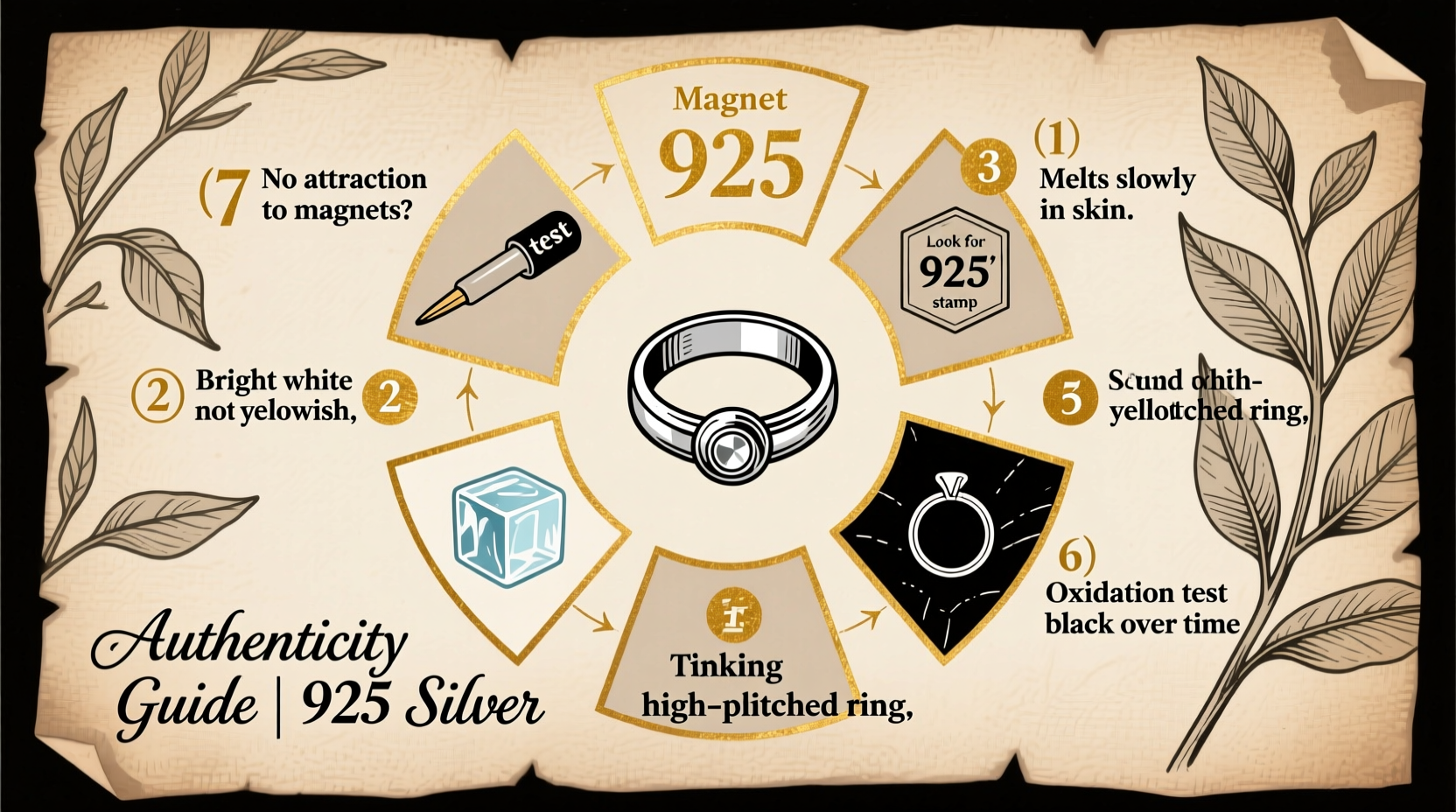
The term “925 silver” refers to sterling silver, an alloy made of 92.5% pure silver and 7.5% other metals—usually copper—to enhance durability. Pure silver (99.9%) is too soft for everyday jewelry, so the addition of alloying metals makes it suitable for rings, necklaces, and bracelets. A legitimate 925 stamp indicates that the piece meets international standards for sterling silver content.
However, not all stamped rings are authentic. Some counterfeiters laser-engrave “925” on base metal jewelry plated with silver to mislead buyers. That’s why visual inspection alone isn’t enough. You need multiple verification methods to build confidence in your assessment.
“Just because a ring has a 925 mark doesn’t mean it’s real. Always combine hallmark checks with physical tests.” — Daniel Reyes, Gemologist & Jewelry Appraiser, GIA-Certified
Step-by-Step Guide to Authenticating Your Ring at Home
Follow this logical sequence to methodically evaluate your ring’s authenticity. Each step builds on the last, increasing accuracy without requiring professional tools.
- Inspect for hallmarks and engravings under magnification
- Perform the magnet test
- Conduct the ice test
- Use the bleach or cloth rub test
- Check for tarnish patterns over time
- Weigh and measure for density consistency
- Compare against known genuine samples if available
1. Examine the Hallmark Closely
The presence of a “925,” “.925,” or “Sterling” stamp is the first clue—but not proof—of authenticity. Use a jeweler’s loupe or a smartphone macro lens to inspect the inner band. Genuine stamps are usually crisp, evenly indented, and precisely aligned.
Fake rings often have blurry, uneven, or misaligned markings. Some may even say “925 Italy” or “925 Thailand” when such country-specific certification doesn’t guarantee material truth. Counterfeiters exploit consumer trust in imported goods.
Also look for additional marks like maker’s stamps, assay office symbols, or copyright logos. While not always present, their precision adds credibility.
2. Conduct the Magnet Test
Silver is diamagnetic, meaning it weakly repels magnets rather than attracting them. This simple test helps rule out common fakes made from ferromagnetic metals like iron or nickel.
To perform the test:
- Hold a strong neodymium magnet near the ring.
- Observe any pull or attraction.
If the ring is attracted to the magnet, it contains magnetic metals and is not genuine sterling silver. A slight resistance or no movement supports authenticity, though non-magnetic base metals like aluminum or lead also exist—so this test rules out fakes but doesn’t confirm real silver alone.
3. Try the Ice Test – Thermal Conductivity Check
Silver has the highest thermal conductivity of any common metal. This means it transfers heat faster than almost all imitations. The ice test leverages this property.
Place a small ice cube directly on the ring resting on a room-temperature surface. Time how long it takes to melt compared to ice on a non-metal surface.
Genuine 925 silver will make the ice melt significantly faster—often within 10–20 seconds—due to rapid heat transfer from the environment through the metal. Plated or base metals won’t conduct heat nearly as efficiently.
“I’ve used the ice test in field assessments—it’s surprisingly reliable when combined with other indicators.” — Lena Patel, Metallurgist & Precious Metals Analyst
4. Perform the Cloth Rub and Bleach Spot Test
Silver oxidizes naturally, forming black tarnish (silver sulfide) when exposed to sulfur compounds in air, lotions, or rubber. Fake silver plating often wears off or discolors green (like costume jewelry), while real silver darkens uniformly.
Cloth Rub Test: Use a soft, non-abrasive white cloth to gently rub the surface. Real silver leaves a dark gray residue; fake coatings may show no change or leave colored streaks.
Bleach Reaction (Use Caution): Dip a cotton swab in household bleach and touch an inconspicuous part of the ring. Genuine silver reacts quickly, turning black within seconds due to accelerated oxidation. If there’s no reaction, the piece may be stainless steel or another non-reactive metal.
5. Assess Tarnish Behavior Over Days
Authentic 925 silver tarnishes gradually. Wearing the ring daily exposes it to natural oils, sweat, and airborne sulfur—conditions that promote slow, even darkening. This patina can be polished back to shine.
Fake silver-plated rings often exhibit red flags:
- Rapid flaking or peeling of the surface layer
- Green discoloration on skin (a sign of copper or nickel alloys reacting)
- No tarnish at all after weeks of wear (plating may be inert)
A mini case study illustrates this: Sarah inherited a ring believed to be family heirloom silver. After wearing it for two weeks, she noticed no tarnish, and her finger developed a green tint. A magnet test revealed slight attraction. Despite a clear “925” stamp, further investigation confirmed it was a plated alloy. She avoided prolonged skin contact and sought a refund from the seller.
6. Measure Weight and Size for Density Analysis
Sterling silver has a density of approximately 10.3 g/cm³. While precise measurement requires tools, you can estimate by comparing weight and volume.
Use a digital scale (accurate to 0.01g) to weigh the ring. Then, calculate volume via water displacement (submerge in graduated cylinder) or approximate using diameter and width.
Compare your result to expected values. For example, a standard 6mm-wide band weighing less than 4 grams is likely hollow or thin-plated.
| Ring Type | Avg. Weight (Size 7) | Expected Material Clue |
|---|---|---|
| 6mm Court Band | 6–8g | Consistent with solid 925 silver |
| 4mm Plain Band | 3–4g | Plausible for real silver |
| Any Ring | <2g | High risk of being fake or hollow |
7. Smell and Sound Tests – Subtle But Useful Indicators
While less scientific, sensory cues help. Real silver is odorless. If your ring smells metallic, sour, or like pennies, it likely contains reactive base metals.
The “ring test”: Gently tap the ring against glass or another piece of metal. Sterling silver produces a soft, high-pitched chime that lingers briefly. Fakes tend to produce a dull thud.
Do’s and Don’ts When Testing Silver at Home
| Do | Don't |
|---|---|
| Use a magnifier to check stamp clarity | Assume all 925 stamps are trustworthy |
| Test in multiple ways for confirmation | Rely solely on one method |
| Wear gloves during chemical tests | Leave bleach on the ring for more than 5 seconds |
| Record observations over time | Dispose of questionable jewelry carelessly—consider resale or recycling |
FAQ
Can a silver ring be real without a 925 stamp?
Yes. Handmade, vintage, or imported pieces may lack official hallmarks. Absence of a stamp doesn’t automatically mean fake, but it increases the need for alternative verification.
Does real silver turn my skin green?
No. Genuine 925 silver should not cause green discoloration. Green skin indicates base metal alloys like copper or nickel beneath worn plating—common in counterfeit items.
How accurate are home tests compared to professional assays?
Home methods are effective screening tools but not definitive. X-ray fluorescence (XRF) or acid testing by a jeweler provides 99%+ accuracy. Use home tests to identify obvious fakes and decide whether professional evaluation is warranted.
Final Checklist: Is Your Ring Likely Authentic?
- ✅ Clear, sharp “925” or “Sterling” stamp visible inside band
- ✅ No attraction to a strong magnet
- ✅ Ice melts noticeably faster on contact
- ✅ Leaves gray residue on cloth, not color stains
- ✅ Develops even black tarnish over time, not green or flaky
- ✅ Weight matches expectations for size and style
- ✅ Produces a light chime when tapped gently
Conclusion
Verifying your 925 silver ring doesn’t require a degree in metallurgy—just attention to detail and a few smart techniques. By combining hallmark inspection, physical reactions, and behavioral observation, you gain control over what you wear and value. These seven expert-backed methods empower you to detect fakes, preserve genuine pieces, and shop with greater confidence in the future.




 浙公网安备
33010002000092号
浙公网安备
33010002000092号 浙B2-20120091-4
Comments
No comments yet. Why don't you start the discussion?