
Moissanite has gained widespread popularity as a brilliant, durable, and ethically sourced alternative to diamonds. Its near-identical appearance and lower price point make it an appealing choice for pendants, rings, and other fine jewelry. However, its similarity to diamonds—and even synthetic imitations—means buyers must be vigilant. Whether you’ve just purchased a moissanite pendant or are considering one, knowing how to confirm its authenticity is essential to avoid overpaying or being misled.
Unlike diamonds, which form naturally under extreme pressure, moissanite is primarily lab-created today, originally discovered in meteorites by French scientist Henri Moissan in 1893. While genuine moissanite exhibits exceptional fire and brilliance, counterfeit versions using cubic zirconia or glass can mimic its look—at least at first glance. To help you confidently distinguish real moissanite from fakes, here are seven expert-vetted verification methods.
1. Use a Moissanite Tester (Not Just a Diamond Tester)
One of the most reliable tools for identifying moissanite is a specialized electronic tester designed specifically for it. Standard diamond testers measure thermal conductivity and may misidentify moissanite as a diamond because both materials conduct heat similarly. However, moissanite also conducts electricity—a property diamonds lack.
Advanced testers use dual-mode technology: they assess both thermal and electrical conductivity. If the stone passes the thermal test but also registers electrical conductivity, it’s almost certainly moissanite.
These testers are affordable, portable, and widely used by jewelers. For peace of mind, consider purchasing one if you frequently buy or evaluate gemstone jewelry.
2. Examine the Fire and Brilliance Under Natural Light
Moissanite is known for its high refractive index (2.65–2.69), surpassing that of diamond (2.42). This means it disperses light more dramatically, creating a “disco ball” effect—especially noticeable in sunlight or bright indoor lighting.
While this intense sparkle is appealing, it can also be a giveaway. Genuine moissanite displays more colored flashes (fire) than a diamond, particularly hues of green, orange, and blue. Diamonds tend to reflect white and gray tones with subtle color bursts.
“Moissanite’s brilliance is beautiful, but its excessive fire under direct light is often the first clue it’s not a diamond.” — Dr. Lena Peterson, Gemologist & Materials Scientist
Perform this test outdoors during midday. Hold the pendant at different angles and observe the light return. If the rainbow flashes dominate over white sparkle, you’re likely looking at moissanite.
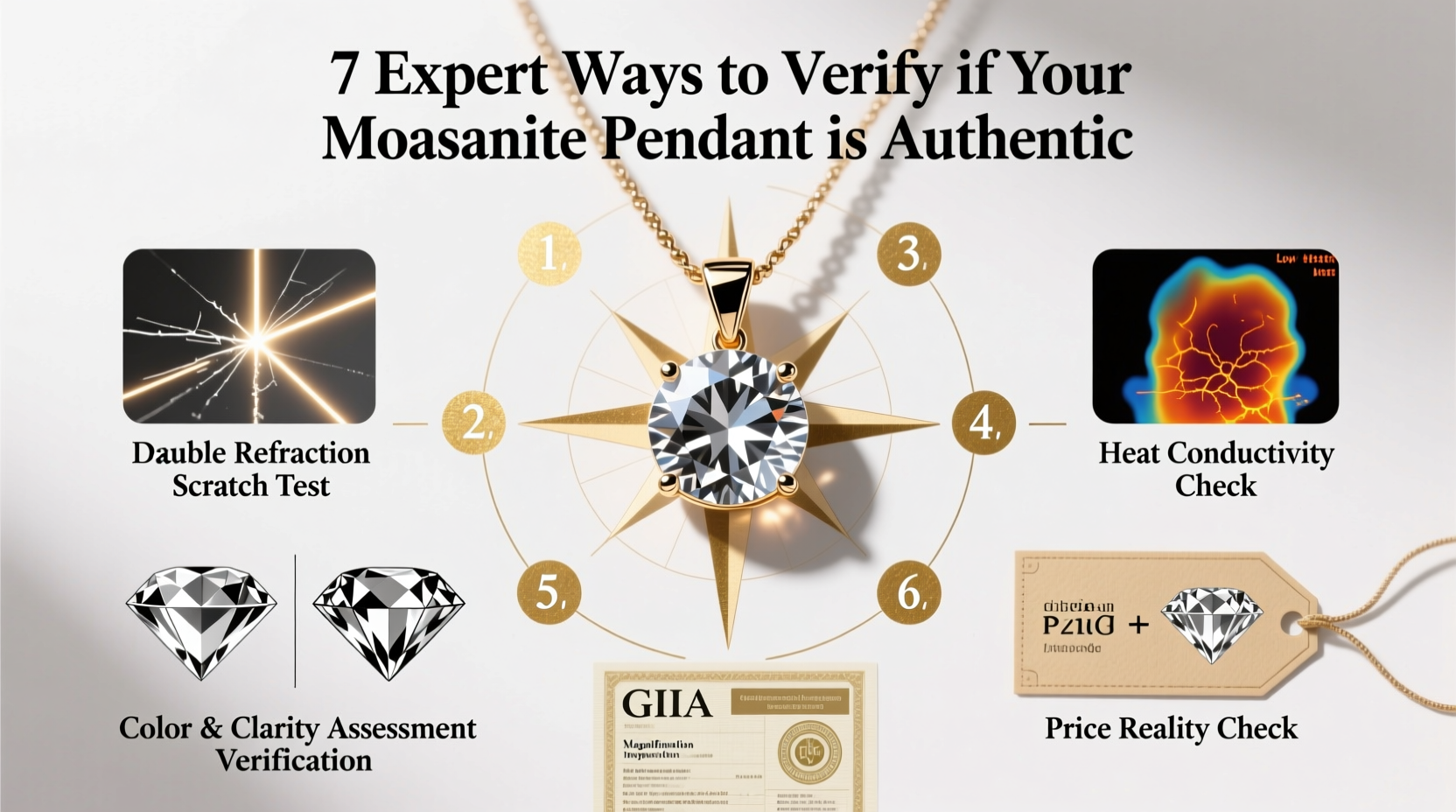
3. Inspect for Double Refraction Using a Loupe
One of the most definitive optical properties of moissanite is double refraction. Due to its crystal structure, light passing through moissanite splits into two rays. This causes facet edges to appear doubled when viewed through a jeweler’s loupe (10x magnification).
To test:
- Secure the pendant on a flat surface.
- Look directly through the table (top face) of the stone.
- Focus on the pavilion facets (bottom edges).
- If you see two lines where there should be one, the stone is doubly refractive—indicative of moissanite.
Diamonds are singly refractive, so no doubling occurs. This test is highly accurate when performed correctly, though small or well-cut stones may make the effect harder to spot.
4. Check for Inclusions and Growth Patterns Under Magnification
Natural and lab-created moissanite often contain microscopic inclusions unique to its manufacturing process. These differ significantly from diamond inclusions.
Under 10x magnification, look for:
- Needle-like or wispy inclusions aligned in specific directions.
- Straight growth lines or color zoning running parallel through the stone.
- A lack of natural mineral inclusions typical of mined diamonds (e.g., feathers, crystals).
Lab-grown moissanite is produced via the Lely process, which results in characteristic internal patterns. While these aren’t visible to the naked eye, a trained eye with a loupe or microscope can detect them easily.
5. Verify Certification and Documentation
Reputable sellers provide a certificate of authenticity from an independent gemological laboratory such as GCAL (Gem Certification & Assurance Lab), IGI (International Gemological Institute), or GIA (though GIA does not grade moissanite, they can identify it).
A valid certificate includes:
- Stone type confirmation (moissanite vs. diamond vs. CZ)
- Measurements and weight
- Color and clarity grades
- Laboratory identification number
- Hologram or security features
| Certification Feature | Why It Matters |
|---|---|
| Independent Lab Name | Ensures unbiased evaluation; avoids seller self-certification. |
| Unique ID Number | Allows online verification via the lab’s database. |
| Specific Identification | Should clearly state “Synthetic Moissanite,” not “Diamond Simulant.” |
| Security Hologram | Reduces risk of forged paperwork. |
If no certificate is provided, request one. Reputable jewelers will accommodate this without hesitation.
6. Perform the Fog Test (With Caution)
The fog test is a quick, non-invasive method based on thermal conductivity. Breathe onto the stone as you would fog a mirror. A genuine moissanite—or diamond—will disperse the moisture almost instantly due to rapid heat transfer.
Imitation stones like cubic zirconia or glass retain fog longer (typically 2–5 seconds).
However, this test alone is not conclusive. Both moissanite and diamond clear quickly, so while lingering fog suggests a fake, instant clearing doesn’t confirm authenticity. Use this as a preliminary screening tool only.
7. Consult a Professional Gemologist
When in doubt, seek a qualified gemologist. Independent appraisers have access to advanced equipment—including spectrometers, microscopes, and refractometers—that can definitively identify moissanite.
A professional assessment typically costs $50–$150 but offers irrefutable confirmation. This is especially wise before insuring high-value pieces or reselling.
Mini Case Study: The Pendant That Wasn’t What It Seemed
Sarah purchased a “diamond” pendant from an online marketplace for $800, described as a 1-carat, near-colorless stone with excellent cut. When she took it to a local jeweler for resizing, the technician immediately noticed unusual fire. Using a dual probe tester, the stone registered electrical conductivity—confirming it was moissanite, valued at around $300. Though still a quality piece, Sarah had been misled. With proper testing, she could have negotiated fairly or chosen differently. The lesson? Verification protects both value and trust.
Quick Verification Checklist
Use this checklist to systematically verify your moissanite pendant:
- ✅ Use a dual-mode (thermal + electrical) tester
- ✅ Observe fire under natural sunlight—excessive rainbow flashes suggest moissanite
- ✅ Examine facet doubling with a 10x loupe
- ✅ Review certification from a recognized lab (IGI, GCAL)
- ✅ Inspect for lab-grown inclusion patterns under magnification
- ✅ Perform the fog test as a preliminary screen
- ✅ Schedule a professional gemological evaluation if uncertain
Frequently Asked Questions
Is moissanite considered a fake diamond?
No. Moissanite is a distinct gemstone with its own chemical composition (silicon carbide). While often used as a diamond alternative, it is not “fake.” It’s a legitimate, lab-created gem with unique optical and physical properties.
Can moissanite pass a diamond test at a jewelry store?
Yes—but only partially. Many standard diamond testers will register moissanite as a diamond due to similar thermal conductivity. However, dual-mode testers will reveal its electrical conductivity, distinguishing it from diamond.
Does real moissanite get cloudy over time?
No, moissanite does not inherently cloud. However, surface oils, lotions, and dirt can accumulate, dulling its shine. Regular cleaning with mild soap and water restores its luster. Unlike cubic zirconia, moissanite maintains its clarity permanently.
Final Thoughts: Knowledge Is Your Best Investment
Authenticating your moissanite pendant isn’t about suspicion—it’s about informed ownership. Whether you cherish it for its beauty, symbolism, or ethical origin, knowing what you own empowers you to care for it properly and appreciate it fully. The tools and techniques outlined here are accessible, practical, and trusted by professionals worldwide.




 浙公网安备
33010002000092号
浙公网安备
33010002000092号 浙B2-20120091-4
Comments
No comments yet. Why don't you start the discussion?