
The Porsche Boxster has earned a loyal following thanks to its balanced handling, mid-engine layout, and driver-focused design. Across generations—specifically the 986 (1997–2004) and 987 (2005–2012)—Porsche made incremental improvements in engineering, emissions control, and reliability. One often-overlooked but critical component in these systems is the secondary air injection pump. While not central to performance, it plays a key role in emissions management during cold starts. A common question among DIY mechanics and owners facing replacement is: Can you swap a 987 secondary air pump into a 986 Boxster, or vice versa? And more importantly, does it actually matter if you do?
Understanding the Role of the Secondary Air Pump
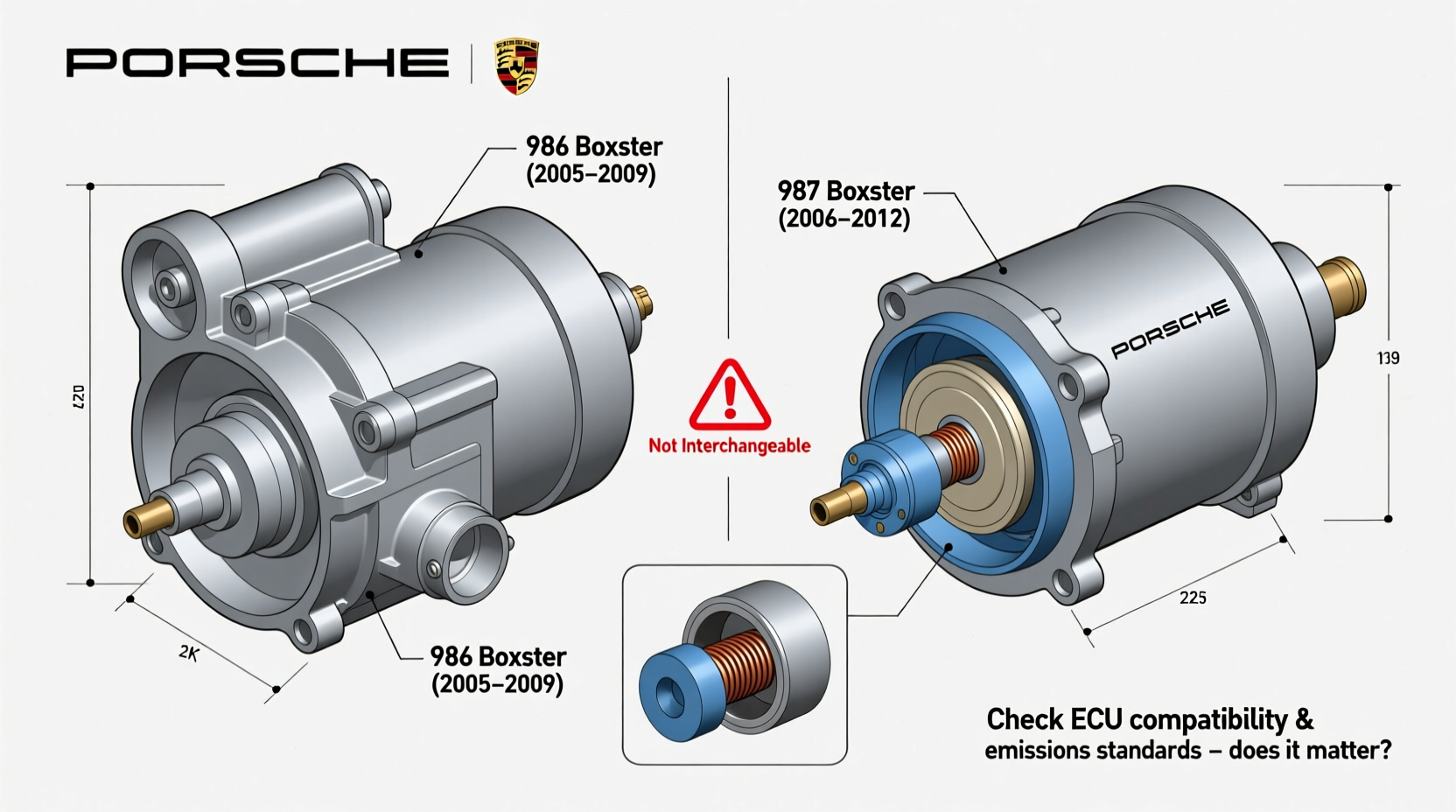
The secondary air injection system (often called \"smog pump\") is designed to reduce hydrocarbon and carbon monoxide emissions during engine warm-up. When a cold engine starts, fuel combustion is less efficient, leading to higher unburned emissions. The secondary air pump injects fresh air into the exhaust manifold, helping burn off excess fuel before it reaches the catalytic converter. This speeds up catalyst light-off temperature and reduces tailpipe pollution.
In both the 986 and 987 Boxsters, this system activates briefly—typically 60 to 90 seconds—after a cold start. Once the engine reaches operating temperature, the system shuts off. Despite its short runtime, failure can trigger check engine lights, failed emissions tests, and long-term damage to the catalytic converters due to incomplete combustion byproducts.
“Even though the secondary air pump isn’t a performance part, neglecting it can lead to costly downstream issues, especially with modern emissions standards.” — Mark Reynolds, European Auto Systems Technician
Comparing 986 and 987 Secondary Air Pumps: Are They Interchangeable?
At first glance, the secondary air pumps on the 986 and 987 appear similar. Both are electrically driven, mounted near the front left fender well, and connected via rubber hoses to the exhaust crossover pipe. However, subtle differences in mounting, electrical connectors, and internal calibration make direct interchangeability complicated.
| Feature | 986 Boxster (M96 Engine) | 987 Boxster (M97 Engine) |
|---|---|---|
| Production Years | 1997–2004 | 2005–2012 |
| Air Pump Model | Bosch 0 598 022 003 (common) | Bosch 0 598 022 033 / 044 (varies by year) |
| Electrical Connector | 3-pin, blade-style | 3-pin, updated housing, different pin spacing |
| Mounting Bracket Design | Single bolt + rubber isolator | Dual bolt + revised geometry |
| Hose Routing & Diameter | 14mm ID, shorter run | 16mm ID, longer path with check valve integration |
| OBD-II Communication | Analog signal monitoring | Digital feedback loop with DME validation |
While some users report success swapping units with minor modifications—such as adapting brackets or splicing connectors—the consensus among experienced Porsche technicians is that these pumps are **not fully interchangeable without potential issues**. Even if physically installed, mismatched electrical signals or flow rates may cause error codes like P0410 (Secondary Air Injection System Malfunction).
Does It Really Matter If You Use the Wrong One?
The answer depends on your priorities: emissions compliance, reliability, check engine lights, and long-term ownership costs.
If you live in a state or country with strict emissions testing (e.g., California, New York, EU nations), using an incorrect or non-compliant air pump can result in test failure. The OBD-II system monitors the secondary air system’s operation during startup. A mismatched pump may not respond correctly to command signals, leading to persistent fault codes—even if the mechanical airflow appears functional.
Additionally, improper airflow timing or volume can delay catalyst heating, increasing thermal stress over time. While this won't destroy the cat immediately, repeated inefficient warm-ups contribute to clogging and reduced efficiency. Over several years, this could necessitate premature catalytic converter replacement—a far costlier repair than installing the correct air pump upfront.
For track-only or off-road vehicles where emissions are irrelevant, disabling or removing the system entirely is common. But for daily drivers, keeping the system functional—and using the correct component—is a wise investment in longevity and hassle-free operation.
Step-by-Step Guide to Verifying and Replacing Your Air Pump
Replacing the secondary air pump requires attention to detail. Follow this sequence to ensure compatibility and proper installation:
- Diagnose the Issue: Use an OBD-II scanner capable of reading manufacturer-specific codes. Look for P0410, P0411, P0418, or related faults. Confirm the relay, fuse, and check valve are operational before replacing the pump.
- Identify Your Model Year and Engine: Check VIN or service records. 986 = M96 engine; 987 = M97. Early 987s (2005–2006) may share more similarities with late 986s than later models.
- Source the Correct Part: Match the OEM Bosch number or use a reputable aftermarket supplier that specifies model-year fitment. Avoid “universal” pumps.
- Inspect Mounting and Hoses: Compare bracket shape, bolt pattern, and hose diameter. Replace cracked hoses and inline check valves during installation—they often fail simultaneously.
- Test Operation: After installation, perform a cold start. You should hear the pump engage for about 60 seconds. Use a smoke test or pressure check to verify airflow direction and absence of leaks.
Real-World Example: A Misguided Swap Gone Wrong
Tom, a DIY enthusiast in Colorado, replaced his failing 986 air pump with a used unit pulled from a junkyard 987. The mounting seemed close enough, and he modified the bracket with a drill. The pump powered on, but his scanner showed intermittent P0410 codes. Initially dismissing them, he passed emissions by disconnecting the battery to clear codes before testing. Six months later, his front catalytic converter failed due to soot buildup. A specialist traced the root cause to inconsistent secondary air delivery during warm-up, which had gone unnoticed. Replacing both the cat and installing the correct pump cost him over $1,200—far more than the $180 price difference between the right and wrong pump.
This case underscores that while mechanical fitment might seem sufficient, system-level integration matters. The ECU expects specific response times and feedback, and deviations—even subtle ones—can degrade performance over time.
Checklist: Ensuring a Successful Air Pump Replacement
- ✅ Verify vehicle model year and engine code
- ✅ Retrieve existing fault codes with a capable scan tool
- ✅ Inspect relay, fuse, and wiring harness for damage
- ✅ Confirm OEM part number on old pump or in maintenance history
- ✅ Source replacement with exact cross-reference (Bosch or OE)
- ✅ Replace associated hoses and check valve (recommended)
- ✅ Test operation during cold start cycle
- ✅ Clear codes and monitor for recurrence
Frequently Asked Questions
Can I delete the secondary air pump on my Boxster?
Yes, but with caveats. In regions without emissions testing, many owners disable the system using software (ECU tune) and block-off plates. However, doing so without tuning may leave active error codes and affect idle behavior. For street-driven cars in regulated areas, deletion is not advised.
How long do these pumps typically last?
Most last between 80,000 and 120,000 miles. Moisture ingress, frequent short trips, and poor ventilation accelerate failure. Hearing a grinding noise or noticing moisture in the hose are early warning signs.
Are aftermarket pumps reliable?
Quality varies widely. Some brands like Pierburg or SWAG offer OE-equivalent units. Cheap no-name pumps often fail within a year. Stick to known suppliers and avoid “budget” options for critical emissions components.
Final Thoughts: Precision Over Assumption
The secondary air pump may seem like a minor player in the grand scheme of Porsche engineering, but its role in emissions control and system health is undeniable. While the 987 and 986 Boxsters share DNA, they are not mechanically identical in every aspect. Assuming interchangeability without verifying specifications risks check engine lights, failed inspections, and unintended long-term damage.
Using the correct pump for your model year ensures seamless integration with the DME, proper emissions performance, and peace of mind. Whether you're maintaining a weekend cruiser or preparing for a cross-country road trip, respecting factory engineering pays dividends in reliability and resale value.




 浙公网安备
33010002000092号
浙公网安备
33010002000092号 浙B2-20120091-4
Comments
No comments yet. Why don't you start the discussion?