
Investing in an ATM machine can be a profitable passive income stream when approached strategically. Unlike traditional businesses that require daily oversight, ATMs generate revenue with minimal ongoing effort—provided they’re placed correctly, maintained properly, and integrated into high-traffic environments. However, purchasing and operating an ATM isn’t as simple as buying the hardware and collecting cash. Success depends on understanding equipment options, location dynamics, transaction fees, regulatory compliance, and long-term financial planning.
This guide walks you through every step of acquiring an ATM, from choosing the right model to optimizing profitability over time. Whether you're a small business owner looking to offer convenience or an investor building a portfolio of machines, this roadmap will help you make informed decisions and avoid costly mistakes.
Understanding ATM Types and Equipment Options
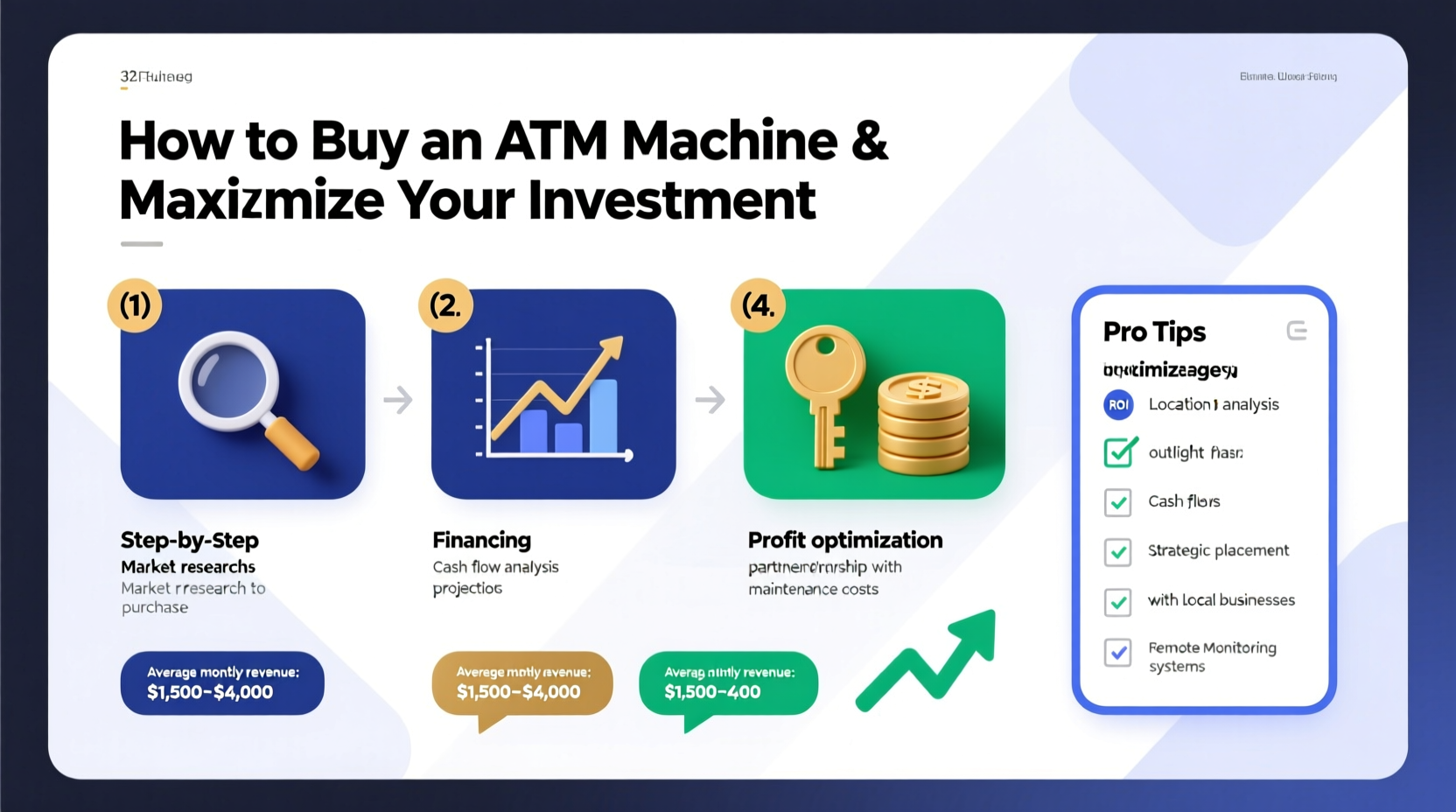
Not all ATMs are created equal. The type you choose affects cost, functionality, security, and earning potential. There are three primary categories:
- Basic Cash Dispensers: These only dispense cash and accept PIN entry. Ideal for low-traffic locations with limited space.
- Full-Function ATMs: Support deposits, balance inquiries, transfers, and more. Typically found in banks but can be deployed commercially with proper licensing.
- White-Label ATMs: Unbranded machines operated independently by private owners. Most common for investors seeking passive income.
When selecting hardware, consider durability, connectivity (Ethernet vs. cellular), and whether it supports surcharge programming—a critical feature for generating revenue.
Step-by-Step Process to Purchase and Deploy Your ATM
Buying an ATM is just one phase. Deployment requires coordination between vendors, site partners, and financial institutions. Follow this timeline to ensure smooth execution:
- Research and Budgeting (Week 1): Determine how much you’re willing to invest. Entry-level machines start around $2,500; fully loaded models exceed $8,000.
- Select a Supplier (Week 2): Choose a vendor offering warranty, remote monitoring software, and technical support. Avoid auction sites unless experienced.
- Negotiate Location Agreement (Weeks 3–4): Partner with a business (liquor store, gas station, nightclub) to host your ATM. Offer them a percentage of surcharge revenue (typically 10–25%) as incentive.
- Secure Cash Loading & Processing (Week 5): Open a dedicated business bank account. Contract with a cash logistics provider or handle loading yourself if feasible.
- Install and Test (Week 6): Install the machine, connect to power and network, conduct test transactions, and verify settlement reporting.
- Launch and Monitor (Ongoing): Begin tracking usage, refill schedules, and customer feedback. Use real-time dashboards to detect downtime.
“Location is everything in ATM investing. A well-placed machine in a high-turnover venue can generate $1,000+ monthly in surcharges alone.” — Marcus Tran, Founder of ATM Income Group
Maximizing ROI: Strategies to Boost Profitability
Purchasing the machine is only the beginning. True returns come from strategic management. Here’s how to increase earnings:
- Optimize Surcharging: Charge competitive yet profitable fees ($2.50–$4.00). Too low reduces profit; too high deters users.
- Track Usage Patterns: Analyze transaction logs to identify peak hours. Schedule cash reloads before weekends or paydays.
- Expand Your Network: Once one machine performs well, replicate the model across similar venues.
- Leverage Data Analytics: Use built-in reporting tools to monitor uptime, error rates, and average withdrawal amounts.
- Negotiate Better Terms: As volume grows, renegotiate split agreements with hosts or lower cash delivery costs.
| Factor | Low-Performance ATM | High-Performance ATM |
|---|---|---|
| Average Daily Transactions | < 20 | 50+ |
| Surcharge Fee | $1.50 | $3.00 |
| Host Revenue Share | 30% | 15% |
| Cash Reload Frequency | Weekly | Bi-weekly |
| Monthly Net Profit | $150–$300 | $800–$1,500 |
Common Pitfalls and How to Avoid Them
Many first-time ATM investors underestimate operational challenges. Awareness prevents preventable losses.
- Poor Location Choice: Placing an ATM in a quiet retail shop may yield fewer than five transactions per day. Focus on high-foot-traffic areas like bars, check-cashing outlets, or event centers.
- Inadequate Security: Ensure the machine has anti-skimming technology, secure anchoring, and surveillance compatibility.
- Cash Flow Mismanagement: Running out of cash during peak times frustrates users and kills trust. Maintain buffer inventory based on historical demand.
- Ignoring Compliance: Register your business entity, comply with ADA accessibility standards, and disclose surcharge fees clearly on screen.
Real-World Example: Turning One Machine Into a Portfolio
Jamal Rivera, a former retail manager in Houston, bought his first ATM in 2020 for $3,200. He placed it in a popular vape shop near a college campus, negotiating a 20% revenue share with the owner. Within four months, the machine averaged 65 transactions per day at $3.00 per surcharge.
After covering cash loading, maintenance, and splits, Jamal cleared $940/month in net profit. Encouraged, he reinvested earnings into two more units—one at a nightclub and another at a 24-hour convenience store. By year three, his six-machine fleet generated over $6,000 in monthly passive income, requiring less than five hours of management weekly.
His success stemmed not from luck, but from data-driven decisions: monitoring transaction trends, rotating cash efficiently, and prioritizing reliable host partnerships.
Frequently Asked Questions
Do I need a license to operate an ATM?
No federal license is required to own and operate a standalone ATM in the U.S., but some states (like New York and California) have registration requirements for money transmission if you process large volumes. Consult a local attorney to confirm compliance.
How much can I realistically earn from one ATM?
Earnings vary widely by location. A poorly placed machine might earn $100/month, while a prime spot can generate $1,500+. With a $3 surcharge and 50 daily transactions, gross revenue is about $4,500/month. After host splits, cash transport, and maintenance, net profits typically range from 60% to 80% of gross.
Can I run an ATM from home?
No. Residential use violates most processor agreements and insurance policies. ATMs must be placed in commercial settings open to the public.
Essential Checklist Before Launch
- ✅ Research and select a reliable ATM supplier
- ✅ Finalize budget including installation and initial cash load
- ✅ Secure a host location with strong foot traffic
- ✅ Negotiate revenue-sharing agreement (written contract)
- ✅ Set up a business bank account and obtain an EIN
- ✅ Arrange cash supply and transportation method
- ✅ Install machine and test all functions
- ✅ Implement remote monitoring and alert system
- ✅ Post required fee disclosures and emergency contact info
- ✅ Schedule first refill and review early transaction reports
Final Thoughts: Building Sustainable ATM Wealth
An ATM is more than a metal box dispensing cash—it's a gateway to consistent, scalable income. The initial investment pays off fastest when paired with strategic thinking, disciplined maintenance, and smart expansion. While not risk-free, the barriers to entry are low compared to other ventures, and the learning curve is manageable with the right resources.
Start small. Master one location. Then scale deliberately. Over time, each additional machine compounds your earnings with diminishing incremental effort. In an era where people still rely heavily on cash—especially in unbanked communities and cash-dominant industries—the demand remains steady.




 浙公网安备
33010002000092号
浙公网安备
33010002000092号 浙B2-20120091-4
Comments
No comments yet. Why don't you start the discussion?