
Determining the true value of your business isn’t just about preparing for a sale. It’s a vital exercise in understanding performance, identifying growth opportunities, and securing financing. Whether you're planning an exit, seeking investment, or simply gauging long-term health, accurate valuation provides clarity. Yet, many entrepreneurs rely on gut feeling or outdated rules of thumb, leading to overestimation—or worse, undervaluation. This guide walks through reliable methods, common pitfalls, and actionable steps to help you arrive at a realistic, defensible figure.
Why Business Valuation Matters Beyond Selling
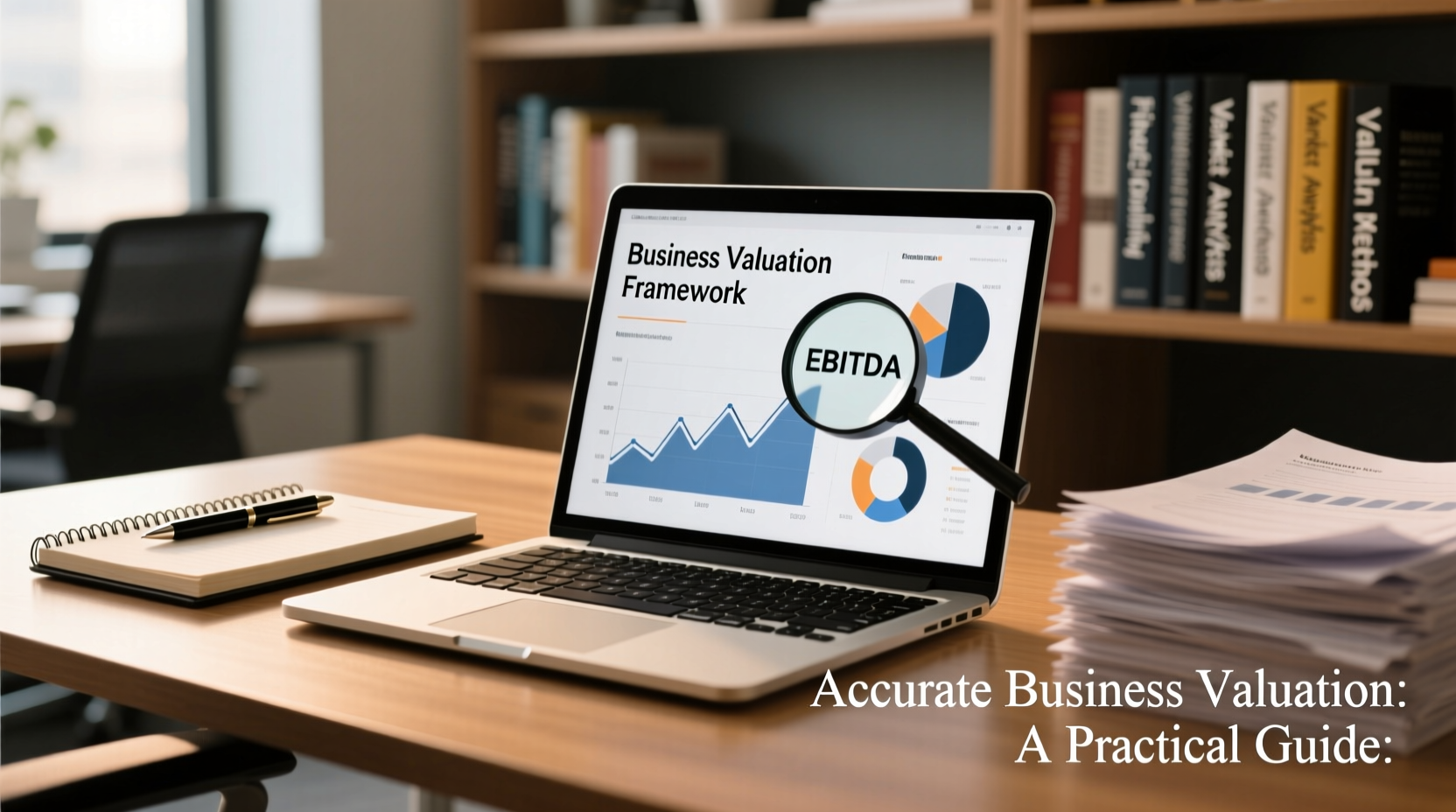
Valuation is often associated with selling a company, but its applications extend far beyond. Knowing your business’s worth supports strategic decisions such as bringing on partners, applying for loans, issuing equity, or even settling disputes during ownership transitions. A well-documented valuation enhances credibility with investors and lenders. It also reveals operational strengths and weaknesses—highlighting areas where profitability, customer concentration, or market positioning may need improvement.
Moreover, regular valuations create a benchmark. Tracking changes in value over time helps measure the impact of management decisions, marketing campaigns, or product launches. Think of it as a financial health check-up: not urgent every day, but essential periodically.
Common Valuation Methods and When to Use Them
No single method fits all businesses. The right approach depends on your industry, growth stage, profitability, and goals. Below are four widely accepted models used by professionals.
- Asset-Based Valuation: Sums up the net value of tangible and intangible assets (equipment, inventory, IP, brand) minus liabilities. Best suited for asset-heavy businesses like manufacturing or real estate.
- Market Approach: Compares your business to similar companies recently sold. Relies on multiples like price-to-earnings (P/E) or revenue multiples. Ideal when there’s ample transaction data in your sector.
- Income Approach (Discounted Cash Flow): Projects future cash flows and discounts them to present value using a risk-adjusted rate. Most appropriate for profitable, growing businesses with predictable earnings.
- Multiple of Earnings (Seller’s Discretionary Earnings - SDE): Applies a multiplier (typically 2x–5x) to SDE, commonly used for small to mid-sized private companies. Reflects owner benefits beyond net income.
The key is alignment. A tech startup with minimal assets but high growth potential should lean toward income-based models. A local service business with steady cash flow might use SDE multiples effectively.
Step-by-Step: How to Evaluate Your Business Value
Follow this structured process to ensure accuracy and consistency in your assessment.
- Gather Financial Statements: Collect at least three years of profit and loss statements, balance sheets, and cash flow statements. Ensure they’re audited or reviewed for reliability.
- Normalize Earnings: Adjust for non-recurring expenses (e.g., one-time legal fees), owner perks (personal travel charged to business), and above-market salaries. This reveals true operating performance.
- Select the Appropriate Method(s): Based on your business type, choose 1–2 primary valuation approaches. Cross-validate results for consistency.
- Research Comparable Sales: Look for recent transactions in your industry and region. Sites like BizBuySell, DealStats, or industry reports can provide benchmarks.
- Apply Risk Adjustments: Higher risk (e.g., customer concentration, regulatory exposure) reduces value. Factor in economic trends, competition, and scalability.
- Calculate and Reconcile: Run the numbers using your chosen method. If results vary significantly, revisit assumptions or consult a professional.
“Accurate valuation starts with clean books and honest normalization. The rest is interpretation.” — Laura Simmons, CPA and Business Valuation Consultant
Checklist: Preparing for a Reliable Valuation
- ✅ Organize 3 years of financial records
- ✅ Remove personal expenses from P&L
- ✅ Document major contracts and client relationships
- ✅ Identify key dependencies (e.g., one supplier, founder-led sales)
- ✅ Assess market position and competitive advantages
- ✅ Choose 1–2 valuation methods based on business model
- ✅ Compare with industry benchmarks
- ✅ Consider third-party review for objectivity
Real Example: Valuing a Mid-Sized Marketing Agency
Consider “Apex Digital,” a marketing agency generating $1.2 million in annual revenue with $300,000 in Seller’s Discretionary Earnings. The owner wants to assess value ahead of a potential partnership.
Using the multiple of earnings method, comparable agencies in the region recently sold for 3.5x SDE. Applying that: $300,000 × 3.5 = $1.05 million. However, Apex has strong recurring contracts (70% of revenue) and low employee turnover—positive differentiators.
A second pass using discounted cash flow, projecting 8% annual growth over five years and a 15% discount rate, yields $1.18 million. The slight variance suggests robust fundamentals. By combining both methods and adjusting for quality factors, the owner concludes a fair market value between $1.1 million and $1.2 million.
This dual-method approach builds confidence and provides negotiation flexibility.
Do’s and Don’ts of Business Valuation
| Do | Don't |
|---|---|
| Normalize financials to reflect true profitability | Rely solely on revenue multiples without considering profit |
| Use multiple valuation methods for cross-validation | Ignore risks like customer concentration or market saturation |
| Update valuations regularly to track progress | Assume your emotional attachment reflects market value |
| Seek input from accountants or valuation experts | Base value on what you need to make, rather than what the market will bear |
Frequently Asked Questions
How do I value a business with no profits?
For pre-profit ventures, traditional earnings-based models don’t apply. Instead, focus on asset value, market potential, intellectual property, or strategic value to a buyer. Venture capital comparables or cost-to-recreate approaches may be more relevant. Emphasize traction—user growth, partnerships, or pipeline strength—as proxies for future value.
What’s the difference between book value and market value?
Book value comes from your balance sheet: total assets minus liabilities. It’s historical and accounting-based. Market value reflects what a willing buyer would pay today, influenced by future potential, brand strength, and industry trends. Market value is typically higher than book value for growing businesses, but lower for declining ones.
Should I hire a professional appraiser?
If the valuation is for legal, tax, or major transaction purposes (e.g., merger, divorce, estate planning), yes. Certified valuation analysts (CVAs) or CPAs with valuation credentials bring objectivity, methodology, and defensibility. For internal planning, a DIY approach with peer review may suffice—but know when to escalate.
Conclusion: Turn Valuation Into Strategic Insight
Valuing your business is more than a number—it’s a lens into performance, sustainability, and opportunity. An accurate assessment empowers smarter decisions, whether you’re refining operations, attracting capital, or planning your next move. The process demands honesty, discipline, and a willingness to confront uncomfortable truths. But the payoff is clarity: knowing not just what your business is worth, but why.
Start today. Pull your latest financials, normalize your earnings, and run a preliminary calculation. Share your findings with a trusted advisor. You don’t need a perfect number to gain valuable insight—just the courage to look objectively at what you’ve built.




 浙公网安备
33010002000092号
浙公网安备
33010002000092号 浙B2-20120091-4
Comments
No comments yet. Why don't you start the discussion?