
The cube is one of the most fundamental shapes in geometry. Its symmetry, uniform faces, and straightforward dimensions make it an ideal starting point for learning about three-dimensional space. Whether you're a student brushing up on geometry, a professional verifying packaging dimensions, or someone tackling a home project, understanding how to calculate the volume and surface area of a cube is both practical and empowering. This guide breaks down the formulas, walks through real-world applications, and provides actionable steps to ensure accuracy every time.
Understanding the Cube: A Geometric Foundation
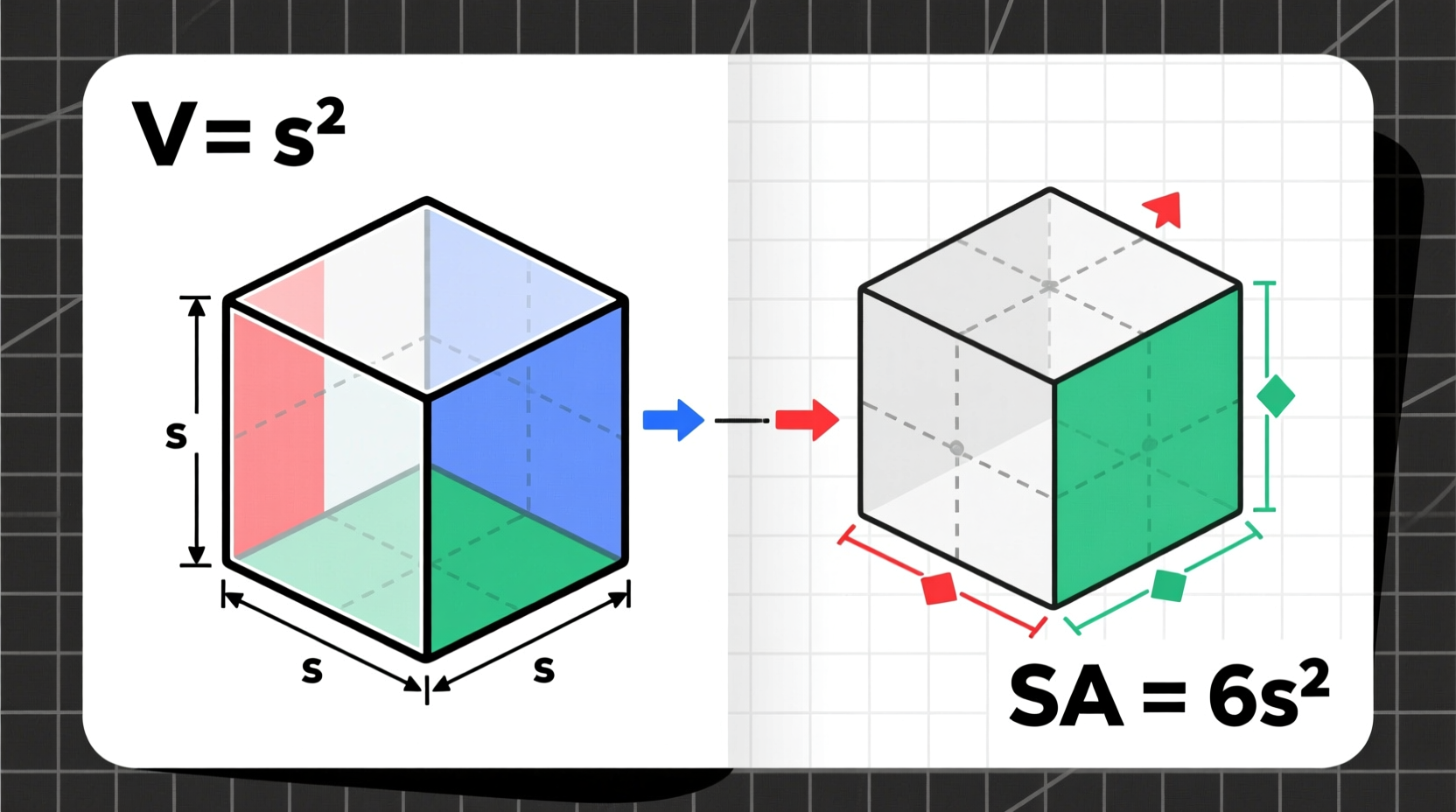
A cube is a three-dimensional solid object bounded by six identical square faces, with all edges equal in length and all angles at 90 degrees. It’s a special case of a rectangular prism where length, width, and height are the same. Because of its regularity, calculations involving cubes are simpler than those for irregular solids.
Every cube has:
- Six faces (all squares)
- Twelve edges (all equal in length)
- Eight vertices (corners)
The two most commonly needed measurements for a cube are its volume—how much space it occupies—and its surface area—how much material covers its exterior. These values are essential in fields ranging from architecture to manufacturing and even everyday tasks like wrapping gifts or painting boxes.
Calculating the Volume of a Cube
Volume measures the amount of three-dimensional space a shape occupies. For a cube, this tells you how much liquid it could hold, how many small objects fit inside, or how much concrete was used to cast it.
The formula for the volume \\( V \\) of a cube is:
\\( V = s^3 \\)
where \\( s \\) represents the length of one side of the cube.
This means you multiply the side length by itself three times—once for each dimension: length, width, and height.
Step-by-Step Guide to Finding Volume
- Measure the length of one edge of the cube using a ruler or tape measure.
- Ensure the measurement is in consistent units (e.g., centimeters, inches).
- Multiply the side length by itself: \\( s \\times s = s^2 \\).
- Multiply the result by the side length again: \\( s^2 \\times s = s^3 \\).
- Label your answer with cubic units (e.g., cm³, in³).
For example, if a cube has a side length of 5 cm:
\\( V = 5^3 = 5 \\times 5 \\times 5 = 125 \\) cm³
The cube can hold 125 cubic centimeters of material.
Determining the Surface Area of a Cube
Surface area refers to the total area covered by the outer surfaces of a solid. In practical terms, it helps determine how much paint is needed to coat a cube, how much wrapping paper is required, or how much heat can be exchanged across its surface.
Since a cube has six identical square faces, the surface area \\( A \\) is calculated as:
\\( A = 6s^2 \\)
Again, \\( s \\) is the length of one side.
This formula comes from finding the area of one face (\\( s^2 \\)) and multiplying it by six—the number of faces.
Step-by-Step Guide to Finding Surface Area
- Measure one side of the cube.
- Square the side length: \\( s \\times s = s^2 \\).
- Multiply the result by 6.
- Label your final answer with square units (e.g., m², ft²).
Using the same 5 cm cube:
Area of one face = \\( 5 \\times 5 = 25 \\) cm²
Total surface area = \\( 6 \\times 25 = 150 \\) cm²
You would need 150 square centimeters of material to fully cover the cube.
“Mastering basic geometric calculations like cube volume and surface area builds confidence for more complex spatial reasoning in engineering and design.” — Dr. Alan Reyes, Mathematics Educator and STEM Curriculum Developer
Practical Applications and Real-World Example
These calculations aren’t just academic exercises—they have tangible uses. Consider a small business owner who manufactures wooden puzzle cubes. Each cube must be coated with non-toxic varnish before shipping. To estimate costs, they need to know the total surface area of each unit.
Mini Case Study: EcoPuzzle Co.
EcoPuzzle Co. produces educational toys made from sustainably sourced wood. Their best-selling item is a 7 cm cube painted with natural dyes and sealed with eco-friendly varnish. The production manager needs to order enough varnish for 500 units.
First, calculate the surface area of one cube:
\\( A = 6 \\times (7)^2 = 6 \\times 49 = 294 \\) cm² per cube
For 500 cubes:
Total surface area = \\( 500 \\times 294 = 147,000 \\) cm²
Convert to square meters (since varnish is sold per m²):
147,000 cm² = 14.7 m²
Knowing this, the manager orders 15 m² of varnish, allowing a small buffer for waste. Without accurate surface area calculations, they might under-order and delay shipment—or over-order and increase costs unnecessarily.
Common Mistakes and How to Avoid Them
Even simple calculations can go wrong without attention to detail. Below is a checklist to help prevent common errors.
Checklist: Accurate Cube Measurements
- ✅ Confirm all edges are equal before assuming it's a cube
- ✅ Use consistent units across all measurements
- ✅ Double-check exponents: volume uses \\( s^3 \\), not \\( 3s \\)
- ✅ Remember surface area includes all six faces—not just visible ones
- ✅ Label answers with correct units (cubic for volume, square for area)
| Do | Don't |
|---|---|
| Use precise measuring tools like calipers for small cubes | Assume a box is a cube without measuring all sides |
| Square the side first when calculating surface area | Multiply the side by 6 first—that gives perimeter, not area |
| Write out each step clearly, especially when teaching others | Rush through mental math and skip verification |
| Round only at the final step, not during intermediate calculations | Round too early and introduce significant error |
Frequently Asked Questions
Can I use the cube formulas if my object is almost a cube but not perfect?
No—if the sides differ, even slightly, the object is a rectangular prism. Use \\( V = l \\times w \\times h \\) and \\( SA = 2(lw + lh + wh) \\) instead. Precision matters in construction and manufacturing.
What if I only know the volume? Can I find the side length?
Yes. Take the cube root of the volume. For example, if \\( V = 64 \\) cm³, then \\( s = \\sqrt[3]{64} = 4 \\) cm. This is useful when designing containers to hold a specific amount.
Is there a relationship between surface area and volume in cubes?
Yes. As a cube grows larger, its volume increases faster than its surface area. This principle affects heat dissipation, chemical reactions, and packaging efficiency. For instance, a larger ice cube melts slower because it has less surface area relative to its volume.
Final Thoughts and Next Steps
Calculating the volume and surface area of a cube is a foundational skill that opens doors to more advanced geometry and real-world problem solving. Once mastered, these concepts support success in academics, DIY projects, and technical careers. The key is consistency: measure carefully, apply the right formula, and always verify units.
Whether you're helping a child with homework, building a model, or optimizing storage space, knowing how to work with cubes gives you control over your environment. Don’t underestimate the power of simple math—it’s often the most reliable tool in any challenge.




 浙公网安备
33010002000092号
浙公网安备
33010002000092号 浙B2-20120091-4
Comments
No comments yet. Why don't you start the discussion?