
Tension is a fundamental force in physics and engineering, governing how strings, ropes, cables, and wires behave under load. Whether you're analyzing a hanging sign, designing a suspension bridge, or solving a textbook problem involving pulleys, knowing how to compute tension accurately is essential. Unlike forces such as gravity or friction, tension is a reactive force—it adjusts based on constraints and applied loads. This guide breaks down the process into clear, actionable steps, equipping you with the tools to confidently determine string tension in static, dynamic, and complex configurations.
Understanding What Tension Is—and Isn’t
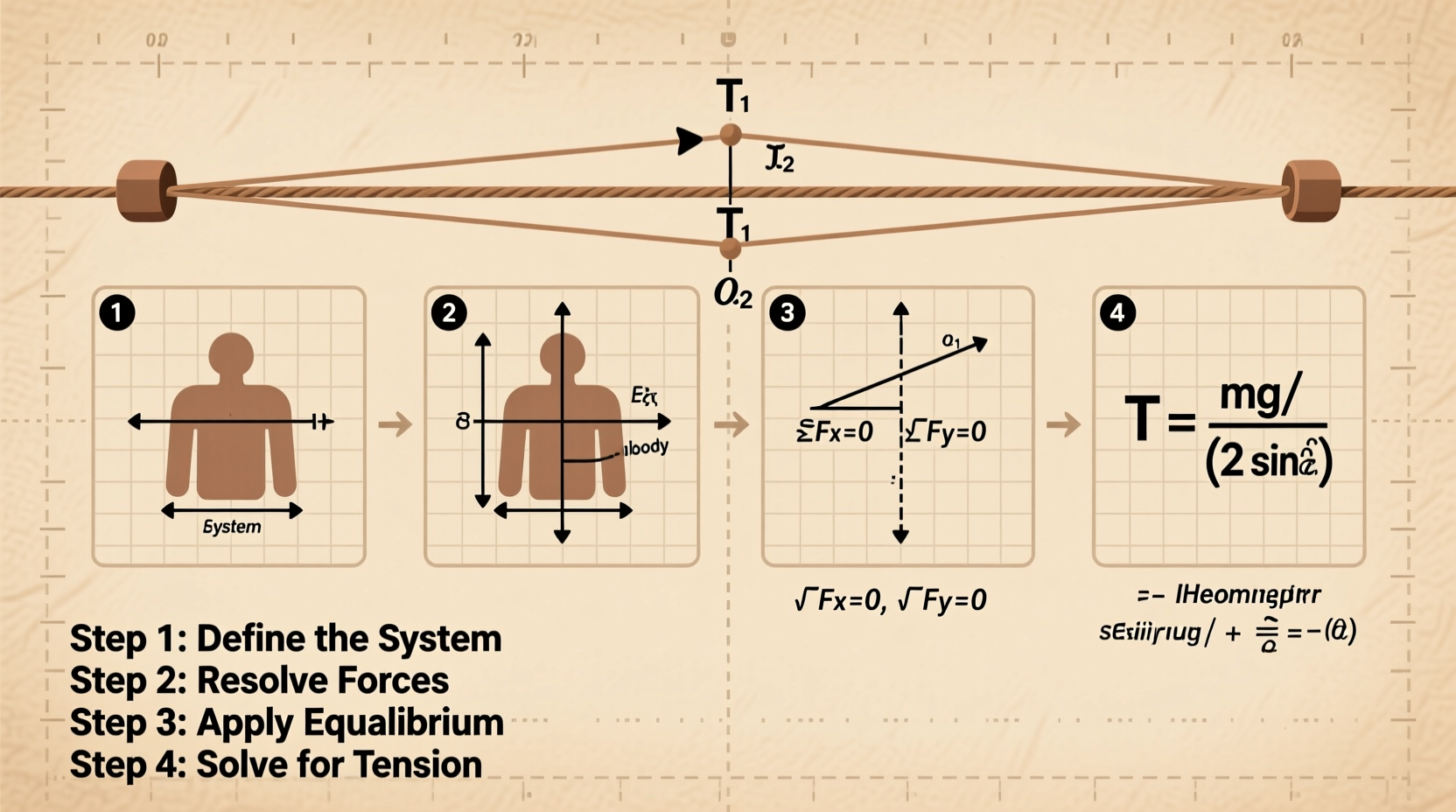
Tension is the pulling force transmitted axially through a string, rope, cable, or similar one-dimensional object when it is pulled tight by forces acting from opposite ends. It is a scalar magnitude but acts as a vector along the direction of the string. Importantly, tension is not a constant value across all scenarios; it varies depending on angles, masses, acceleration, and external forces.
Common misconceptions include assuming that tension equals weight (only true in vertical, static cases with no acceleration) or that tension is uniform throughout a system (true only for massless, inextensible strings without friction).
“Tension is not an independent force—it emerges in response to other forces. To find it, you must analyze the entire system using Newton’s laws.” — Dr. Alan Reyes, Professor of Mechanical Engineering, MIT
Step-by-Step Procedure to Calculate String Tension
Step 1: Identify the System and Draw a Free-Body Diagram
Begin by isolating the object(s) connected to the string. Sketch a free-body diagram showing all forces acting on each object: gravity, normal forces, applied forces, friction, and—of course—the tension force. Represent tension as a vector pointing away from the object along the string.
Step 2: Resolve Forces into Components
If the string is at an angle, break the tension force into horizontal (x) and vertical (y) components using trigonometry:
- Tₓ = T ⋅ cos(θ)
- Tᵧ = T ⋅ sin(θ)
where θ is the angle between the string and the horizontal axis.
Step 3: Apply Newton’s Second Law
For each direction, sum the forces and set them equal to mass times acceleration:
ΣFₓ = m⋅aₓ
ΣFᵧ = m⋅aᵧ
In static equilibrium (no motion), acceleration is zero, so net force is zero in both directions.
Step 4: Solve the System of Equations
Use algebra to solve for unknowns. In many problems, you’ll have two equations (from x and y directions) and can solve for tension and another variable like acceleration or an unknown mass.
Step 5: Check Units and Reasonableness
Ensure your answer is in newtons (N) and evaluate whether it makes physical sense. For example, tension should never be negative in a taut string.
Common Scenarios and Their Calculations
Scenario 1: Vertical String Supporting a Hanging Mass (Static)
A 5 kg mass hangs motionless from a ceiling via a string. Since acceleration is zero:
T − mg = 0 → T = mg = 5 × 9.8 = 49 N
The tension equals the weight of the object.
Scenario 2: Two Strings at Angles Supporting a Mass
A 10 kg object is suspended by two strings making 30° and 60° with the ceiling. Let T₁ and T₂ be the tensions.
In equilibrium:
- ΣFₓ = T₁⋅cos(30°) − T₂⋅cos(60°) = 0
- ΣFᵧ = T₁⋅sin(30°) + T₂⋅sin(60°) − mg = 0
Solving this system yields T₁ ≈ 49 N, T₂ ≈ 85 N.
Scenario 3: Atwood Machine (Two Masses Over a Pulley)
Masses m₁ = 3 kg and m₂ = 7 kg hang over a frictionless pulley. The system accelerates due to unbalanced weights.
Applying Newton’s second law to each mass:
- For m₁ (rising): T − m₁g = m₁a
- For m₂ (falling): m₂g − T = m₂a
Add equations: (m₂ − m₁)g = (m₁ + m₂)a → a = (4)(9.8)/10 = 3.92 m/s²
Substitute back: T = m₁(g + a) = 3(9.8 + 3.92) = 41.16 N
Advanced Considerations and Real-World Adjustments
In practical applications, assumptions like massless strings or frictionless pulleys don't hold. Here’s how to refine your calculations:
- String mass: If the string has significant mass, tension increases from top to bottom in a hanging rope due to cumulative weight.
- Elasticity: Stretchable strings (like rubber bands) follow Hooke’s Law: T = kΔL, where k is stiffness and ΔL is elongation.
- Friction in pulleys: Friction adds resistance, increasing required tension. Efficiency factors or torque equations may be needed.
- Damping and vibrations: Dynamic systems may require wave equation analysis for oscillating strings.
Mini Case Study: Designing a Zipline for an Adventure Park
An adventure park plans a zipline spanning 50 meters between two trees, 8 meters apart in height. A rider (total mass 80 kg) will start from rest. Engineers need to calculate peak tension in the steel cable to ensure safety.
The cable sags under load, forming an angle of approximately 15° at the lower end. Using energy conservation, maximum speed is found, then centripetal force at the lowest point adds to gravitational force.
Tension at the bottom: T = mg + (mv²)/r
After calculating velocity and radius of curvature, engineers determine T ≈ 1,050 N. They add a 3× safety factor, selecting a cable rated for over 3,000 N. Without accurate tension modeling, the system could fail under unexpected loads.
Do’s and Don’ts When Calculating Tension
| Do’s | Don’ts |
|---|---|
| Draw clear free-body diagrams | Assume tension is always equal to weight |
| Use consistent units (kg, m, s, N) | Mix degrees and radians in trig functions |
| Account for acceleration in moving systems | Ignore string mass in long suspensions |
| Verify results with limiting cases (e.g., θ=0°) | Forget to check vector directions |
Frequently Asked Questions
Can tension ever be negative?
No. Tension is a magnitude of a pulling force. A “negative” result usually indicates an incorrect assumption about direction. In reality, strings cannot push—only pull. If your calculation yields negative tension, the string would go slack.
How does acceleration affect tension?
Acceleration changes net force requirements. In an elevator accelerating upward, tension exceeds weight (T = m(g + a)). During downward acceleration, tension is less than weight (T = m(g − a)). At free fall, tension drops to zero.
Is tension the same throughout a rope going over a pulley?
Only if the pulley is massless and frictionless. With real pulleys, friction and rotational inertia cause slight differences in tension on either side. For high-precision systems, these differences must be modeled using torque equations.
Checklist: How to Accurately Compute String Tension
- Sketch the physical setup and identify all objects involved
- Draw free-body diagrams for each relevant object
- Label all forces, including tension, gravity, and contact forces
- Choose a coordinate system and resolve vectors into components
- Apply Newton’s second law in both x and y directions
- Solve the resulting equations algebraically
- Substitute known values and calculate tension
- Verify units, signs, and physical plausibility
- Adjust for real-world factors if necessary (mass, elasticity, friction)
- Cross-check with alternative methods or simulations when possible
Conclusion: Mastering Tension Builds Stronger Understanding
Calculating string tension isn’t just about solving textbook problems—it’s a gateway to understanding mechanical systems in real life. From elevators and cranes to guitar strings and suspension bridges, tension plays a silent but critical role. By following a disciplined, physics-based approach, you can analyze virtually any configuration with confidence. Accuracy comes not from memorization, but from systematic application of principles.




 浙公网安备
33010002000092号
浙公网安备
33010002000092号 浙B2-20120091-4
Comments
No comments yet. Why don't you start the discussion?