
Understanding how to calculate your test score percentage is a fundamental skill for students, parents, and educators alike. Whether you're reviewing exam results, tracking academic progress, or preparing for standardized tests, knowing the exact method ensures accuracy and builds confidence in interpreting outcomes. While the math may seem straightforward, small errors—such as miscounting questions or misunderstanding partial credit—can lead to incorrect percentages and misleading conclusions. This guide walks through the entire process with clarity, real-world examples, and expert-backed strategies to help you compute your scores correctly every time.
Why Accurate Score Calculation Matters
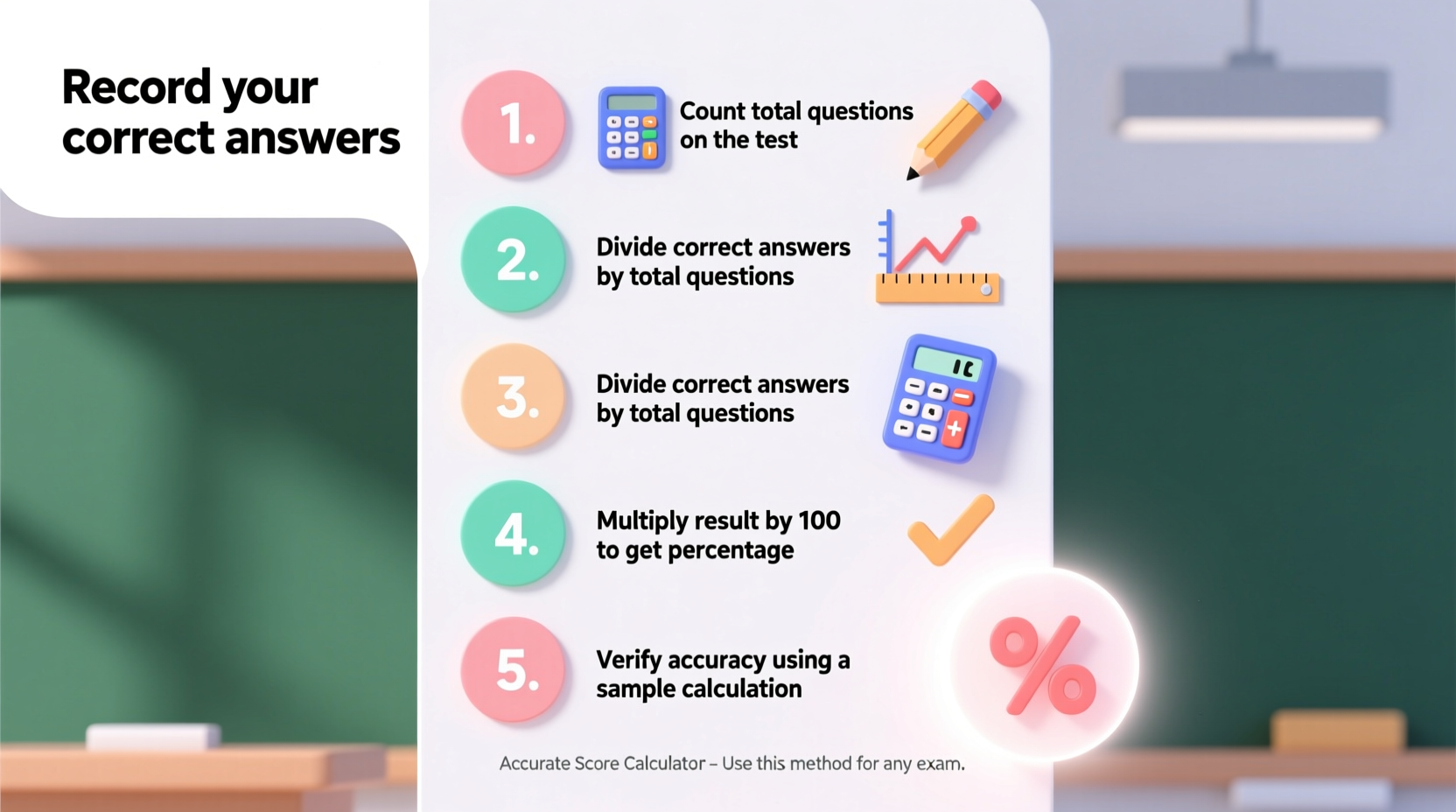
Precise score calculation isn't just about getting a number—it's about understanding performance. A correct percentage reflects not only how many answers were right but also provides insight into areas of strength and weakness. In academic settings, even a 1% difference can affect grading curves, scholarship eligibility, or course placement. For self-learners and professionals taking certification exams, accurate scoring helps measure readiness and guides further study.
“Accurate self-assessment begins with precise score calculation. It’s the foundation of meaningful learning improvement.” — Dr. Linda Chen, Educational Psychologist
Step-by-Step Guide to Calculating Your Test Score Percentage
Follow this clear, five-step process to determine your test score percentage with confidence. Each step includes explanations and common pitfalls to avoid.
- Determine the Total Number of Questions
Begin by confirming how many questions were on the test. This includes multiple choice, true/false, short answer, and essay items. If the test uses weighted sections (e.g., essays count more), note that separately for later adjustment.
Example: A math test has 50 questions total—40 multiple choice and 10 word problems. - Count the Number of Correct Answers
Carefully tally how many answers you got right. Double-check each section. For partial credit (common in open-ended responses), use the point values assigned by the instructor.
Tip: If grading your own work, go question by question without skipping around to prevent double-counting or omissions. - Account for Partial Credit or Weighted Scoring
Some tests assign different point values per question. In such cases, add up the actual points earned rather than counting correct answers.
Example: An essay worth 20 points where you scored 16 contributes more than a 2-point multiple-choice item. Sum all points earned across the test. - Divide Points Earned by Total Possible Points
Use the formula:
Score = (Points Earned ÷ Total Possible Points)
This gives you a decimal value between 0 and 1. For instance, if you earned 78 out of 100 points, the result is 0.78. - Multiply by 100 to Get the Percentage
Convert the decimal to a percentage by multiplying by 100.
Using the previous example: 0.78 × 100 = 78%.
This is your final test score percentage.
Real-World Example: Midterm Exam Calculation
Consider Sarah, a high school biology student who just completed her midterm. Here’s how she calculates her score:
- Total questions: 60
- Multiple choice: 40 questions (1 point each)
- Short answer: 15 questions (2 points each) → Max 30 points
- Essay: 1 question (10 points)
- Total possible points: 40 + 30 + 10 = 80
Sarah reviews her paper:
- Correct multiple choice: 35 → 35 points
- Short answer: Earned 24 out of 30 points
- Essay: Scored 7 out of 10
- Total earned: 35 + 24 + 7 = 66 points
Calculation:
(66 ÷ 80) = 0.825
0.825 × 100 = 82.5%
This places her in the B range according to her school’s grading scale. Without accounting for point weighting, she might have incorrectly assumed she answered 46 out of 60 questions correctly (~76.7%), leading to an inaccurate assessment.
Common Mistakes and How to Avoid Them
Even simple calculations can go wrong under pressure. Below are frequent errors and how to prevent them.
| Mistake | Why It Happens | How to Prevent |
|---|---|---|
| Treating all questions as equal | Assuming every question is worth one point | Check the test instructions or rubric for point distribution |
| Forgetting partial credit | Only counting fully correct answers | Add actual points earned, not just “correct” responses |
| Misreading the total points | Using number of questions instead of total points | Confirm maximum possible score from the test header or syllabus |
| Calculation error in division | Manual math mistakes or rounding too early | Use a calculator and keep decimals until final step |
Checklist: Ensure Accuracy Every Time
Before finalizing your test score percentage, run through this quick checklist:
- ✅ Confirmed the total number of questions and their point values
- ✅ Counted only the points you actually earned (including partial credit)
- ✅ Used the correct total possible points (not just number of questions)
- ✅ Divided earned points by total points to get a decimal
- ✅ Multiplied the decimal by 100 to convert to a percentage
- ✅ Rounded appropriately (e.g., to one decimal place if needed)
- ✅ Double-checked calculations using a calculator or spreadsheet
Frequently Asked Questions
What if some questions are worth more than others?
In that case, do not count correct answers—instead, sum the points earned. For example, if Question 1 is worth 5 points and you got it right, that’s 5 points. If Question 2 is worth 1 point and you missed it, you gain nothing. Add all points to find your total score before dividing.
Can I calculate my percentage if I only know the number of correct answers?
Only if all questions carry equal weight. If so, divide the number correct by total questions, then multiply by 100. But if the test includes essays, diagrams, or bonus questions, this method will be inaccurate.
How do I handle extra credit?
Extra credit should not be included in the denominator (total possible points). Instead, add extra credit points to your numerator (earned points) only. This can push your score above 100% in some cases, depending on policy.
Advanced Tip: Using Digital Tools for Faster Accuracy
While manual calculation builds understanding, digital tools can enhance speed and precision. Consider using:
- Spreadsheets (Google Sheets or Excel): Enter your scores in cells and use formulas like
= (Earned/Total)*100. - Grade calculator websites: Many free online tools allow input of points and instantly return percentages and letter grades.
- Educational apps: Platforms like Canvas or Google Classroom often auto-calculate scores, but verifying manually ensures transparency.
These tools reduce human error and are especially useful when managing multiple assessments over time.
Conclusion: Take Control of Your Academic Results
Calculating your test score percentage accurately is a small act with significant impact. It empowers you to understand your performance objectively, track progress meaningfully, and advocate for yourself when discrepancies arise. By following the steps outlined—verifying point values, applying the correct formula, and avoiding common traps—you ensure your results reflect reality, not miscalculation. Whether you're a student aiming for excellence, a parent supporting a child’s education, or a teacher guiding learners, mastering this skill brings clarity and confidence.




 浙公网安备
33010002000092号
浙公网安备
33010002000092号 浙B2-20120091-4
Comments
No comments yet. Why don't you start the discussion?