
Understanding the symmetry of mathematical functions is essential in calculus, algebra, and real-world modeling. Two key types of symmetry—even and odd functions—offer powerful shortcuts in integration, graphing, and simplifying expressions. Recognizing them isn't just about memorizing rules; it's about developing an intuitive sense of how functions behave under reflection. This guide walks you through a systematic approach to identifying even and odd functions using definitions, algebraic tests, visual cues, and real examples.
What Are Even and Odd Functions?
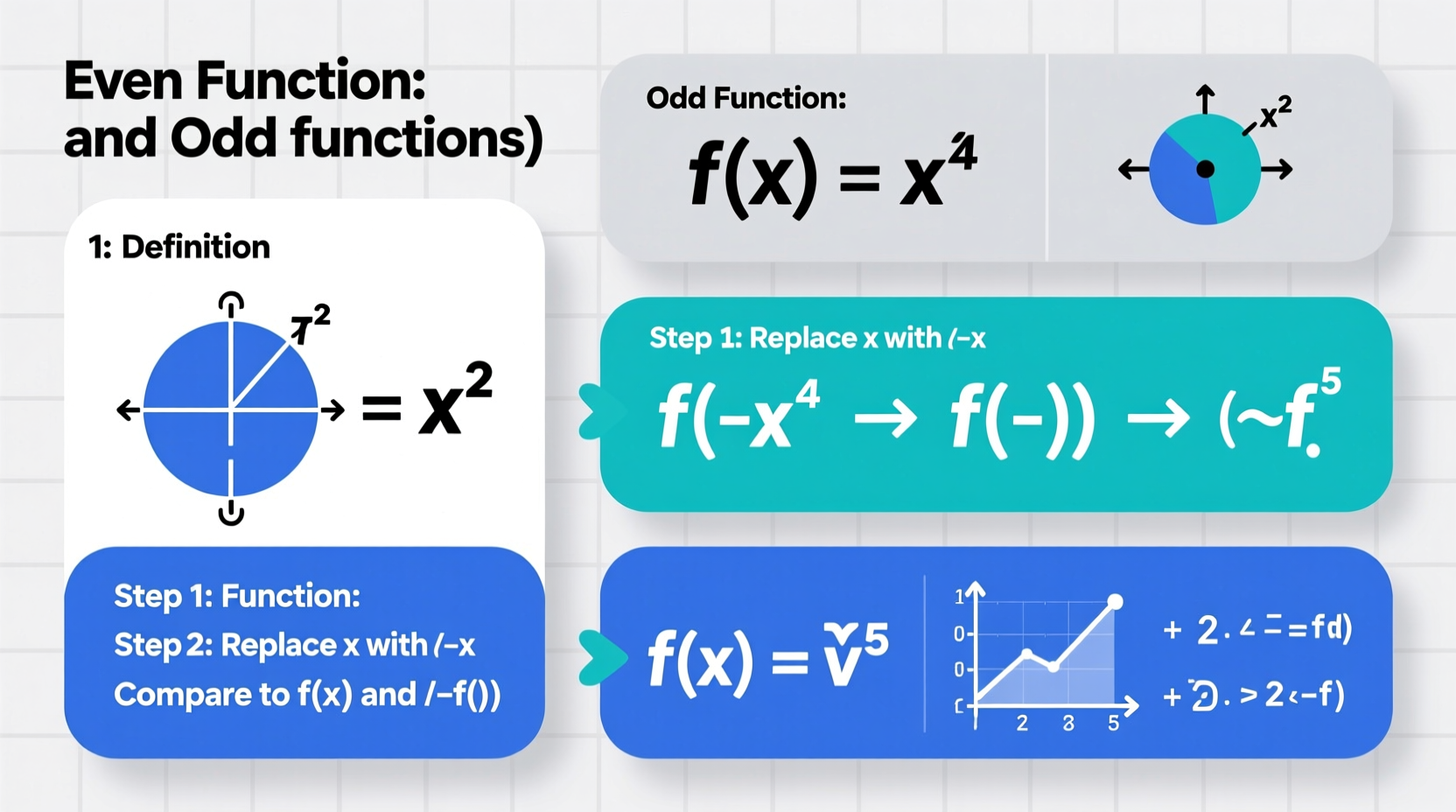
In mathematics, the terms \"even\" and \"odd\" describe symmetry properties of functions across the y-axis or origin, respectively. These labels come from polynomial behavior: functions like \\( f(x) = x^2 \\) or \\( x^4 \\) are symmetric about the y-axis (even), while \\( f(x) = x^3 \\) or \\( x^5 \\) exhibit rotational symmetry around the origin (odd).
An even function satisfies the condition:
\\[ f(-x) = f(x) \\]
This means that flipping the input sign doesn’t change the output. The graph remains unchanged when reflected over the y-axis.
An odd function satisfies:
\\[ f(-x) = -f(x) \\]
Here, changing the sign of the input flips the sign of the output. Graphically, this results in 180° rotational symmetry about the origin.
If neither condition holds, the function is neither even nor odd.
Step-by-Step Process to Identify Function Symmetry
Follow this five-step method to determine whether any given function is even, odd, or neither.
- Write down the original function: Clearly define \\( f(x) \\). Example: \\( f(x) = x^4 - 3x^2 + 1 \\).
- Compute \\( f(-x) \\): Replace every instance of \\( x \\) with \\( -x \\) and simplify completely.
- Evaluate \\( -f(x) \\): Multiply the entire function by -1 for comparison.
- Compare results:
- If \\( f(-x) = f(x) \\), the function is even.
- If \\( f(-x) = -f(x) \\), the function is odd.
- If neither equality holds, it’s neither.
- Verify visually (optional): Sketch or imagine the graph. Even functions mirror across the y-axis; odd ones rotate 180° around the origin.
Example 1: A Polynomial Function
Let \\( f(x) = x^4 - 2x^2 \\).
- Step 1: Original function defined.
- Step 2: Compute \\( f(-x) = (-x)^4 - 2(-x)^2 = x^4 - 2x^2 \\).
- Step 3: \\( f(-x) = f(x) \\), so it’s even.
Example 2: A Cubic Function
Let \\( f(x) = x^3 - 5x \\).
- \\( f(-x) = (-x)^3 - 5(-x) = -x^3 + 5x = -(x^3 - 5x) = -f(x) \\).
- Thus, \\( f(-x) = -f(x) \\), so it’s odd.
Example 3: A Mixed Function
Let \\( f(x) = x^3 + x^2 \\).
- \\( f(-x) = (-x)^3 + (-x)^2 = -x^3 + x^2 \\).
- Compare: Is \\( -x^3 + x^2 = x^3 + x^2 \\)? No → not even.
- Is \\( -x^3 + x^2 = -(x^3 + x^2) = -x^3 - x^2 \\)? No → not odd.
- Conclusion: Neither.
Common Function Types and Their Symmetries
Certain classes of functions follow predictable symmetry patterns. Use this table as a reference when analyzing more complex expressions.
| Function Type | Example | Symmetry | Reason |
|---|---|---|---|
| Even-degree monomial | \\( x^2, x^4, x^6 \\) | Even | \\( (-x)^{2n} = x^{2n} \\) |
| Odd-degree monomial | \\( x^3, x^5, x^7 \\) | Odd | \\( (-x)^{2n+1} = -x^{2n+1} \\) |
| Cosine function | \\( \\cos(x) \\) | Even | \\( \\cos(-x) = \\cos(x) \\) |
| Sine function | \\( \\sin(x) \\) | Odd | \\( \\sin(-x) = -\\sin(x) \\) |
| Absolute value | \\( |x| \\) | Even | \\( |-x| = |x| \\) |
| Linear function (through origin) | \\( f(x) = 3x \\) | Odd | \\( f(-x) = -3x = -f(x) \\) |
| Exponential function | \\( e^x \\) | Neither | No consistent symmetry |
“Symmetry reduces complexity. Recognizing even and odd functions allows us to compute integrals faster and predict graph behavior without plotting every point.” — Dr. Alan Reyes, Mathematics Educator and Calculus Specialist
Practical Tips and Common Pitfalls
While the algebraic test is straightforward, students often make avoidable errors. Here’s a checklist to ensure accuracy.
Checklist: Confirming Even or Odd Status
- ✅ Replace all \\( x \\) with \\( -x \\) carefully—use parentheses.
- ✅ Simplify \\( f(-x) \\) completely before comparison.
- ✅ Calculate \\( -f(x) \\) explicitly if needed.
- ✅ Watch for mixed degrees in polynomials—they often break symmetry.
- ✅ Consider domain restrictions: if the domain isn’t symmetric about zero (e.g., \\( f(x) = \\sqrt{x} \\)), the function can’t be even or odd.
For instance, \\( f(x) = \\sqrt{x} \\) is only defined for \\( x \\geq 0 \\), so \\( f(-x) \\) isn’t defined for positive \\( x \\). Thus, symmetry cannot exist. Similarly, piecewise functions must be evaluated on both sides of zero to confirm symmetry.
Real Example: Analyzing a Trigonometric Function
Consider the function \\( f(x) = x \\cdot \\cos(x) \\).
At first glance, it combines an odd function (\\( x \\)) and an even function (\\( \\cos(x) \\)). What happens when we multiply them?
Compute \\( f(-x) \\):
\\[ f(-x) = (-x) \\cdot \\cos(-x) = -x \\cdot \\cos(x) = - (x \\cdot \\cos(x)) = -f(x) \\]
Despite combining even and odd components, the result is an odd function. This illustrates a useful rule:
- Even × Even = Even
- Odd × Odd = Even
- Odd × Even = Odd
This pattern mirrors integer multiplication and helps predict symmetry in composite functions.
Frequently Asked Questions
Can a function be both even and odd?
Only one function satisfies both \\( f(-x) = f(x) \\) and \\( f(-x) = -f(x) \\) simultaneously: the zero function, \\( f(x) = 0 \\). For all other functions, the two conditions are mutually exclusive.
Do constant functions count as even?
Yes. A constant function \\( f(x) = c \\) is even because \\( f(-x) = c = f(x) \\). It fails the odd test unless \\( c = 0 \\), which again brings us back to the zero function.
How does symmetry help in calculus?
When integrating over symmetric intervals like \\([-a, a]\\):
- If \\( f(x) \\) is even, then \\( \\int_{-a}^{a} f(x)\\,dx = 2 \\int_{0}^{a} f(x)\\,dx \\).
- If \\( f(x) \\) is odd, then \\( \\int_{-a}^{a} f(x)\\,dx = 0 \\).
This saves computation time and is widely used in physics and engineering applications.
Conclusion: Mastering Function Symmetry
Identifying even and odd functions is more than a classroom exercise—it's a foundational skill that enhances problem-solving efficiency across mathematics and applied sciences. By following a disciplined step-by-step process, checking for common pitfalls, and understanding the underlying principles of symmetry, you gain deeper insight into how functions behave. Whether you're preparing for exams, teaching others, or working on advanced models, this knowledge streamlines analysis and builds confidence.




 浙公网安备
33010002000092号
浙公网安备
33010002000092号 浙B2-20120091-4
Comments
No comments yet. Why don't you start the discussion?