
Monitoring the boot process of Windows systems is critical for maintaining performance, diagnosing startup delays, and ensuring compliance across enterprise networks. While built-in tools like Event Viewer and Performance Monitor provide insights, leveraging Group Policy Objects (GPO) allows centralized control and consistent configuration across thousands of endpoints. This guide walks through how to use GPOs to monitor each phase of the boot process—firmware, operating system loading, logon, and user session initialization—with precision and scalability.
Understanding the Windows Boot Process
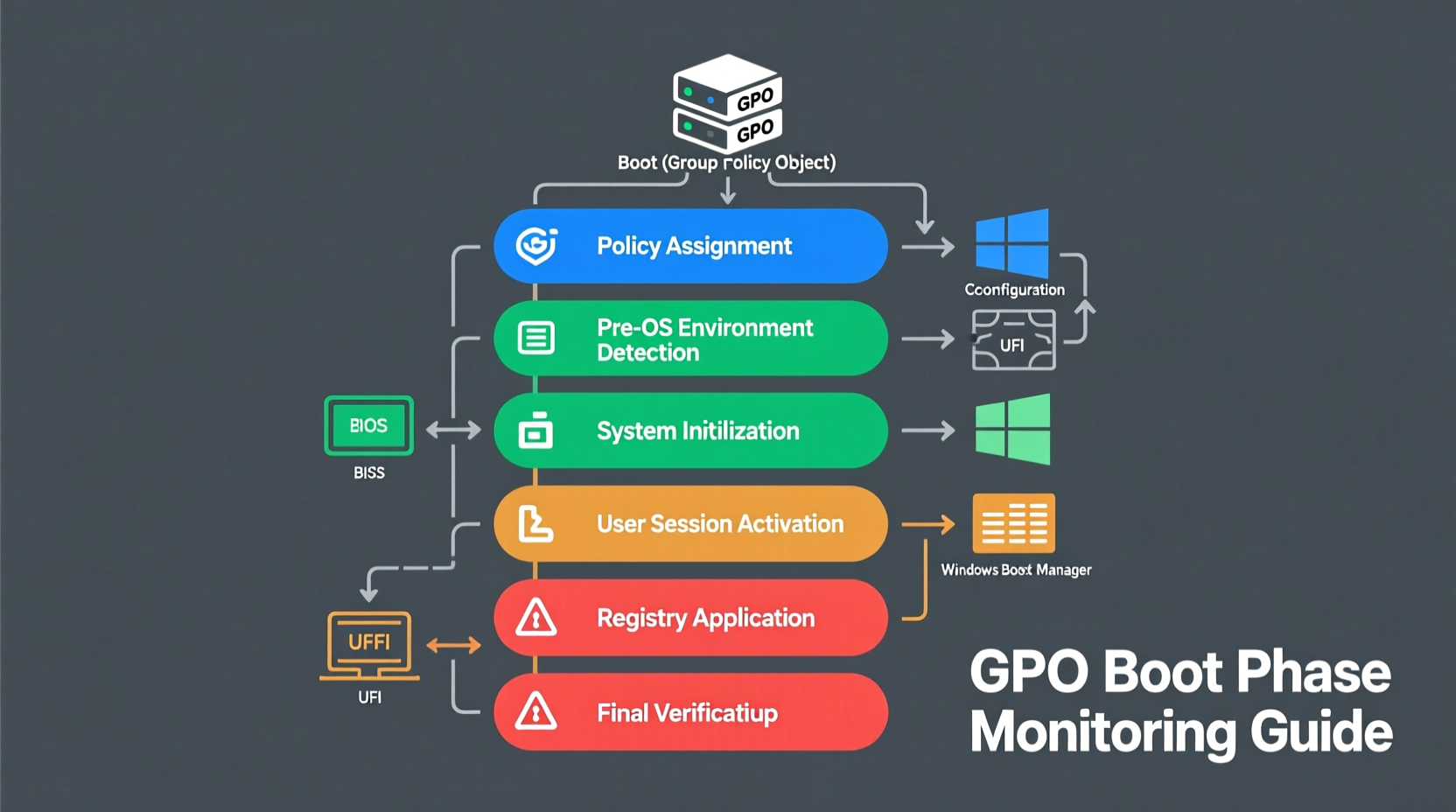
The Windows boot sequence consists of several distinct phases, each offering unique opportunities for monitoring and optimization:
- Firmware Initialization: BIOS or UEFI performs hardware checks and loads the bootloader.
- Windows Boot Manager: Selects the operating system and starts winload.exe.
- Kernel Loading: The NT kernel (ntoskrnl.exe) initializes core drivers and services.
- Session Manager (SMSS): Starts essential subsystems including the Winlogon process.
- Logon Phase: Users authenticate via Winlogon and LSASS; Group Policies are applied.
- User Initialization: Profile loading, startup scripts, and background applications launch.
Delays in any of these stages can lead to poor user experience and reduced productivity. By using GPOs to enable diagnostic logging and trace data collection during these phases, administrators gain visibility without manually configuring individual machines.
Enabling Boot and Logon Performance Logging via GPO
Windows includes built-in diagnostics through the \"Boot and Logon Events\" feature, part of the Group Policy preference for Advanced Audit Policy Configuration. This capability logs detailed timing information about system startup and user logon processes.
Step-by-Step: Configure Performance Logging via GPO
- Open Group Policy Management Console (GPMC) on your domain controller or management workstation.
- Create a new GPO named \"Boot Performance Monitoring\" and link it to the OU containing target computers.
- Edit the GPO and navigate to:
Computer Configuration → Policies → Administrative Templates → System → Diagnostics - Enable the policy: \"Configure boot-time event tracing\".
- Set the option to Enabled and configure trace duration if needed (default captures first 60 seconds).
- Navigate to:
Computer Configuration → Administrative Templates → System → User Profiles - Enable: \"Add the time taken to apply Group Policies to Event Viewer\".
- Link this to detailed tracking of logon delays caused by GPO processing.
Once applied, systems will begin recording boot and logon events in the Event Viewer under Applications and Services Logs → Microsoft → Windows → Diagnostics-Performance → Operational.
Data Collection and Interpretation
After enabling boot logging, administrators can analyze key performance metrics from Event ID 100 through 114 in the Diagnostics-Performance log. These include timestamps for:
- Start of kernel initialization
- Winlogon start time
- User profile load duration
- Shell (Explorer) readiness
- Total boot time to desktop availability
To streamline analysis across multiple devices, consider forwarding these logs to a central SIEM or using PowerShell scripts triggered via GPO startup scripts to export and aggregate data.
| Event ID | Description | Relevance |
|---|---|---|
| 100 | Boot timeline started | Benchmark for total boot duration |
| 104 | Winlogon initialization | Indicates OS readiness for authentication |
| 112 | User shell launched | Measures time until desktop usable |
| 200 | GPO application duration | Tracks policy processing overhead at logon |
“Centralized boot telemetry via GPO gives IT teams actionable insight into real-world endpoint performance, not just theoretical benchmarks.” — Michael Tran, Senior Systems Architect at Enterprise IT Solutions Inc.
Optimizing GPO Application During Boot
Ironically, misconfigured GPOs can themselves slow down boot times. To ensure monitoring doesn’t introduce latency, follow best practices for efficient policy design.
Checklist: Optimize GPO Impact on Boot
- ✔ Limit the number of GPOs linked to computer OUs (ideally under 10)
- ✔ Use WMI filters sparingly—they increase processing time during boot
- ✔ Enable Asynchronous Group Policy Processing where appropriate
- ✔ Disable unused extensions (e.g., Software Installation, Folder Redirection) on servers or non-relevant clients
- ✔ Leverage Group Policy Caching (available in Windows 10/11 20H2+) to reduce network dependency at startup
- ✔ Audit GPO processing time using Resultant Set of Policy (RSoP) or
gpresult /h report.html
Real-World Example: Resolving Slow Boot Times in a Branch Office
A regional office reported average boot times exceeding 3 minutes, despite having modern hardware. Using the method described above, the IT team created a targeted GPO enabling boot diagnostics across 75 workstations.
Analysis revealed Event ID 100 to 112 took only 45 seconds on average—but users weren't seeing their desktops until nearly 180 seconds. Further investigation showed excessive login scripts and roaming profile bloat delaying shell initialization.
By modifying the GPO to:
- Redirect large profile folders off the roaming path
- Replace legacy login scripts with faster alternatives via Task Scheduler
- Enable verbose GPO logging temporarily
…the team reduced average boot-to-desktop time to under 60 seconds. The entire diagnosis and remediation was managed remotely through GPOs, without visiting any physical location.
Frequently Asked Questions
Can GPO-based boot monitoring affect system performance?
When properly configured, the performance impact is negligible. Tracing uses lightweight ETW (Event Tracing for Windows) providers and runs only briefly during boot. Avoid enabling debug-level logging permanently across large fleets.
Is this method compatible with Windows 10 and Windows 11?
Yes. The Diagnostics-Performance logging features are fully supported in Windows 10 (version 1607+) and Windows 11. Ensure devices are domain-joined and receiving GPOs correctly. Some features require Pro or Enterprise editions.
How do I disable boot logging after collecting data?
Return to the same GPO and set \"Configure boot-time event tracing\" to Not Configured or Disabled. The logging stops on next reboot, and no further events are recorded.
Conclusion
Monitoring boot phases using Group Policy Objects transforms reactive troubleshooting into proactive system health management. From firmware handoff to user shell readiness, every stage can be measured, analyzed, and optimized at scale. With precise GPO configurations, IT departments gain deep visibility into endpoint performance while maintaining centralized control.
Start small—deploy diagnostic policies to a pilot group, collect baseline data, and refine your approach. Over time, you’ll build a responsive, high-performance environment where boot delays become exceptions, not norms.




 浙公网安备
33010002000092号
浙公网安备
33010002000092号 浙B2-20120091-4
Comments
No comments yet. Why don't you start the discussion?