
The Divine Mercy Prayer is more than a recitation—it is an invitation to experience God’s boundless compassion. Rooted in the visions of Saint Faustina Kowalska, a Polish nun in the early 20th century, this devotional practice centers on trust in Christ’s infinite mercy and a desire to extend that mercy to others. When prayed with intention, it becomes a powerful spiritual tool for healing, conversion, and peace. This guide walks you through each element of the prayer, explains its significance, and offers practical ways to deepen your devotion.
Understanding the Origins and Significance
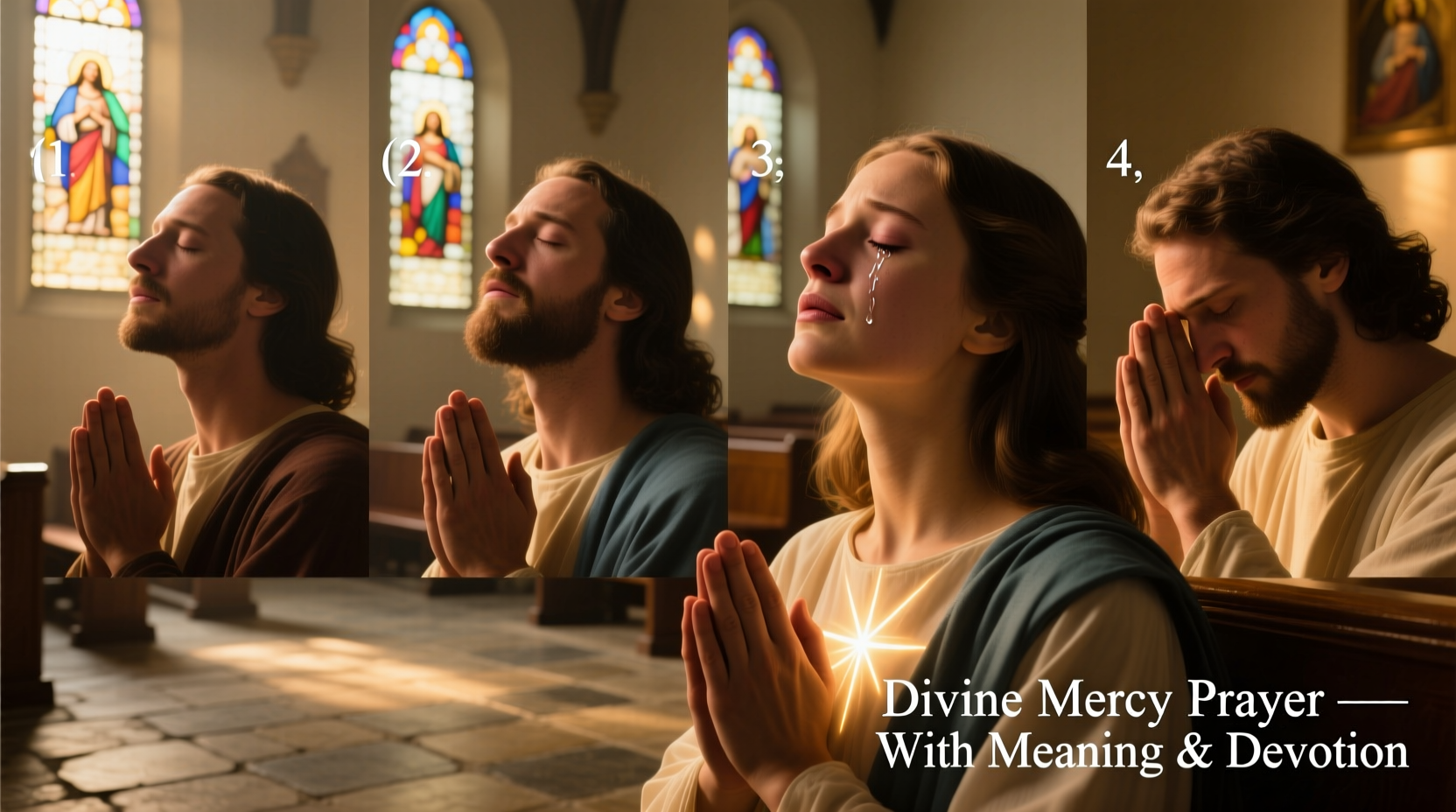
In the 1930s, Jesus appeared to Sister Maria Faustina Kowalska, revealing a message of divine mercy accessible to all souls. He emphasized the Chaplet of Divine Mercy as a means of obtaining grace, especially for sinners at the hour of death. The prayer was first recorded in her diary, now known as *Divine Mercy in My Soul*, which the Vatican approved as spiritually sound. Pope John Paul II, who canonized Faustina in 2000, called the message of mercy “the appropriate antidote to the evil of our times.”
The Chaplet is traditionally said using rosary beads, but its purpose transcends ritual. It aligns the heart with Christ’s redemptive love and invites believers to participate in His mission of forgiveness. The nine-day Novena to Divine Mercy, often begun on Good Friday, culminates on Divine Mercy Sunday—the first Sunday after Easter—established by the Church as a day of special graces.
“The soul that will go to Confession and receive Holy Communion shall obtain complete forgiveness of sins and punishment.” — Jesus to St. Faustina (Diary, 699)
Step-by-Step Guide to Praying the Chaplet
To pray the Divine Mercy Chaplet with authenticity, follow this structured approach. Each part carries symbolic weight and spiritual depth. While the full chaplet takes about 20 minutes, even a partial prayer offered in sincerity is honored by God.
- Begin with the Sign of the Cross
Make the Sign of the Cross slowly, conscious of entering sacred time. Say: “In the name of the Father, and of the Son, and of the Holy Spirit. Amen.” This act sanctifies your intention and unites you to the Trinity. - Optional Opening Prayers
Some add the Apostles’ Creed or an Act of Contrition to prepare the heart. While not required, these help focus the mind on faith and repentance. - On the Crucifix: The Lord’s Prayer
Recite the Our Father, grounding the prayer in Christ’s own words. Reflect on God as Father—merciful, just, and loving. - On the First Bead: The Creed
Say the Nicene or Apostles’ Creed, reaffirming core Christian beliefs. This professes your trust in the saving power of Christ’s death and resurrection. - On Each of the Next Three Beads: Hail Mary
Pray one Hail Mary per bead, asking for openness to grace, humility, and purity of heart. These virtues are essential for receiving mercy. - Then, Announce the Chaplet
“For the sake of His sorrowful Passion, have mercy on us and on the whole world.” Pause briefly, contemplating Christ’s suffering in Gethsemane, before Pilate, on the way to Calvary. - On the Large Beads: “Eternal Father”
For each large bead, pray: “Eternal Father, I offer You the Body and Blood, Soul and Divinity of Your dearly beloved Son, Our Lord Jesus Christ, in atonement for our sins and those of the whole world.”
As you say this, envision Christ’s sacrifice being presented to the Father—not just for you, but for every person, living and dead. - On the Small Beads: “For the Sake of His Sorrowful Passion”
Repeat: “For the sake of His sorrowful Passion, have mercy on us and on the whole world.”
With each repetition, bring to mind someone in need—yourself, a loved one, an enemy, a dying soul. Allow sorrow and hope to coexist in your heart. - After the Final Decade: Concluding Doxology
Repeat three times: “Holy God, Holy Mighty One, Holy Immortal One, have mercy on us and on the whole world.”
This echoes the angels’ praise and affirms God’s holiness as the foundation of mercy. - Close with a Personal Petition
Add a quiet prayer of thanksgiving or intercession. You might say: “Jesus, I trust in You,” the central mantra of the devotion.
Deepening Devotion: Beyond the Words
True devotion requires more than repetition. To make the Divine Mercy Chaplet transformative, integrate these practices:
- Prepare Interiorly: Spend five minutes in silence before praying. Acknowledge your need for mercy and your desire to show it to others.
- Visualize Christ’s Passion: As you pray, imagine scenes from the crucifixion—not to dwell on pain, but to grasp the cost of love.
- Pray for Specific Intentions: Assign names to each decade—someone struggling, a non-believer, a nation at war, a soul in purgatory.
- Read St. Faustina’s Diary: Even a few paragraphs daily enrich understanding. Entry 687 contains Jesus’ direct instructions on the chaplet.
- Receive the Sacraments: The chaplet reaches its fullness when combined with Confession and Eucharist, especially on Divine Mercy Sunday.
Common Challenges and How to Overcome Them
Many struggle with distractions, dryness, or doubt during prayer. These are normal. What matters is fidelity, not feeling.
| Challenge | Solution |
|---|---|
| Mental distractions | Pause and gently return focus. Use a physical aid like a rosary or icon to anchor attention. |
| Emotional dryness | Continue anyway. Trust that prayer bears fruit even when unseen. Faith, not feeling, sustains devotion. |
| Doubt about efficacy | Recall Jesus’ promise: “Even if a sinner were to say it only once, he would obtain great mercy” (Diary, 687). |
| Lack of time | Pray one decade with full intention. Quality surpasses quantity in spiritual matters. |
“The greater the sinner, the greater the right he has to My mercy.” — Jesus to St. Faustina (Diary, 723)
Real Example: A Story of Transformation
Thomas, a man estranged from the Church for decades, began praying the Divine Mercy Chaplet after his sister’s funeral. She had left him a small rosary with a note: “Jesus, I trust in You.” Grieving and angry, he started the chaplet out of obligation. By the third day, something shifted. On the line “For the sake of His sorrowful Passion,” he broke down weeping—over his pride, his lost years, his father’s unhealed wounds. He went to Confession the next week. Within months, he was volunteering at a shelter. “I didn’t feel holy,” he later shared. “But I felt seen. And that changed everything.”
Frequently Asked Questions
Can anyone pray the Divine Mercy Chaplet?
Yes. The prayer is open to all—Catholics and non-Catholics, believers and seekers. No formal permission or special status is required. Jesus told St. Faustina it was intended for “the whole world.”
Do I need a rosary to pray it?
No. While the traditional format uses rosary beads, you can count on your fingers, use a digital counter, or simply pray the sequence mentally. The heart’s posture matters most.
What are the promised graces of the chaplet?
According to St. Faustina’s diary, Jesus promised extraordinary graces: comfort at the hour of death, protection in danger, softening of hardened hearts, and even conversion of sinners. The greatest grace is a deeper relationship with God’s merciful love.
Conclusion: Begin Where You Are
The Divine Mercy Chaplet is not reserved for saints or mystics. It is for the weary, the broken, the doubting, the hopeful. You don’t need perfect words or flawless focus. You only need to begin—with honesty, with longing, with trust. Whether you pray it at 3 a.m. in a hospital room or silently during a commute, each word opens a door to grace. Let the rhythm of “For the sake of His sorrowful Passion” become a heartbeat of surrender. Let “Jesus, I trust in You” be your anchor in uncertainty.




 浙公网安备
33010002000092号
浙公网安备
33010002000092号 浙B2-20120091-4
Comments
No comments yet. Why don't you start the discussion?