
Choosing the right notebook size might seem trivial, but it directly impacts how consistently you use it. Whether you're taking meeting notes, journaling, sketching, or managing tasks, the physical dimensions of your notebook influence comfort, portability, and functionality. The two most common sizes—A5 and A4—are often debated among students, professionals, and creatives. While both have loyal followings, one may serve your lifestyle better than the other depending on your habits and needs.
A5 measures 148 x 210 mm (approximately 5.8 x 8.3 inches), while A4 is significantly larger at 210 x 297 mm (8.3 x 11.7 inches). That difference in surface area affects everything from pocket compatibility to handwriting freedom. Understanding these trade-offs helps you make an informed decision that supports—not hinders—your daily routine.
Portability: Can You Actually Carry It Every Day?
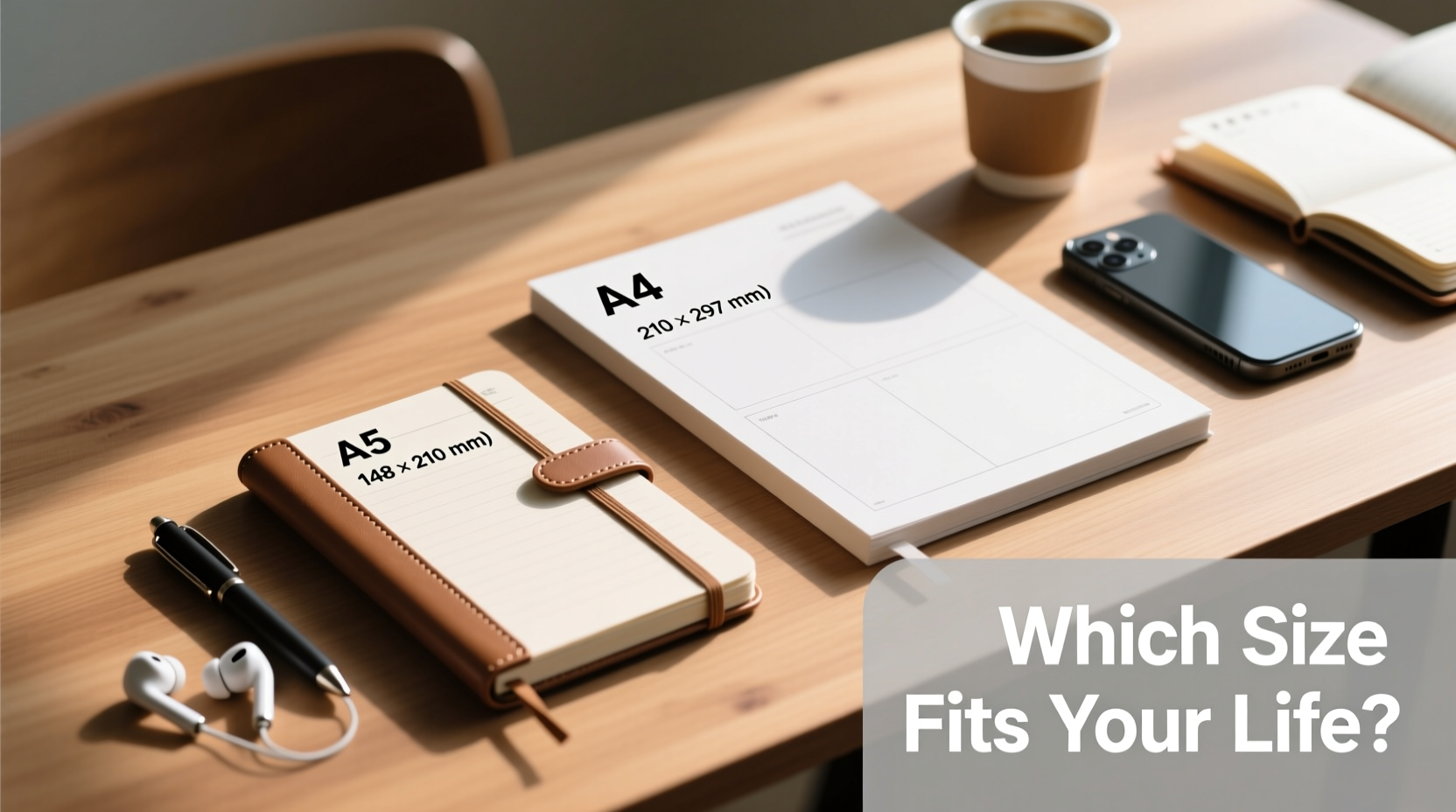
Portability is often the deciding factor when choosing between A5 and A4. An A5 notebook fits comfortably into most backpacks, tote bags, and even large coat pockets. Its compact size makes it ideal for commuters, travelers, and anyone who values minimalism. In contrast, A4 notebooks are bulkier and rarely slip into smaller bags without folding or bending.
Consider this: if your notebook doesn’t go with you, it won’t get used. Many people buy A4 pads hoping for more writing space, only to leave them on their desks. A5 wins in real-world mobility, encouraging consistent use across environments—cafes, meetings, transit, or outdoor brainstorming sessions.
Writing Space: Is Bigger Always Better?
At first glance, A4’s larger page seems superior. With nearly double the surface area of A5, it allows for expansive mind maps, wide tables, or detailed sketches. Architects, designers, and data-heavy professionals often prefer A4 for its generous layout flexibility.
However, more space doesn’t always translate to better productivity. Studies suggest that moderate constraints can enhance focus. A5 forces concise note-taking, reducing the tendency to overfill pages with disorganized thoughts. For bullet journals, daily logs, or quick meeting summaries, A5 provides enough room without encouraging sprawl.
Moreover, handwriting size varies by individual. If you write small or use narrow ruled paper, A5 accommodates full sentences and diagrams just as effectively as A4. But if you have large handwriting or frequently draw complex diagrams, A4 may be necessary to avoid crammed content.
Comparison Table: A5 vs A4 at a Glance
| Feature | A5 (148 x 210 mm) | A4 (210 x 297 mm) |
|---|---|---|
| Portability | Excellent – fits in most bags | Limited – requires larger bag |
| Page Area | ~310 cm² | ~624 cm² |
| Ideal For | Daily notes, journals, travel | Sketching, spreadsheets, drafting |
| Pocket Compatibility | Fits most jacket and pants pockets | Rarely fits standard pockets |
| Desk Usability | Good – manageable size | Excellent – spacious layout |
| Weight (Average) | 150–250g | 300–500g |
Real-World Example: The Freelancer’s Dilemma
Sophie, a freelance copywriter based in Lisbon, initially used A4 notebooks for client briefs and project planning. She appreciated the space for outlining long-form content and sketching website structures. However, she found herself leaving the notebook at home because her crossbody bag couldn’t accommodate it. When inspiration struck during walks or coffee breaks, she had no way to capture ideas.
After switching to an A5 dotted notebook, Sophie began carrying it everywhere. Though she occasionally missed the extra width for flowcharts, she adapted by using fold-out sticky notes or digital tools when needed. Her consistency improved dramatically—she filled three A5 books in six months versus one A4 in a year. The key wasn’t more space, but reliable access.
“Convenience trumps capacity every time when it comes to daily tools.” — James Reed, Productivity Consultant
When to Choose A5: Practical Scenarios
- On-the-go professionals: Sales reps, consultants, or field workers benefit from a notebook that moves with them.
- Bullet journalers: A5 is the gold standard for BuJo enthusiasts due to its balance of layout options and portability.
- Students attending multiple classes: Easier to carry alongside textbooks and laptops.
- Creative thinkers capturing fleeting ideas: Always having a notebook handy increases idea retention.
When A4 Makes More Sense
Despite its limitations in mobility, A4 remains the better choice in specific contexts:
- Detailed technical work: Engineers, coders, or mathematicians often need space for formulas, diagrams, or multi-column layouts.
- Classroom settings: Students in lecture halls may prefer A4 for splitting pages into notes and summaries.
- Artists and designers: Larger canvases allow for expressive sketching and comprehensive storyboarding.
- Home-based planners: If your notebook stays on a desk, A4 maximizes usable space without compromising accessibility.
Checklist: How to Decide Between A5 and A4
Answer these questions honestly to determine the best fit:
- Do I move between locations during the day?
- Will this notebook fit in my everyday carry bag?
- Do I write large or need wide margins?
- Am I primarily using it for structured tasks or freeform thinking?
- Do I currently abandon notebooks due to inconvenience?
- Would I benefit from using both sizes for different purposes?
If most answers lean toward mobility and simplicity, A5 is likely your best bet. If space and detail dominate your needs, A4 deserves serious consideration.
Frequently Asked Questions
Can I use A5 for academic note-taking?
Yes, especially in seminars or portable study setups. Many university students prefer A5 for its ease of transport. Use lined or graph paper depending on subject matter. For subjects requiring extensive diagrams (like biology or engineering), supplement with digital tools or occasional A4 sheets.
Is A5 too small for left-handed writers?
Not necessarily. While A4 offers more clearance, A5 is still wide enough for most left-handed users, particularly if you write at a slight angle or use quick-drying ink. Some brands offer reverse-bound A5 notebooks (spiral on the right) specifically for left-handers.
Are refills available for both sizes?
A4 refill pads are widely available in office supply stores. A5 has seen a surge in refill options thanks to the bullet journal trend—brands like Leuchtturm1917, Moleskine, and Rhodia offer premium inserts. Check compatibility if using third-party covers.
Final Recommendation: Match Size to Lifestyle
The “better” notebook isn’t defined by size alone—it’s determined by how well it integrates into your daily rhythm. A5 excels when consistency and portability matter most. It reduces friction between intention and action, making it easier to record thoughts, track habits, and stay organized throughout the day.
A4 shines in stationary, high-output environments where spatial freedom enhances creativity or precision. It’s not inferior—just less suited to constant movement.
Many experienced users adopt a hybrid approach: an A5 for daily logging and an A4 for weekly reviews, project mapping, or creative development. This tiered system leverages the strengths of both formats.
Take Action Today
Don’t let indecision keep you from starting. Try an A5 notebook for one week as your primary tool. Carry it everywhere. Notice how often you reach for it. Then test an A4 in a controlled environment like your office or study. Compare usage frequency, comfort, and output quality.




 浙公网安备
33010002000092号
浙公网安备
33010002000092号 浙B2-20120091-4
Comments
No comments yet. Why don't you start the discussion?