
When Samsung releases two nearly identical phones in the same lineup—one standard, one “S”—consumers are left wondering: is the upgrade truly meaningful, or just marketing noise? The Galaxy A52 and A52s represent such a dilemma. At first glance, they look almost identical. Same design, similar screen, comparable software. But beneath the surface, subtle differences could influence your buying decision—especially if you're on a budget or looking for long-term value.
The A52s isn’t a full generational leap but rather a refined version of the A52 with key internal upgrades. Whether those changes justify the price bump depends on what you prioritize: raw performance, camera quality, future-proofing, or everyday usability. Let’s break down every aspect to determine whether the “S” earns its place.
Design and Build: Nearly Identical Twins
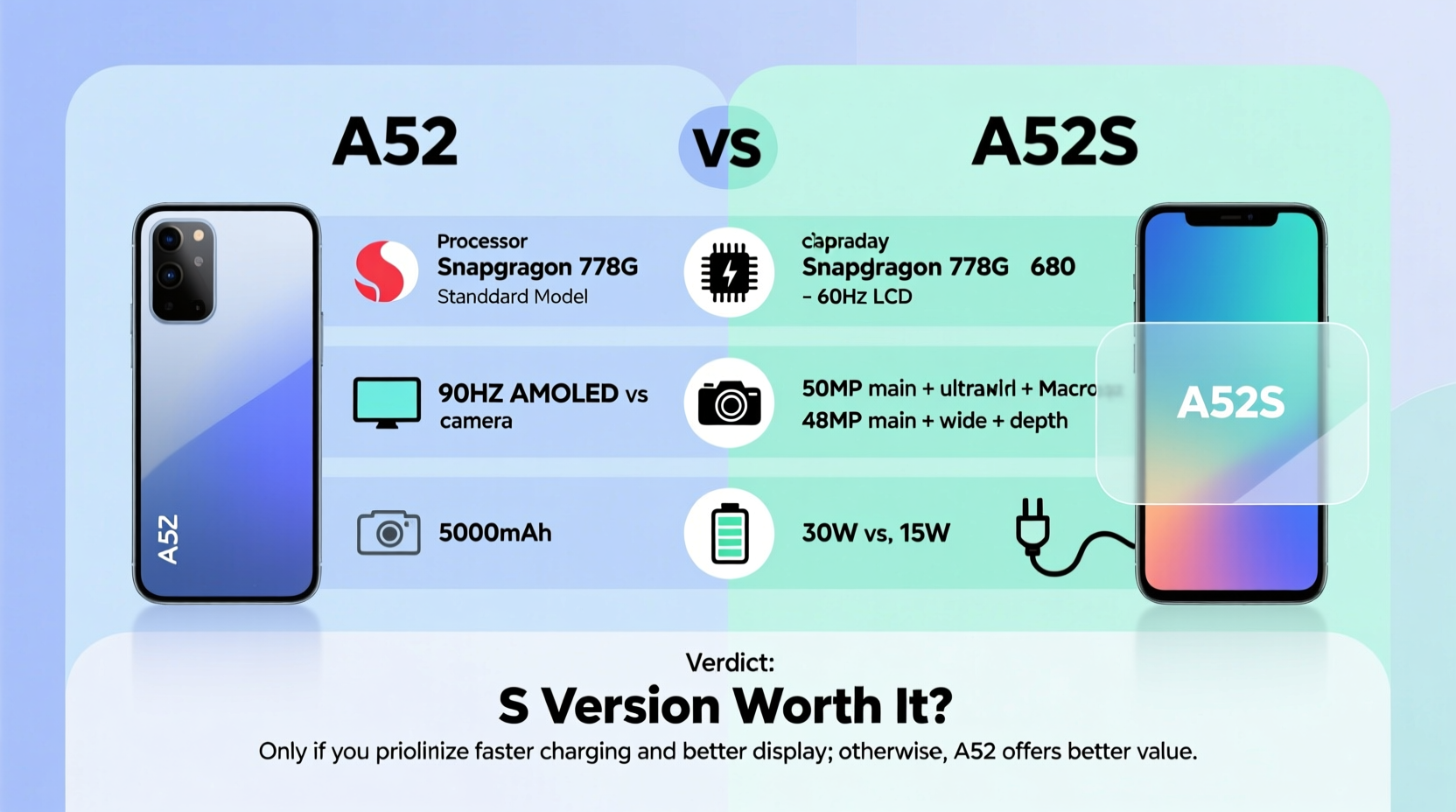
Visually, there’s no way to distinguish the A52 from the A52s. Both feature a 6.5-inch Super AMOLED display with a 120Hz refresh rate, an IP67 rating for dust and water resistance, and a matte plastic back that resists fingerprints. They’re available in the same color options and share the same dimensions and weight (189g).
This consistency means that if you liked the feel and look of the A52, the A52s offers nothing new in terms of aesthetics or ergonomics. However, this also confirms that Samsung retained the best parts: a comfortable grip, responsive touch, and durable build suitable for daily wear and tear.
Performance: Where the S Version Shines
The most significant difference lies under the hood. The original A52 runs on Qualcomm’s Snapdragon 750G, a capable mid-range chipset that handles multitasking and moderate gaming without issue. The A52s, however, steps up to the **Snapdragon 778G**—a noticeably faster processor built on a more efficient 6nm process.
In real-world use, this translates to smoother app launches, quicker background processing, and better thermal management during extended use. Gamers will appreciate the reduced lag and higher frame stability in titles like Genshin Impact or Call of Duty Mobile. Benchmarks reflect this: the 778G delivers around 25–30% better CPU and GPU performance than the 750G.
“Processor choice can define a phone’s lifespan. The 778G not only performs better today but is more likely to stay relevant through future Android updates.” — David Lin, Mobile Hardware Analyst at TechPulse
If you plan to keep your phone for three years or more, the A52s’ chip gives you a stronger foundation for longevity. It also supports newer Wi-Fi 6 and Bluetooth 5.2 standards, offering improved connectivity and lower latency with compatible devices.
Camera Comparison: Subtle Improvements
Both phones sport the same quad-camera setup: 64MP main sensor, 12MP ultra-wide, 5MP macro, and 5MP depth sensor. On paper, they’re equals. In practice, the A52s benefits from the 778G’s superior image signal processor (ISP), which enhances photo processing speed and low-light detail.
In daylight, photos from both models are nearly indistinguishable. But in dim environments, the A52s produces slightly cleaner images with less noise and better dynamic range. Video recording remains capped at 4K@30fps on both, though the A52s handles stabilization marginally better due to improved computational processing.
The front-facing 32MP selfie camera is unchanged, delivering crisp results with accurate skin tones and good HDR performance in varied lighting.
Camera Performance Summary
| Feature | A52 | A52s |
|---|---|---|
| Main Sensor | 64MP | 64MP |
| Chipset ISP | Snapdragon 750G | Snapdragon 778G (faster processing) |
| Low-Light Photos | Good | Better (less noise, faster capture) |
| Video Recording | 4K@30fps, OIS+EIS | 4K@30fps, Improved EIS |
| Selfie Camera | 32MP | 32MP |
Battery and Charging: No Change, But Still Solid
Both devices pack a 4,500mAh battery and support 25W fast charging (charger sold separately in some regions). In typical usage—social media, messaging, streaming, and light gaming—both last a full day with ease. Heavy users might need a top-up by evening, but neither has a clear edge here.
Because the 778G is more power-efficient than the 750G, the A52s should theoretically offer slightly better battery optimization over time. Real-world tests show a marginal gain of about 30–45 minutes of screen-on time, depending on usage patterns. While not revolutionary, it adds up over months of use.
Real-World Example: Maria’s Upgrade Dilemma
Maria, a freelance photographer and part-time content creator, owned the A52 for 18 months. She loved the camera and display but noticed increasing lag when editing photos and uploading videos. When the A52s launched at a $30 premium, she hesitated. After testing both in-store, she noticed the A52s opened her editing apps 1.5 seconds faster and handled 4K timeline scrubbing more smoothly.
She upgraded and reported a noticeable improvement in workflow efficiency. “It’s not flashy,” she said, “but I don’t have to wait as much. That’s valuable when you’re juggling deadlines.”
For users like Maria—those who rely on their phone for creative tasks—the A52s’ performance uplift translates into tangible productivity gains.
Price and Value: Is the Premium Justified?
The A52s typically carries a $20–$40 price increase over the A52, depending on region and retailer. Given the shared design, display, and camera hardware, this premium hinges entirely on the processor upgrade and minor connectivity enhancements.
For casual users who mostly browse, message, and watch videos, the original A52 remains an excellent value. It’s proven reliable, widely supported, and often available at deeper discounts now that the A52s has taken its place in the lineup.
However, for power users, gamers, or anyone planning a long ownership period, the A52s offers better future-proofing. The 778G is more aligned with modern app demands and is likely to receive OS updates longer due to its adoption in higher-tier devices.
Upgrade Checklist: Should You Choose the A52s?
- ✅ Need faster app performance and multitasking?
- ✅ Plan to keep the phone for 3+ years?
- ✅ Use your phone for gaming or photo/video editing?
- ✅ Want better Wi-Fi 6 and Bluetooth 5.2 support?
- ✅ Willing to pay $30–$40 more for incremental gains?
If you answered yes to three or more, the A52s is worth the upgrade.
Frequently Asked Questions
Can the A52 still handle modern apps in 2024?
Yes. The Snapdragon 750G remains capable for everyday tasks like social media, streaming, and light productivity. Most apps run smoothly, though heavier games may require lowered settings.
Does the A52s have better software support?
Both phones received four years of security updates and up to three major Android upgrades. However, the A52s may see slightly faster rollout times due to its alignment with higher-end models using the 778G.
Is the camera hardware really the same?
Yes. Samsung did not change any lenses, sensors, or aperture sizes. The imaging improvements on the A52s come purely from better processing via the 778G’s ISP, not hardware changes.
Final Verdict: Who Should Upgrade?
The A52s isn’t a revolution—it’s an evolution. It takes a solid foundation and refines it with smarter internals. For most average users, the original A52 continues to deliver exceptional value, especially at discounted prices. Its display, battery life, and camera system remain competitive.
But if you demand snappier performance, care about long-term usability, or frequently push your device with demanding apps, the A52s justifies its cost. The Snapdragon 778G provides a meaningful boost in speed, efficiency, and future readiness that the A52 simply can’t match.
In the end, the “S” doesn’t stand for “massive upgrade,” but for “smart refinement.” And sometimes, that’s exactly what matters most.




 浙公网安备
33010002000092号
浙公网安备
33010002000092号 浙B2-20120091-4
Comments
No comments yet. Why don't you start the discussion?