
When geometry enters the conversation, terms like “congruent” can feel intimidating. But at its core, congruence is a straightforward idea: two shapes are identical in size and shape, even if they’re positioned differently. When we say rectangles ABCD and WXYZ are congruent, we’re making a precise mathematical statement about their dimensions and structure. This article breaks down what that really means—without jargon overload—and shows how this concept applies in everyday reasoning and problem-solving.
What Does \"Congruent\" Mean in Geometry?
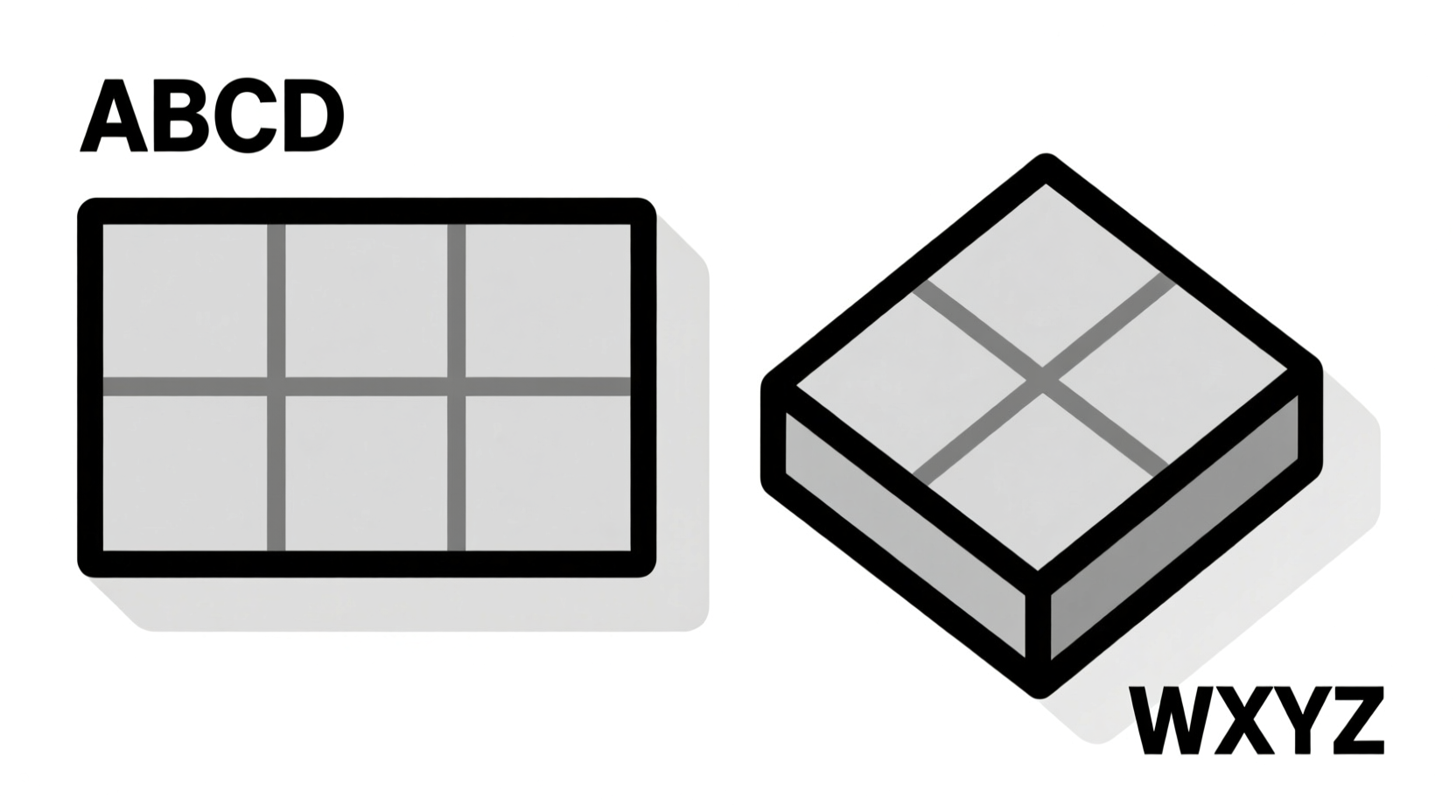
In geometry, two figures are congruent if one can be transformed into the other through a combination of translations (sliding), rotations (turning), and reflections (flipping)—but not resizing. For rectangles, this means every corresponding side must be equal in length, and every corresponding angle must be equal in measure.
All rectangles have four right angles (90°), so angle matching is automatic. That simplifies things: for two rectangles to be congruent, all you need to verify is that their lengths and widths match exactly.
For example, if rectangle ABCD has a length of 8 units and a width of 5 units, then rectangle WXYZ must also have sides measuring 8 and 5 units (in some order) to be congruent. The labeling (ABCD vs. WXYZ) doesn’t matter—what matters is the pair of side lengths and how they align.
How to Prove Rectangles ABCD and WXYZ Are Congruent
To prove two rectangles are congruent, follow these logical steps:
- Measure or identify the side lengths of both rectangles.
- Confirm that both pairs of opposite sides are equal within each rectangle (a property of all rectangles).
- Compare the length and width of ABCD to those of WXYZ.
- If both dimensions match—regardless of labeling order—the rectangles are congruent.
Suppose ABCD has sides AB = 6 cm, BC = 4 cm, CD = 6 cm, DA = 4 cm. Now suppose WXYZ has WX = 4 cm, XY = 6 cm, YZ = 4 cm, ZW = 6 cm. Even though the first side listed differs, the pair of dimensions (6 cm and 4 cm) is the same. Since rectangles don’t require a fixed starting point or direction, ABCD and WXYZ are congruent.
Corresponding Parts Matter
Congruence also implies that corresponding parts match. If ABCD ≅ WXYZ, then:
- Side AB corresponds to side WX (if aligned by vertex order)
- Angle B matches angle X
- Diagonal AC equals diagonal WY
This correspondence becomes crucial when solving proofs or applying congruence in coordinate geometry.
Common Misconceptions About Congruent Rectangles
People often confuse congruence with similarity. Here’s the key difference:
| Concept | Definition | Example |
|---|---|---|
| Congruent | Same shape and same size | Two rectangles both 5×3 units |
| Similar | Same shape, different size | One rectangle 5×3, another 10×6 |
You can think of similar rectangles as scaled versions of each other—like enlarging a photo without distorting it. Congruent rectangles are like perfect photocopies: no scaling, no stretching.
Another misconception: rotating or flipping a rectangle changes its identity. It doesn’t. A rectangle turned on its side is still congruent to the original. Orientation does not affect congruence.
“Congruence is about intrinsic properties, not placement. Two rectangles with identical side lengths are congruent, whether one is upside down or across the room.” — Dr. Lena Torres, Mathematics Educator
Real-World Example: Framing Identical Art Prints
Imagine you're framing two identical landscape photographs, each measuring 16 inches by 10 inches. You cut two wooden frames—one labeled Frame ABCD, the other Frame WXYZ. Even if you rotate one frame during assembly, the final product must match the other in dimensions to fit the print properly.
In this case, if both frames have outer dimensions of 16×10 inches, they are congruent rectangles. It doesn’t matter which corner you start from when labeling—ABCD and WXYZ represent the same geometric form. This ensures consistency in design, manufacturing, and installation.
This kind of precision is essential in carpentry, architecture, and graphic design. Mistaking similar for congruent could lead to mismatched tiles, misaligned panels, or poorly fitting furniture.
Step-by-Step Guide: Checking Rectangle Congruence
Use this clear process to determine if rectangles ABCD and WXYZ are congruent:
- Gather measurements: Obtain the lengths of all four sides for both rectangles.
- Verify rectangularity: Confirm that each figure has two pairs of equal, parallel sides and four right angles.
- Identify length and width: From each rectangle, pick the longer side as length, shorter as width (or note both pairs).
- Compare dimensions: Check if length₁ = length₂ and width₁ = width₂.
- Account for labeling: Remember that ABCD and WXYZ may label vertices in different orders (clockwise vs. counterclockwise).
- Conclude: If both dimensions match, the rectangles are congruent.
This method works whether you're working on paper, using coordinate grids, or handling physical objects.
Checklist: Ensuring Rectangle Congruence
Before concluding that ABCD and WXYZ are congruent, run through this checklist:
- ✅ Both shapes are definitely rectangles (four right angles, opposite sides equal)
- ✅ Side lengths of ABCD are known (e.g., 7 and 3 units)
- ✅ Side lengths of WXYZ are known (e.g., 7 and 3 units)
- ✅ No scaling factor exists between them (not just proportional, but identical)
- ✅ Labeling order does not prevent comparison (you’ve matched corresponding sides correctly)
If all boxes are checked, congruence is confirmed.
Frequently Asked Questions
Can two rectangles have the same area but not be congruent?
Yes. For example, a 6×4 rectangle and a 8×3 rectangle both have an area of 24 square units, but their side lengths differ. They are not congruent because congruence requires matching dimensions, not just area.
Does the order of letters in ABCD or WXYZ matter for congruence?
The labeling helps track vertex correspondence, but congruence depends on measurements. As long as sides and angles match, the rectangles are congruent—even if one is labeled clockwise and the other counterclockwise.
If ABCD is congruent to WXYZ, is WXYZ congruent to ABCD?
Absolutely. Congruence is symmetric. If shape A matches shape B, then shape B matches shape A. This is one of the foundational properties of geometric congruence.
Why This Concept Matters Beyond the Classroom
Understanding congruence isn’t just useful for passing geometry tests. It plays a role in design, engineering, and even digital interfaces. When creating templates for packaging, developers rely on congruent shapes to ensure consistency. In floor tiling, using congruent rectangles prevents gaps and misalignment.
Moreover, recognizing congruence builds spatial reasoning skills. It trains the mind to see beyond appearance and focus on measurable attributes—a skill valuable in data analysis, coding, and technical troubleshooting.
Final Thoughts
Saying that rectangles ABCD and WXYZ are congruent is more than a textbook phrase—it’s a declaration that two shapes are exact twins in the world of geometry. Whether rotated, flipped, or relabeled, their underlying measurements define their identity. By focusing on side lengths and angles, and setting aside visual distractions, you gain a clearer understanding of shape relationships.
Next time you see two rectangles labeled differently, don’t assume they’re different. Measure, compare, and apply the principles of congruence. You might just discover they’re perfectly matched.




 浙公网安备
33010002000092号
浙公网安备
33010002000092号 浙B2-20120091-4
Comments
No comments yet. Why don't you start the discussion?