
Selecting the perfect ring online can be exciting—until sizing becomes an issue. A ring that's too tight cuts off circulation; one that's too loose slips off and risks loss. Unlike in-store fittings, online shopping doesn’t allow you to try before you buy. That’s why accurately measuring your finger at home is essential. With the right method, common household tools, and attention to detail, you can determine your correct ring size from the comfort of your home—no guesswork required.
Why Ring Size Accuracy Matters
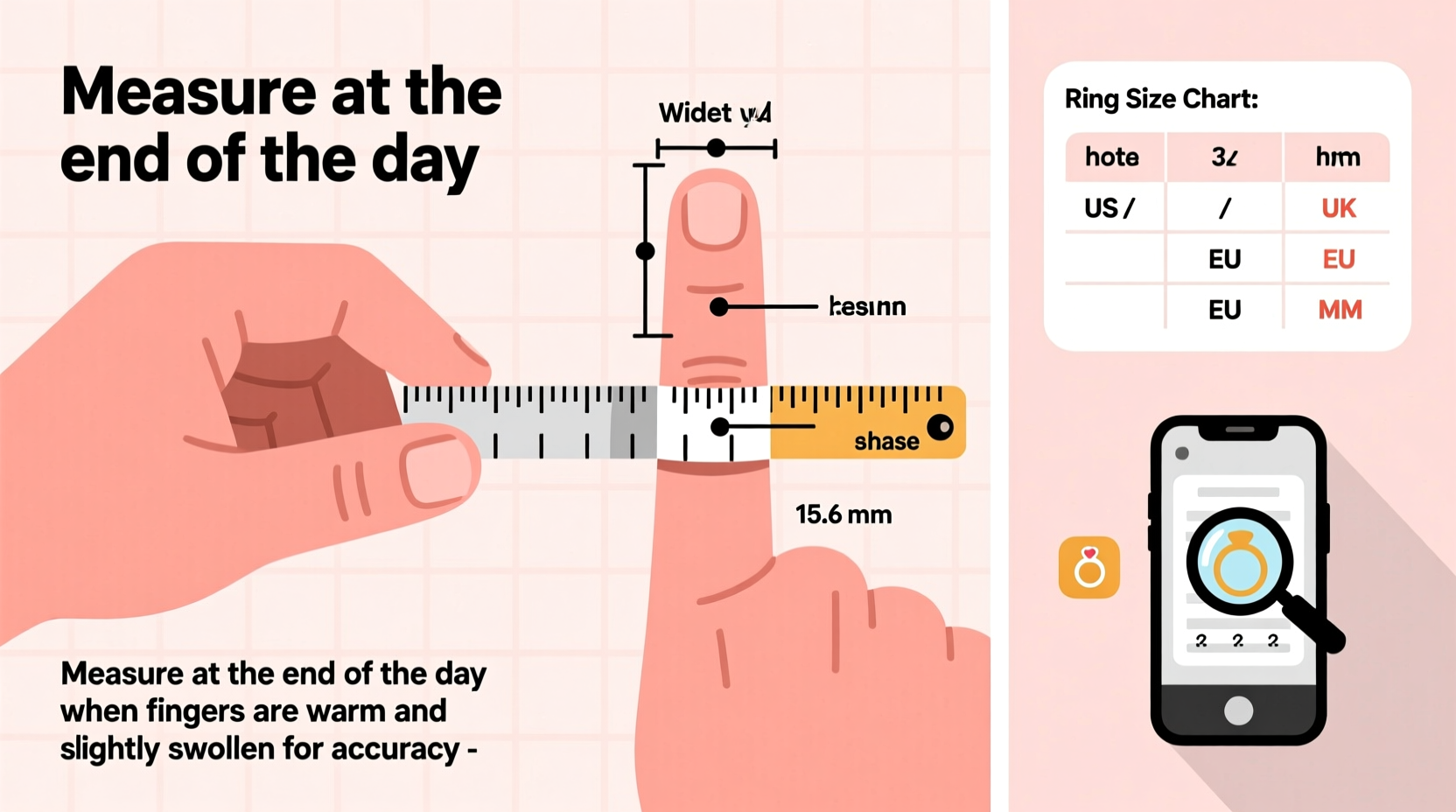
A properly fitting ring should slide over your knuckle with slight resistance and sit snugly on your finger without pinching. An ill-fitting ring not only causes discomfort but can also damage delicate bands or gem settings over time. Temperature, time of day, and even hydration levels affect finger swelling, making consistent measurement practices critical. According to jewelers at the Gemological Institute of America (GIA), up to 30% of online ring returns are due to incorrect sizing—a problem easily avoided with careful measurement.
“Getting the right ring size starts with understanding that fingers vary throughout the day. The best measurements are taken when hands are warm and slightly swollen, mimicking typical wear conditions.” — Sarah Lin, Certified Bench Jeweler and Sizing Consultant
Step-by-Step Guide: How to Measure Your Finger at Home
Follow this detailed process to ensure precision. This method works whether you're buying for yourself or surprising someone else.
- Gather Supplies: You’ll need a flexible measuring tape (or a strip of paper/string), a ruler, a pen, and a calculator.
- Choose the Correct Finger: Rings are typically worn on specific fingers (e.g., engagement rings on the left ring finger). Measure the exact finger where the ring will go—sizes can differ between hands and fingers.
- Measure at the Right Time: Fingers are largest in the evening due to natural fluid retention. For realistic fit, measure between 3 PM and 6 PM.
- Wrap the Paper or String: Cut a thin strip of paper (about 1/4 inch wide) or use a piece of non-stretchy string. Wrap it snugly around the base of your finger—the area just behind the knuckle.
- Mark the Overlap Point: Where the paper or string meets itself, make a clear mark with a pen.
- Measure the Length: Lay the strip flat on a ruler and measure from the start to the mark in millimeters. This is your finger’s circumference.
- Convert to Ring Size: Use a standard ring size chart to convert circumference to US, UK, or European sizes. For example, 51.5 mm ≈ US size 6, UK size L.
- Repeat Twice: Always take two additional measurements to confirm consistency. If results vary by more than 0.5 mm, retake them.
Alternative Method: Using a Well-Fitting Ring You Already Own
If you already own a ring that fits perfectly, use it to determine your size. This is especially helpful when buying for someone else.
- Place the ring on a millimeter ruler so the inner edge touches the zero line.
- Measure the inside diameter across the center to the opposite inner edge.
- Match the diameter (in mm) to a ring size chart. For instance, 16.5 mm internal diameter = US size 6.
This method eliminates variability caused by skin elasticity and provides highly accurate results if the reference ring sits at the same position on the finger as the new one will.
Ring Size Conversion Table
| US Size | UK Size | Internal Diameter (mm) | Circumference (mm) |
|---|---|---|---|
| 4 | H | 14.86 | 46.7 |
| 5 | J | 15.9 | 49.9 |
| 6 | L | 16.51 | 51.5 |
| 7 | N | 17.35 | 54.5 |
| 8 | P | 18.19 | 57.2 |
| 9 | R | 18.84 | 59.2 |
| 10 | T | 19.84 | 62.3 |
Keep this table handy when comparing international sizing standards. Many online retailers list sizes in US format, but brands from the UK or Europe may use their local systems.
Common Mistakes to Avoid
Even small errors can lead to incorrect sizing. Be mindful of these frequent pitfalls:
- Using stretchy string: Yarn or elastic thread expands, leading to oversized readings.
- Measuring a cold finger: Cold temperatures shrink blood vessels, reducing finger size by up to half a size.
- Ignoring knuckle size: If your knuckle is larger than the base of your finger, measure both. Some jewelers recommend sizing up slightly if the ring must pass over a large knuckle.
- Forgetting seasonal changes: Fingers swell in summer and contract in winter. If buying during extreme weather, consider averaging two seasonal measurements.
Mini Case Study: Emma’s Engagement Ring Surprise
Emma wanted to propose with a custom-designed engagement ring but didn’t want to ruin the surprise by asking her partner for her size. She borrowed a silver band her partner wore daily and measured its inner diameter using a digital caliper. It came to 17.3 mm—matching US size 7. To verify, she used the paper method late one afternoon while her partner was cooking (hands naturally warm). The circumference measured 54.6 mm, again confirming size 7. She ordered the ring confidently and delivered a flawless proposal. The ring fit perfectly, proving that indirect methods work when done carefully.
Checklist: Ensuring Accurate Ring Measurement at Home
- ✅ Measure at the end of the day when fingers are warm
- ✅ Use non-stretch material like paper or thread
- ✅ Take three separate measurements for consistency
- ✅ Measure the correct finger on the correct hand
- ✅ Confirm with a known-fitting ring if possible
- ✅ Account for wider bands (may require half-size larger)
- ✅ Double-check conversion using a reliable size chart
Frequently Asked Questions
Can I use a regular ruler instead of a measuring tape?
Yes. While a flexible tape is ideal, a strip of paper or string wrapped around the finger can be marked and then laid flat against a rigid ruler to get the circumference.
Do wide rings require a different size?
Yes. Wider bands (over 5 mm) cover more surface area and may feel tighter. Most jewelers recommend going up half a size for widths above 6 mm to maintain comfort.
What if my knuckle is bigger than the base of my finger?
In this common scenario, measure both the knuckle and the finger base. Choose a size that allows the ring to slide over the knuckle comfortably but isn’t loose at the base. Some opt for adjustable rings or spring inserts in such cases.
Final Tips for Confidence in Online Purchases
Many reputable jewelers offer free resizing within a certain period. However, not all rings can be resized—especially those with intricate designs, eternity bands, or tension settings. Whenever possible, prioritize accuracy upfront. If uncertain, order a ring sizer tool (a reusable metal band set in multiple sizes) for under $10. It’s the most precise home method available.
Conclusion
Measuring your finger for a ring at home doesn’t require professional tools—just patience, precision, and the right technique. By following this guide, you eliminate the stress of guessing and reduce the risk of costly returns. Whether it’s an engagement ring, wedding band, or fashion statement, getting the size right enhances both comfort and confidence. Take accurate measurements today, double-check your results, and shop online with peace of mind.




 浙公网安备
33010002000092号
浙公网安备
33010002000092号 浙B2-20120091-4
Comments
No comments yet. Why don't you start the discussion?