
When shopping for headphones or earbuds, you’ll often see terms like “active noise cancellation” and “passive noise isolation.” While both aim to reduce unwanted ambient sound, they operate on entirely different principles. Understanding these distinctions is crucial if you're trying to improve focus, sleep better, or enjoy music without distractions. The right choice depends on your environment, lifestyle, and listening preferences—not just marketing buzzwords.
Passive isolation relies on physical design to block sound, while active noise cancellation (ANC) uses electronic processing to neutralize noise. Neither is inherently superior; each has strengths and limitations that become apparent in real-world use.
How Passive Noise Isolation Works
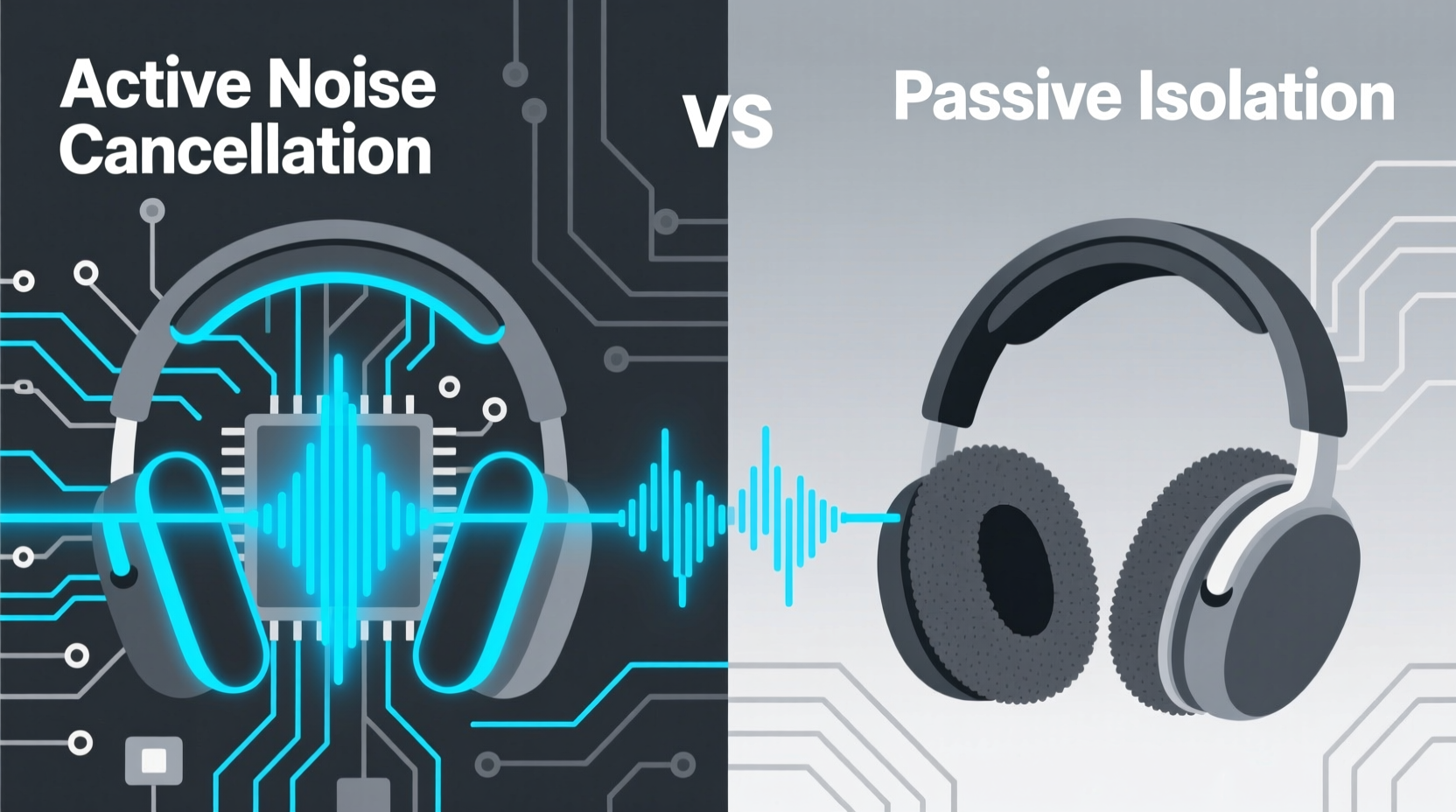
Passive noise isolation—also called passive noise reduction—is a mechanical method of blocking external sound using materials and fit. It works by creating a physical barrier between your ears and the outside world. Think of it as soundproofing: the denser and more complete the seal, the less noise gets through.
This type of isolation depends heavily on three factors:
- Ear cup or earbud design: Over-ear headphones with thick padding create a stronger seal than on-ear models.
- Material density: Memory foam, silicone, and rubber molds absorb and reflect sound waves before they reach the ear canal.
- Fit and seal: A proper fit is essential. Even small gaps can drastically reduce effectiveness, especially with high-frequency sounds like voices or alarms.
Because it’s purely physical, passive isolation doesn’t require power or electronics. This makes it reliable, energy-efficient, and always active. In-ear monitors (IEMs), for example, achieve excellent isolation when paired with custom-molded tips. Some audiophiles prefer passive-only designs for their simplicity and unaltered audio quality.
The Science Behind Active Noise Cancellation
Active noise cancellation takes a technological approach. Instead of blocking sound physically, ANC uses microphones, processors, and anti-noise signals to cancel out ambient noise electronically.
Here’s how it works:
- A built-in microphone picks up incoming environmental noise.
- A digital signal processor (DSP) analyzes the sound wave in real time.
- The system generates a new sound wave that is the exact inverse (anti-phase) of the original noise.
- This “anti-noise” wave combines with the ambient sound, effectively canceling it out through destructive interference.
The result? A noticeable reduction in constant low-frequency sounds like airplane engines, HVAC systems, or traffic rumble. However, ANC struggles with sudden or high-pitched noises such as conversations, door slams, or birdsong—these are too fast or too variable for the system to respond to effectively.
ANC requires power, which means it drains battery life. Most modern wireless headphones offer adjustable ANC levels—some even adapt automatically based on your surroundings. Transparency modes, which allow selective sound through, are also powered features built into ANC systems.
“Active noise cancellation excels at reducing predictable, low-frequency noise but can't match the consistency of a perfect physical seal for higher frequencies.” — Dr. Lena Torres, Audio Engineer at Acoustic Insights Lab
Key Differences: A Comparative Overview
To clarify the distinction, here's a side-by-side comparison of active noise cancellation and passive isolation across several critical categories:
| Feature | Active Noise Cancellation (ANC) | Passive Noise Isolation |
|---|---|---|
| Mechanism | Electronic—uses anti-noise signals | Mechanical—relies on physical barriers |
| Power Required | Yes—drains battery | No—always active |
| Best At Reducing | Low-frequency, continuous noise (e.g., engine hum) | Broad spectrum, especially mid-to-high frequencies (e.g., voices, clatter) |
| Effectiveness Against Sudden Sounds | Limited—too slow to react | Good—if seal is intact |
| Sound Quality Impact | Can introduce subtle hiss or coloration | Pure audio path—no processing artifacts |
| Cost | Higher due to tech complexity | Generally lower |
| Durability | Depends on electronics longevity | More durable—fewer failure points |
This table highlights a key insight: passive isolation is often more effective at blocking higher-frequency noise, while ANC dominates in suppressing steady background rumbles. The most effective headphones combine both—using a strong physical seal to block high frequencies and ANC to eliminate low-end drone.
Real-World Example: The Commuter’s Dilemma
Consider Sarah, a software developer who commutes daily via subway and works remotely from coffee shops. Her old earbuds offered minimal passive isolation, forcing her to crank volume to unsafe levels just to hear podcasts over train noise. After researching options, she invested in over-ear ANC headphones with memory foam earcups.
The change was immediate. On the subway, ANC canceled the deep rumble of the tracks, while the padded cups blocked station announcements and chatter. In cafes, she could focus without distraction—even during peak hours. But she noticed one limitation: when someone sat nearby and started talking directly to her, she still heard them clearly. That’s because human speech sits in the mid-to-high frequency range, where ANC is weakest—but passive sealing helped significantly when properly fitted.
Sarah eventually switched to hybrid earbuds with both ANC and silicone tips designed for deep insertion. This combination gave her the best of both worlds: electronic cancellation for background noise and physical sealing for vocal clarity. Her productivity improved, and she reported fewer headaches from auditory stress.
Step-by-Step Guide to Choosing the Right Option
Selecting between active noise cancellation and passive isolation isn’t an either/or decision—it’s about matching your needs with the right tools. Follow this process to make an informed choice:
- Assess Your Environment
Identify the types of noise you encounter most. Is it constant (airplane, fan) or intermittent (people talking, phones ringing)? Constant low-frequency noise favors ANC; variable or high-pitched noise responds better to passive sealing. - Determine Usage Duration
Long flights or workdays benefit from ANC’s fatigue-reducing effects. For short commutes or intermittent use, passive isolation may suffice and preserve battery life. - Test Fit and Comfort
Try different ear tip styles or headband pressures. A poor fit undermines both passive and active performance. Custom molds or memory foam can dramatically improve isolation. - Evaluate Battery Needs
If you forget to charge devices often, relying solely on ANC can leave you exposed when power runs out. Passive-only models remain functional indefinitely. - Compare Hybrid Models
Many premium options now combine both technologies. Look for terms like “hybrid ANC” or “advanced acoustic sealing” in product descriptions. - Listen Before You Buy (If Possible)
Visit a store or borrow a friend’s model. Pay attention not only to noise reduction but also to any pressure sensation or audio artifacts introduced by ANC.
Frequently Asked Questions
Does passive isolation work better than ANC?
It depends on the noise type. Passive isolation typically outperforms ANC for high-frequency sounds like voices, keyboards, or birds. ANC is superior for low-frequency, continuous noise such as engines or air conditioners. For comprehensive coverage, combining both yields the best results.
Can I use ANC and passive isolation together?
Absolutely—and you should. Most high-performance noise-canceling headphones are designed with both in mind. For example, Sony WH-1000XM5 and Bose QuietComfort models use plush earcups (passive) alongside sophisticated ANC (active). The synergy creates a much quieter experience than either method alone.
Does ANC damage hearing over time?
No credible evidence suggests ANC damages hearing. In fact, by reducing the need to increase volume in loud environments, ANC can help protect hearing. However, some users report a slight \"pressure effect\" or ear fatigue during prolonged use, which usually subsides when turning off ANC or taking breaks.
Actionable Checklist: Maximizing Noise Reduction
Use this checklist to get the most out of your headphones or earbuds, whether they rely on active, passive, or both methods:
- ✅ Ensure a tight, comfortable seal—replace worn ear tips or pads
- ✅ Enable ANC only when needed to conserve battery
- ✅ Choose deeper-insertion earbuds for better passive blocking
- ✅ Clean ear tips regularly to maintain seal integrity
- ✅ Use ANC in transport settings (planes, trains, cars)
- ✅ Switch to transparency mode when awareness is needed
- ✅ Store headphones in a case to preserve cushion quality
- ✅ Consider custom-molded earpieces for maximum passive isolation
Final Thoughts: Match Technology to Lifestyle
The debate between active noise cancellation and passive isolation isn’t about declaring a winner—it’s about understanding their roles. Passive isolation is foundational. Without a good seal, even the most advanced ANC will underperform. Meanwhile, ANC adds a powerful layer of comfort in monotonous sound environments, reducing cognitive load and enhancing concentration.
For travelers, remote workers, light sleepers, or anyone seeking mental quiet, the ideal solution often lies in integration. Modern audio gear increasingly reflects this: combining aerospace-grade ANC chips with anatomically tuned ear tips and ergonomic clamping force. But no technology replaces the importance of fit and usage habits.
Ultimately, your ears deserve more than guesswork. Invest time in testing options, prioritize comfort alongside specs, and remember that silence—true, restorative silence—is rarely achieved by one feature alone.




 浙公网安备
33010002000092号
浙公网安备
33010002000092号 浙B2-20120091-4
Comments
No comments yet. Why don't you start the discussion?