
Modern wireless headphones offer advanced audio technologies that go beyond just playing music. Two of the most impactful features—active noise cancellation (ANC) and transparency mode—serve very different purposes. Understanding when to use each can dramatically improve your listening experience, productivity, and even personal safety. These aren’t just gimmicks; they’re tools designed for real-world scenarios, from crowded commutes to focused work sessions and social interactions.
The key lies not in choosing one over the other permanently, but in knowing when each is most effective. Misusing them can lead to fatigue, missed information, or unnecessary isolation. This guide breaks down how both technologies work, their strengths and limitations, and exactly when to switch between them based on your surroundings and goals.
How Active Noise Cancellation Works
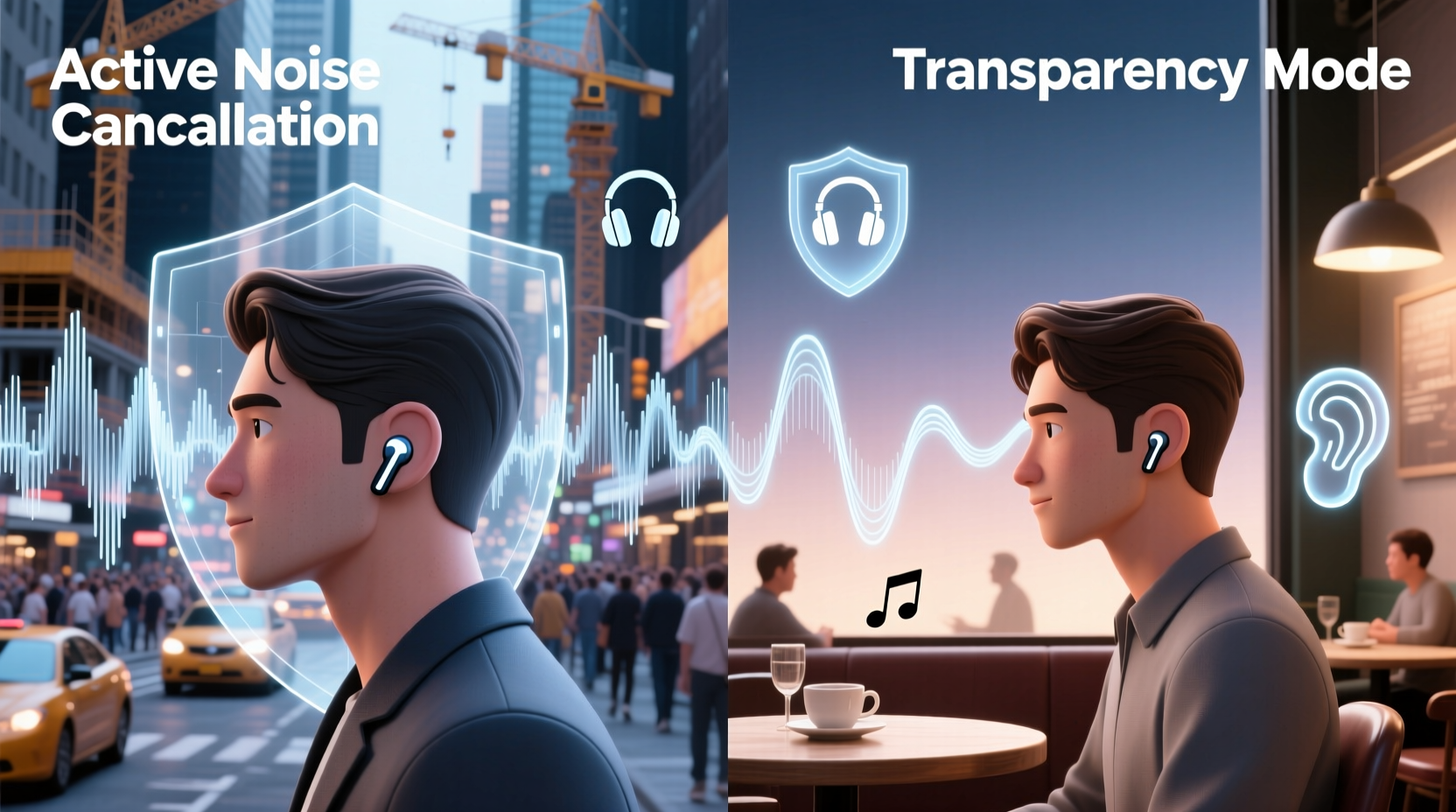
Active noise cancellation uses built-in microphones to detect external sounds, then generates inverse sound waves—anti-noise—that cancel out incoming noise before it reaches your ears. This process, known as destructive interference, is especially effective against low-frequency, consistent sounds like airplane engines, HVAC systems, or traffic rumble.
ANC doesn’t eliminate all noise. It struggles with sudden, high-pitched, or irregular sounds such as voices, door slams, or construction clatter. However, it excels at creating a quiet bubble, reducing auditory fatigue during long periods in noisy environments.
There are two main types: feedforward and feedback ANC. Feedforward systems use outward-facing mics to anticipate noise, while feedback systems use inward-facing mics to monitor what’s already inside the earcup. Most premium headphones now use hybrid ANC, combining both for broader coverage.
What Is Transparency Mode—and Why It Matters
Transparency mode, sometimes called ambient mode or hear-through mode, does the opposite of ANC. Instead of blocking sound, it allows external noise to pass through—or even amplifies it—so you can stay aware of your surroundings while wearing headphones.
This feature uses the same microphones that power ANC, but instead of canceling noise, they capture environmental sounds and pipe them into your earcups in real time. The result is a natural-sounding blend of your audio and the outside world, letting you hear conversations, announcements, or approaching vehicles without removing your headphones.
Transparency mode is essential for safety and social engagement. Imagine walking across a busy street while listening to music—without hearing horns or cyclists—or trying to chat with a colleague while your headphones are still on. In these cases, transparency mode bridges the gap between immersion and awareness.
“Transparency mode isn’t just a convenience—it’s a critical safety feature. Being able to hear your environment prevents accidents and improves situational awareness.” — Dr. Lena Park, Audio Ergonomics Researcher, MIT Media Lab
When to Use ANC: Scenarios That Demand Focus
Active noise cancellation shines in situations where minimizing distractions is the priority. Here are common use cases:
- Air travel: Engine drone and cabin pressure fluctuations create a fatiguing sonic backdrop. ANC reduces this by up to 20–30 dB, making long-haul flights significantly more comfortable.
- Open-plan offices: Keyboard clatter, phone calls, and office chatter disrupt deep work. ANC helps maintain cognitive flow by dampening mid-to-low frequency disturbances.
- Public transit: Subway screeches, bus engines, and station announcements contribute to sensory overload. ANC filters the worst of it, allowing you to focus or relax.
- Noisy home environments: If you're working from home with loud roommates, construction, or household appliances, ANC creates a personal sanctuary.
- Sleep and relaxation: Some users wear ANC headphones to sleep, especially in noisy urban areas. The reduction in ambient noise can support better sleep onset and continuity.
However, prolonged ANC use in complete silence can cause a sensation some describe as “ear pressure” or “underwater feeling,” due to the absence of natural ambient cues. This is more common with over-ear designs that also provide passive isolation. Taking breaks every 60–90 minutes helps mitigate discomfort.
When to Switch to Transparency Mode: Staying Connected
Transparency mode becomes essential whenever interaction or environmental awareness is required. Relying solely on ANC in these situations can be inconvenient or even dangerous.
Consider these everyday moments:
- Walking or cycling in urban areas: You need to hear traffic signals, horns, sirens, and verbal warnings. Transparency mode keeps you safe without sacrificing your playlist.
- Having quick conversations: Instead of pulling off one earcup or pausing music manually, activate transparency mode to talk hands-free while staying connected to your audio.
- Waiting for announcements: At airports, train stations, or events, missing a boarding call or schedule change can be costly. Transparency lets you stay informed without constant vigilance.
- Working out at the gym: While listening to music, you may need to hear staff instructions, equipment clangs, or someone approaching your machine. Awareness enhances both safety and courtesy.
- Parenting or caregiving: If you're listening to a podcast while watching children or assisting someone who needs attention, transparency ensures you don’t miss important cues like crying or calling your name.
Some high-end models, like Apple AirPods Pro and Sony WF-1000XM5, offer adaptive transparency, which automatically adjusts the level of ambient sound based on volume and environment. For instance, they might amplify speech frequencies when someone speaks near you—a subtle but powerful enhancement.
Comparison: ANC vs Transparency Mode at a Glance
| Feature | Active Noise Cancellation (ANC) | Transparency Mode |
|---|---|---|
| Primary Purpose | Reduce external noise | Allow external noise in |
| Best For | Focus, relaxation, travel | Safety, communication, awareness |
| Ideal Environments | Airplanes, offices, public transit | Streets, gyms, homes with kids |
| Battery Impact | Higher consumption | Moderate to high (similar to ANC) |
| Natural Sound Quality | Altered; can feel pressurized | More natural; varies by model |
Step-by-Step Guide: Choosing the Right Mode Automatically
Many modern headphones allow you to set rules or triggers for automatic switching. Here’s how to optimize your setup:
- Check your headphone app: Whether it’s Sony Headphones Connect, Bose Music, or Apple’s Settings, explore the ambient sound controls. Look for options like “Auto ANC,” “Adaptive Sound Control,” or “Wear Detection.”
- Enable motion-based switching: Some models detect walking or running and automatically switch to transparency mode. This is ideal for commuters.
- Set location-based profiles: Using apps like Shortcuts (iOS) or Tasker (Android), configure your headphones to enable ANC when you arrive at the airport or office, and switch to transparency when you reach the gym or park.
- Use voice commands: Assign a wake word (“Hey Siri,” “OK Google”) to toggle modes hands-free. Say “Turn on transparency mode” when stepping outside.
- Test and refine: Spend a few days experimenting. Note when you felt isolated when you shouldn’t have, or distracted when you needed focus. Adjust sensitivity and triggers accordingly.
Mini Case Study: The Daily Commute of a Remote Worker
Jamal, a software developer in Chicago, works remotely but commutes weekly to client meetings. His journey includes a 15-minute walk through downtown, a 30-minute subway ride, and a final 10-minute walk to the office.
Previously, he kept ANC on the entire way, only removing his AirPods Pro when someone spoke to him. He often missed train announcements and once nearly walked into a construction zone because he didn’t hear warning signals.
After adjusting his settings, he now uses adaptive transparency during walks, which activates automatically when motion is detected. On the subway, ANC kicks in as soon as he boards. When exiting, transparency resumes. He receives notifications only for major delays via his calendar app, reducing auditory clutter.
The result? Fewer close calls, less stress, and uninterrupted coding sessions on the train. He estimates he saves 20 minutes per week just by not missing stops or doubling back.
Common Mistakes to Avoid
- Using ANC in unsafe outdoor settings: Never rely on full noise cancellation while walking, biking, or driving. It impairs spatial awareness and reaction time.
- Leaving transparency on during deep work: Allowing every keyboard tap or hallway laugh into your ears defeats the purpose of using premium headphones for focus.
- Ignoring battery drain: Both ANC and transparency consume significant power. If you’re on a long trip, consider turning both off and using passive isolation when possible.
- Assuming all transparency modes sound natural: Lower-tier models may produce metallic or artificial-sounding ambient audio. Test yours in a quiet room before relying on it.
- Forgetting to clean microphone ports: Dirt or earwax on ANC/transparency mics degrades performance. Clean gently with a dry brush monthly.
Frequently Asked Questions
Can I use ANC and transparency mode at the same time?
No—these modes are mutually exclusive. ANC cancels noise; transparency allows it in. However, some headphones offer a middle ground called “ambient Sound Control” or “Adjustable ANC,” letting you fine-tune how much external sound gets through. This isn’t both modes simultaneously, but a blended setting.
Does transparency mode affect audio quality?
Yes, slightly. Because external sound is mixed with your media, the overall listening experience can feel less immersive. Higher-end models do a better job blending inputs seamlessly. Also, transparency often introduces a faint hiss or electronic artifact, especially in quiet rooms.
Is ANC bad for my ears?
No, ANC is not harmful. The anti-noise waves are inaudible and pose no risk to hearing. However, the pressure-like sensation some users report—often called “eardrum suck”—can be uncomfortable. This usually subsides with use or by adjusting fit. If discomfort persists, try shorter sessions or switch to transparency mode periodically.
Maximize Your Listening Intelligence
The real advantage of owning smart headphones isn’t just superior sound—it’s the ability to adapt your auditory environment on demand. Treating ANC and transparency mode as situational tools, rather than default settings, transforms how you interact with sound throughout the day.
Think of it as auditory intelligence: knowing when to shut out the world and when to tune into it. With practice, switching between modes becomes second nature—like adjusting sunglasses for bright sunlight or stepping aside for oncoming traffic.
Your ears are your connection to both your inner focus and the outer world. Respect both. Use ANC to protect your attention, and transparency to protect your awareness. The best listening experience isn’t the quietest or the loudest—it’s the most appropriate.




 浙公网安备
33010002000092号
浙公网安备
33010002000092号 浙B2-20120091-4
Comments
No comments yet. Why don't you start the discussion?