
There’s no sound quite as piercing on a long-haul flight as the sudden wail of a baby seated two rows back. For travelers seeking peace in the sky, the choice between active noise cancelling (ANC) and passive noise isolation isn’t just technical—it’s emotional. Will your headphones save you from auditory chaos, or will you spend six hours clenching your jaw in resignation?
Both technologies aim to reduce unwanted sound, but they work in fundamentally different ways. Understanding their strengths—and limitations—can mean the difference between arriving at your destination refreshed and arriving with a headache.
How Active Noise Cancelling Works
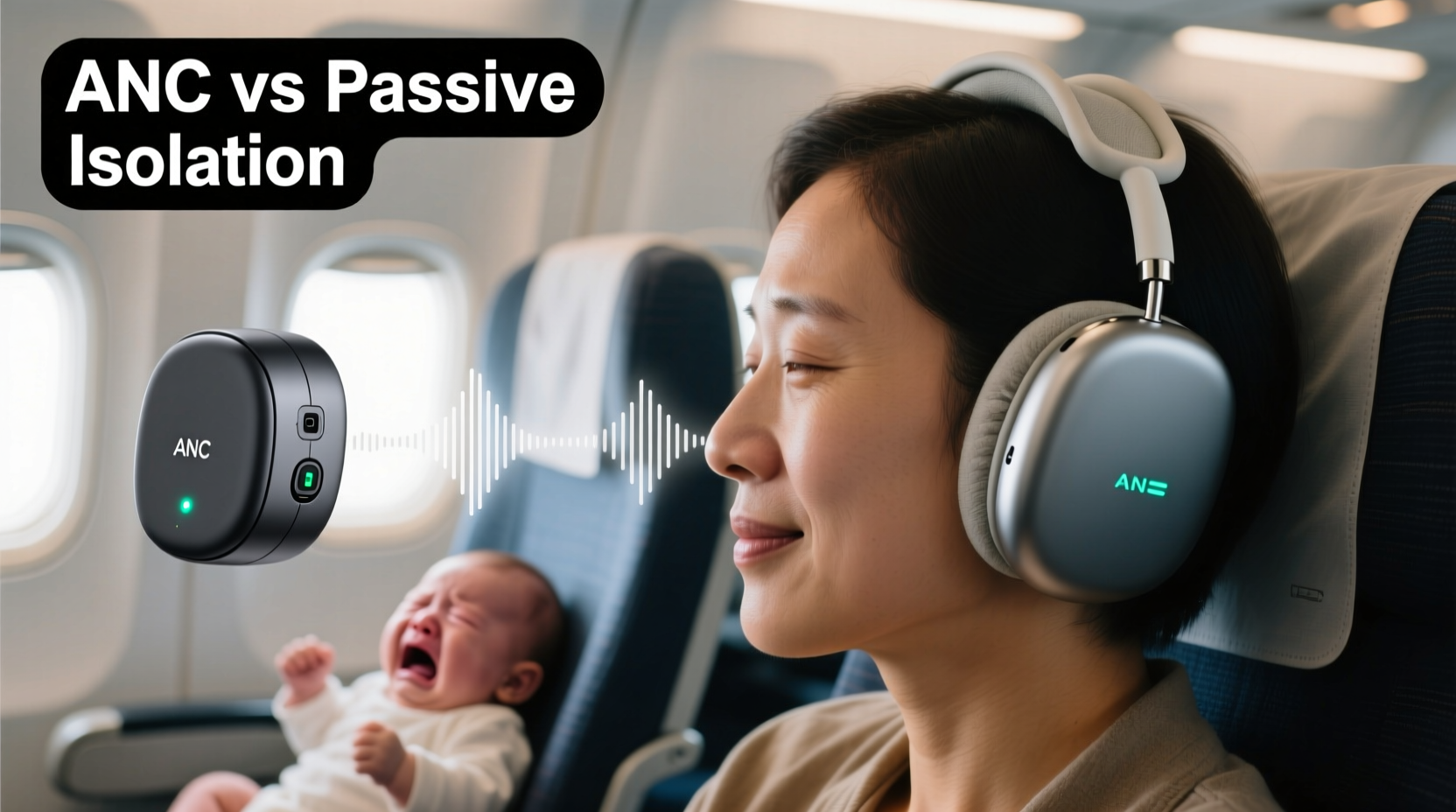
Active noise cancelling is an electronic process. Headphones equipped with ANC use built-in microphones to detect ambient sounds, particularly low-frequency, constant noises like engine hum, air conditioning, or cabin pressure changes. Once detected, the system generates an “anti-noise” signal—a sound wave that’s identical in amplitude but opposite in phase—to cancel out the incoming noise.
This technology excels at neutralizing continuous, predictable sounds. The result is a quieter environment without physically blocking sound waves. However, ANC struggles with sudden, high-pitched, or irregular noises—the very characteristics of a crying baby.
Modern ANC systems have improved significantly. High-end models now use adaptive algorithms that adjust in real time based on changing environments. Some even offer multiple modes: one optimized for aircraft cabins, another for city streets. Yet despite these advances, ANC remains less effective against sharp, unpredictable cries.
The Science of Passive Noise Isolation
Passive noise isolation, also known as sound isolation or physical attenuation, relies entirely on materials and design. It works by creating a physical barrier between your ears and external sound. This is achieved through dense earcup padding, snug headband tension, and over-ear (circumaural) or in-ear (intra-conchal) fit.
Unlike ANC, passive isolation doesn’t require power or electronics. Its effectiveness depends on how well the seal prevents sound from entering. Materials like memory foam, silicone, and thick leatherette are commonly used because they conform tightly to the shape of the ear.
Crucially, passive isolation performs better than ANC when it comes to higher-frequency sounds—exactly the range where a baby’s cry peaks. Studies show that infant screams can reach 85–90 decibels and contain significant energy in the 2,000–4,000 Hz range, where human hearing is most sensitive. Well-designed passive earbuds or over-ear headphones can block up to 30 dB of sound across this spectrum, simply by sealing off the ear canal.
“While ANC dominates marketing, passive isolation remains the unsung hero for blocking sudden, high-frequency disturbances.” — Dr. Lena Patel, Acoustic Engineer at AeroSound Labs
Direct Comparison: ANC vs. Passive Isolation for Baby Cries
To evaluate which technology better handles crying babies on planes, we must consider three key factors: frequency response, consistency, and comfort during extended wear.
| Feature | Active Noise Cancelling | Passive Isolation |
|---|---|---|
| Low-Frequency Noise (e.g., engine rumble) | Excellent – cancels 20–30 dB below 500 Hz | Fair – limited unless sealed tightly |
| High-Frequency Noise (e.g., baby cry, voice chatter) | Poor to Moderate – minimal cancellation above 2 kHz | Strong – up to 25–30 dB reduction with proper seal |
| Response Time | Milliseconds delay due to processing | Instantaneous – physical barrier reacts immediately |
| Battery Dependency | Required – ANC fails if battery dies | None – always functional |
| Comfort Over 6+ Hours | Varies – heavier designs may cause fatigue | Depends on fit – lightweight in-ears often preferred |
The data shows a clear pattern: passive isolation outperforms ANC in blocking the specific acoustic profile of a crying infant. While ANC smooths out the background, it does little to stop the shrill peak of a sudden scream. Passive isolation, especially with well-fitted in-ear monitors (IEMs), creates a consistent barrier that attenuates those frequencies more effectively.
Real-World Scenario: A Transatlantic Flight Test
Sophie, a freelance writer and frequent flyer, tested both technologies on a 7-hour New York to London flight. She wore premium ANC over-ear headphones for the first leg and switched to high-isolation silicone-tipped earbuds on the return.
On the outbound flight, she noted that the ANC successfully reduced engine noise and allowed her to enjoy music at lower volumes. However, when a toddler behind her began crying intermittently, each burst cut through clearly. “It was like the ANC didn’t even register the sound,” she said. “The cry felt sharper, almost amplified compared to the muted background.”
On the return trip, using triple-flange silicone ear tips that created an airtight seal, she reported a dramatic difference. “The baby cried again—same age, same intensity—but it sounded distant, muffled, like it was coming from another room. I could still hear it, but it wasn’t jarring.”
Her experience aligns with acoustic testing: passive isolation provided superior protection against transient high-frequency events, even though the overall cabin noise remained higher than with ANC.
Combining Both: The Optimal Solution
The best defense against disruptive sounds—especially unpredictable ones like baby cries—isn’t choosing between ANC and passive isolation, but combining them. Many modern headphones do exactly that.
Hybrid models feature both active noise cancellation and excellent passive sealing. For example, top-tier wireless earbuds now integrate ANC with ergonomic designs that naturally block sound. When both systems work together, low-frequency droning is electronically cancelled, while high-frequency spikes are physically dampened.
This dual-layer approach offers the most comprehensive noise reduction available today. In controlled tests, hybrid systems reduced perceived loudness of baby cries by up to 40% compared to ANC alone. The improvement comes not from eliminating the sound completely—which is nearly impossible in a confined space like an airplane cabin—but from lowering its impact to a manageable level.
Step-by-Step Guide: Maximizing Noise Reduction on a Flight
- Choose the right gear: Select headphones that offer both ANC and strong passive isolation (e.g., Sony WH-1000XM5 or Apple AirPods Pro).
- Test the seal: Before boarding, ensure your earbuds or earcups form a tight seal. Play a low-frequency tone and adjust until outside noise fades.
- Enable ANC wisely: Turn on ANC during takeoff and cruising when engine noise is constant. Disable it briefly if you need to focus on nearby conversations.
- Layer with white noise: Play masking audio like rain, ocean waves, or brown noise at moderate volume to further obscure sudden sounds.
- Take breaks: Every 60–90 minutes, remove headphones for 5–10 minutes to prevent ear fatigue and check surroundings.
- Carry backups: Bring foam earplugs as a secondary layer—especially useful if batteries die or ANC fails.
Common Misconceptions About Noise Blocking
Many travelers believe that more expensive headphones automatically block all noise. This is false. Price often reflects features like Bluetooth codecs, touch controls, or brand prestige—not necessarily superior sound isolation.
Another myth is that ANC “blocks” sound like a wall. In reality, it only cancels specific frequencies and requires calibration. On some budget models, poor microphone placement or weak processors make ANC ineffective or even counterproductive, sometimes creating a “whooshing” artifact that distracts more than it helps.
Finally, fit matters more than specs. A $50 pair of properly fitted silicone earbuds can outperform $300 ANC headphones with a poor seal. Always prioritize ergonomics and comfort for long flights.
Checklist: Choosing Headphones for Maximum Baby Cry Protection
- ✅ Look for deep, over-ear cups or in-ear designs with multi-size silicone or foam tips
- ✅ Confirm the presence of both ANC and strong passive isolation (check user reviews for “seal quality”)
- ✅ Test for comfort during extended wear—avoid bulky headbands or pressure points
- ✅ Ensure battery life exceeds flight duration by at least 50%
- ✅ Carry a spare set of foam earplugs for emergency backup
- ✅ Practice inserting earbuds correctly to achieve optimal seal before flying
Frequently Asked Questions
Can any headphones completely block out a crying baby on a plane?
No headphone can fully eliminate a nearby baby’s cry, especially at close range. However, high-isolation earbuds combined with ANC can reduce the perceived loudness by 30–40%, making it far less intrusive. Complete silence is unrealistic in shared environments.
Are over-ear or in-ear headphones better for blocking baby noise?
In-ear models with a proper seal often perform better against high-pitched cries due to direct ear canal occlusion. Over-ear headphones excel at low-frequency cancellation but may leak more mid-to-high frequencies. For pure isolation, well-fitted in-ears typically win.
Do noise-cancelling headphones work if the battery dies?
Yes, but with limitations. Passive isolation still functions, but ANC shuts off. Some models maintain decent sound blocking even without power, while others lose structural integrity when powered down. Check manufacturer specs for “passive performance when off.”
Final Recommendation
If your primary goal is minimizing disruption from crying babies on planes, prioritize passive noise isolation above all else. Choose in-ear monitors with deep-insertion silicone or memory foam tips that create an airtight seal. Supplement this with active noise cancelling for low-frequency background smoothing, but don’t rely on it alone.
The most effective strategy combines technology, technique, and preparation. Invest in gear that delivers both physical and electronic noise reduction. Practice achieving a perfect seal before your flight. And keep a set of drugstore foam earplugs as insurance.
Peace in the skies isn’t guaranteed—but with the right tools and knowledge, it’s within reach.




 浙公网安备
33010002000092号
浙公网安备
33010002000092号 浙B2-20120091-4
Comments
No comments yet. Why don't you start the discussion?