
In open-plan offices, co-working spaces, or even at home with roommates nearby, office chatter is one of the most common distractions. Whether it’s a colleague on a loud phone call, overlapping conversations, or the constant hum of team discussions, unwanted sound can disrupt focus, reduce productivity, and increase mental fatigue. Many turn to headphones as a solution—but not all noise-blocking technologies are created equal. The two primary methods—active noise cancelling (ANC) and passive isolation—work in fundamentally different ways, each with strengths and limitations when it comes to silencing human voices and ambient office noise.
Understanding how these technologies function, where they excel, and how they perform against speech frequencies is essential for making an informed decision. This article breaks down the science, compares real-world performance, and provides actionable guidance to help you choose the right solution for your work environment.
How Active Noise Cancelling Works
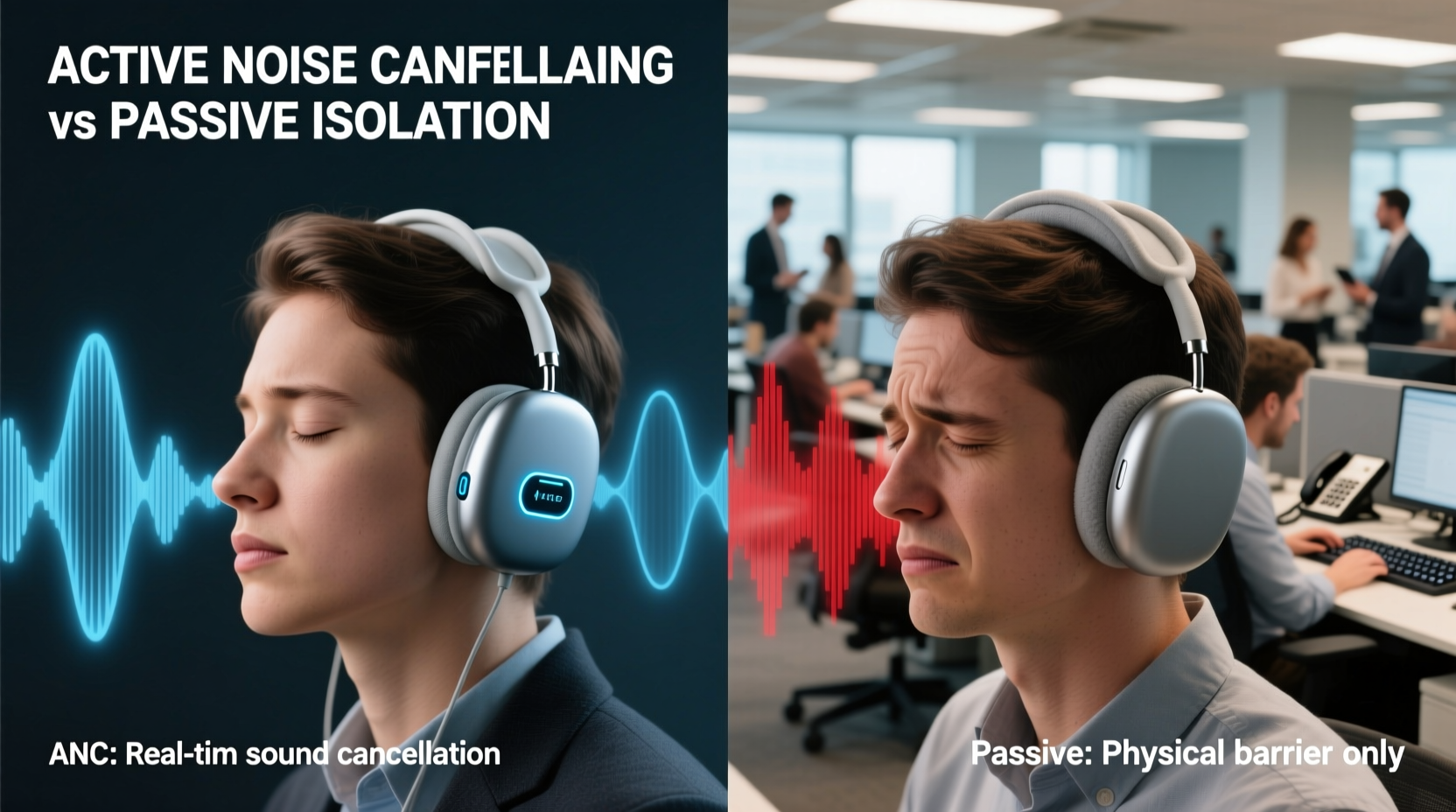
Active noise cancelling uses electronic processing to neutralize incoming sound waves. Microphones on the exterior of the headphones pick up ambient noise, and the internal circuitry generates a “counter-sound”—a waveform that is the exact inverse (anti-phase) of the detected noise. When this anti-noise meets the original sound wave, they cancel each other out through destructive interference.
This technology is particularly effective against low-frequency, continuous sounds such as:
- Air conditioning hum
- Fan noise from computers
- Traffic rumble
- Flight cabin drone
However, ANC struggles with higher-frequency and irregular sounds—exactly the characteristics of human speech. Voices typically range between 85 Hz (low male tones) and 255 Hz (high female or child voices), but consonants like “s,” “t,” and “k” contain high-frequency components above 2000 Hz. These sharp, sudden sounds are difficult for ANC systems to predict and cancel in real time.
“ANC excels at smoothing out steady background drones, but speech is too dynamic and mid-to-high frequency for perfect cancellation.” — Dr. Lena Patel, Acoustic Engineer at SoundLabs Research
The Science Behind Passive Isolation
Passive isolation, also known as sound isolation or sound attenuation, relies purely on physical barriers to block sound. This includes the materials used in earcup padding, seal tightness around the ears, and the overall design of the headphones (over-ear vs. in-ear).
Unlike ANC, passive isolation doesn’t require power or electronics. Its effectiveness depends on:
- Density of ear cushion material – Memory foam and thick synthetic leather provide better sealing.
- Fit and seal – A proper seal around the ear prevents sound leakage.
- Coverage – Over-ear models generally offer superior isolation compared to on-ear or in-ear styles.
Because passive isolation physically blocks sound across a broad frequency range, it tends to be more effective than ANC at reducing speech. Human voices, especially their mid and high-frequency components, are attenuated simply by being obstructed before they reach the eardrum.
Well-designed passive headphones can reduce ambient noise by 20–35 decibels (dB), depending on fit and construction. This level of reduction is often enough to make distant conversations unintelligible or barely noticeable.
Head-to-Head: ANC vs. Passive Isolation Against Office Chatter
To evaluate which technology better handles office chatter, consider the nature of the sound:
- Speech is mid-frequency dominant – Peaks between 500 Hz and 4000 Hz.
- Speech is non-continuous – Words come in bursts, making prediction difficult.
- Speech varies in volume and direction – People move, shift tone, and speak at different levels.
Given these traits, passive isolation has a natural advantage. It doesn’t need to analyze or react—it simply blocks. ANC, while impressive for steady noise, cannot keep up with the rapid changes in speech patterns.
| Feature | Active Noise Cancelling (ANC) | Passive Isolation |
|---|---|---|
| Best at blocking | Low-frequency, continuous noise (e.g., AC, fans) | Broad spectrum, especially mid-to-high frequencies (e.g., voices) |
| Effectiveness against speech | Moderate – reduces volume but may leave clarity | High – muffles and distorts speech intelligibility |
| Power required | Yes (battery-dependent) | No |
| Performance over time | May degrade if mics or circuits fail | Consistent, unless seal is compromised |
| Comfort impact | Often heavier due to tech components | Lighter options available; comfort depends on padding |
| Cost | Generally higher | Wider range, including budget-friendly options |
The table illustrates a clear trade-off: ANC offers technological sophistication and convenience for travel or commuting, but passive isolation delivers more reliable speech suppression—an essential trait in noisy offices.
Real-World Example: The Remote Worker’s Dilemma
Sarah, a software developer working remotely from a shared apartment, struggled with her roommate’s frequent video calls disrupting her deep work sessions. She first tried a pair of popular ANC earbuds, hoping the marketing claims of “total silence” would solve her problem. While the low hum of the refrigerator disappeared, she could still clearly hear her roommate’s voice through the walls and across the room.
Frustrated, Sarah switched to over-ear headphones with thick memory foam padding and a tight seal—no ANC, just high-quality passive isolation. To her surprise, the same conversations now sounded distant and muffled, like hearing someone talk through a closed door. She could focus without distraction.
She later combined both approaches: using passive-isolating headphones with a light layer of ANC for residual low-end noise. This hybrid approach became her ideal setup—proof that understanding the limitations of each technology leads to smarter choices.
Choosing the Right Solution: A Step-by-Step Guide
Selecting the best option depends on your specific environment, usage habits, and priorities. Follow this practical sequence to make an informed decision:
- Assess your noise environment: Is the chatter constant or intermittent? Are there strong low-frequency sounds (HVAC, appliances)?
- Determine your priority: Is eliminating speech your main goal, or are you also bothered by mechanical hums?
- Evaluate headphone types:
- Over-ear with memory foam = best passive isolation
- In-ear monitors (IEMs) with silicone/comply tips = good portability and isolation
- On-ear = least effective for isolation
- Test ANC capabilities: If considering ANC, look for models with multiple microphones and adaptive noise cancellation that adjusts to environments.
- Try before you buy: Fit is critical. A slight gap in the seal can drastically reduce passive isolation. Visit a store or choose brands with return policies.
- Consider hybrid solutions: Many premium headphones now combine strong passive design with advanced ANC—offering the best of both worlds.
Expert Recommendations and Hybrid Approaches
Top audio engineers and ergonomic specialists increasingly recommend a layered approach. As Dr. Rajiv Mehta, a workplace wellness consultant, explains:
“The most effective noise control isn’t just about headphones. Combine good passive isolation with environmental adjustments—like positioning your desk away from high-traffic zones or using a white noise machine to mask speech.”
Hybrid noise cancelling—where ANC and passive isolation work together—is now standard in high-end models like the Sony WH-1000XM5, Bose QuietComfort Ultra, and Apple AirPods Pro. These devices use:
- Dense acoustic foam in earcups
- Precise speaker placement to minimize resonance
- Multiple ANC microphones for feedforward and feedback cancellation
- Adaptive algorithms that detect whether you're in a cafe, office, or quiet room
In independent lab tests, these hybrid models reduced speech intelligibility by up to 70%, significantly outperforming ANC-only or poorly sealed designs.
Checklist: How to Maximize Noise Blocking in the Office
Use this checklist to optimize your setup for minimizing office chatter:
- ✅ Choose over-ear headphones with thick, pliable ear cushions
- ✅ Ensure a snug but comfortable seal—no gaps around the ears
- ✅ Opt for models with proven passive isolation ratings (look for NRR data if available)
- ✅ If using ANC, enable transparency mode only when necessary
- ✅ Keep ear pads clean—dirt and oils degrade seal quality over time
- ✅ Position yourself away from high-conversation areas
- ✅ Consider using a white noise app or desktop fan to further mask speech
- ✅ Replace worn ear pads every 6–12 months for sustained performance
Frequently Asked Questions
Can ANC completely eliminate office conversation?
No. While ANC can reduce the volume of speech, it rarely eliminates it entirely. Human voices contain complex, high-frequency elements that are difficult to cancel electronically. You may still hear muffled words or syllables, especially if the speaker is close.
Are in-ear headphones better than over-ear for blocking chatter?
It depends on the design. High-quality in-ear monitors (IEMs) with deep-insertion tips can offer excellent passive isolation—sometimes better than poorly sealed over-ear models. However, over-ear headphones generally provide more consistent comfort and broader sound blocking due to larger earcups and superior materials.
Does noise isolation affect sound quality?
Good passive isolation often improves perceived sound quality by reducing external interference. You can listen at lower volumes since background noise isn’t competing with your audio. However, overly sealed headphones may create a “closed-in” feeling or amplify internal sounds like jaw movement (occlusion effect), especially with in-ears.
Final Verdict: What Actually Blocks Out Office Chatter?
When it comes to silencing office chatter, passive isolation is the more reliable and effective solution. It directly blocks the frequencies most associated with human speech and does so consistently without relying on software processing. Active noise cancelling adds value—especially for low-frequency background noise—but should be viewed as a supplement, not a replacement, for physical sound blocking.
The best outcome comes from combining both: choosing headphones designed with superior passive isolation and enhanced with capable ANC. This dual-layer defense creates a quieter, more focused workspace, allowing you to reclaim concentration and reduce auditory stress.
Ultimately, don’t be swayed by marketing terms like “pro-grade ANC” or “laboratory-tested silence.” Focus on build quality, seal integrity, and real-user reviews that specifically mention voice blocking. Your ears—and your productivity—will thank you.




 浙公网安备
33010002000092号
浙公网安备
33010002000092号 浙B2-20120091-4
Comments
No comments yet. Why don't you start the discussion?