
The Adam’s apple—technically known as the laryngeal prominence—is one of the most recognizable features of the human neck, particularly in males. Despite its common name, it has nothing to do with apples or biblical diets. Instead, it plays a crucial role in voice production and protection of the vocal cords. More than just a physical trait, the Adam’s apple carries cultural weight, linguistic history, and biological significance. This article delves into the etymology of the term, the anatomy behind the bulge, and its functional importance across genders and ages.
The Biblical Myth Behind the Name
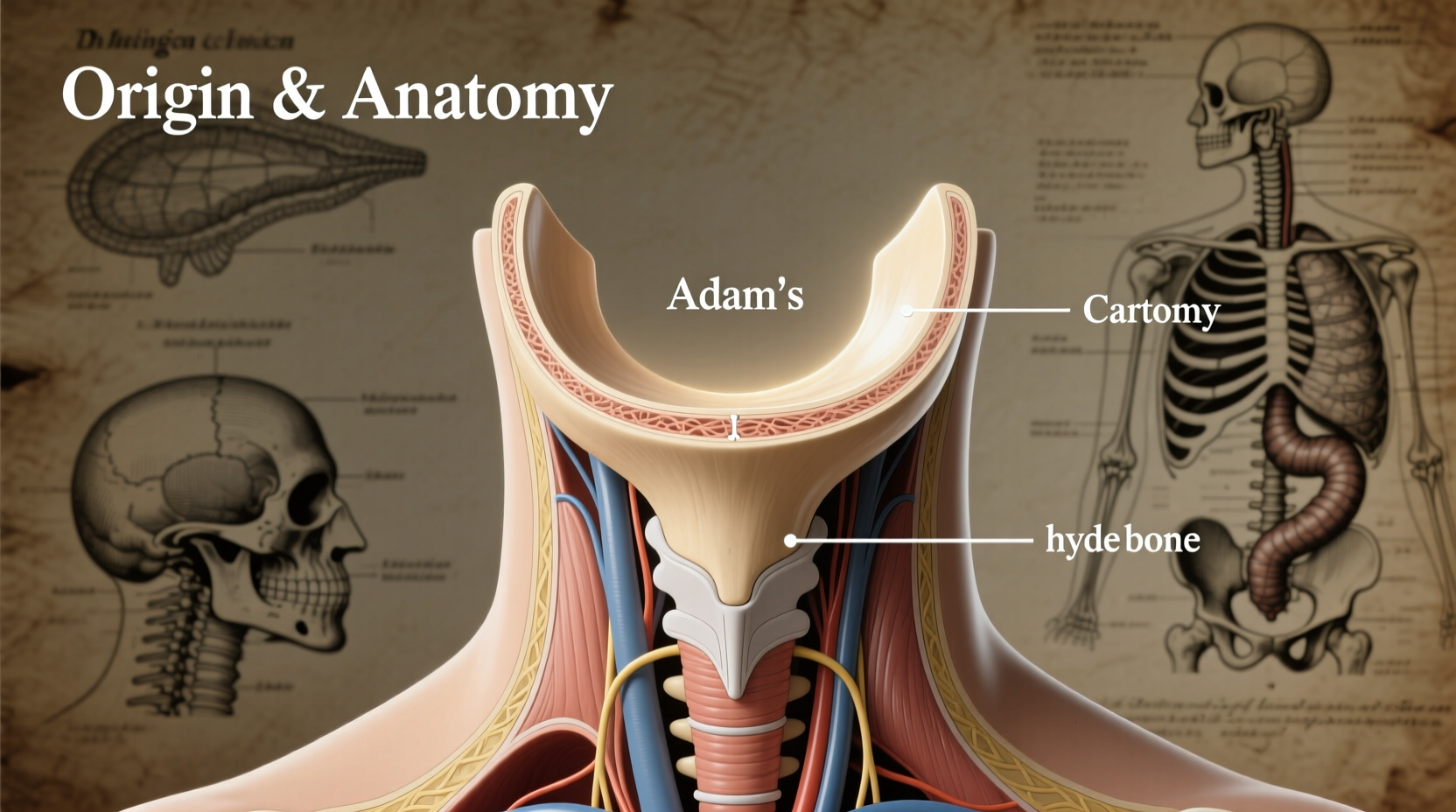
The term “Adam’s apple” is steeped in religious folklore. According to Judeo-Christian tradition, when Adam ate the forbidden fruit from the Tree of Knowledge in the Garden of Eden, a piece supposedly got stuck in his throat. Over time, this legend evolved into the idea that the protrusion in the front of the human throat was a permanent reminder of humanity’s first sin.
Interestingly, the forbidden fruit is never specified as an apple in the original Hebrew text—it was simply referred to as “fruit.” The association with an apple emerged much later, during the Middle Ages, possibly due to a Latin pun: *malum* means both “apple” and “evil.” This linguistic coincidence may have cemented the fruit’s identity in popular imagination.
“While the story is mythological, it gave rise to a lasting anatomical nickname—one that persists even in medical education.” — Dr. Lila Nguyen, Medical Historian
Though not scientifically accurate, the tale illustrates how cultural narratives shape our understanding of the body. The name “Adam’s apple” endures not because of its accuracy, but because of its storytelling power.
Anatomy of the Laryngeal Prominence
Medically, the Adam’s apple is the visible projection formed by the thyroid cartilage surrounding the larynx (voice box). It protects the delicate structures inside, including the vocal folds. The size and angle of the cartilage vary between individuals and are influenced primarily by hormones during puberty.
During adolescence, testosterone causes the thyroid cartilage to grow more prominently and at a sharper angle in males—typically around 90 degrees—leading to a more noticeable bulge. In females, the angle is wider (about 120 degrees), resulting in a less pronounced or often invisible protrusion.
The larynx itself sits at the level of the C4–C6 vertebrae and rises during swallowing, which is why the Adam’s apple moves up and down. This motion helps close off the airway, preventing food from entering the trachea—a vital protective reflex coordinated by the epiglottis.
Key Structures Involved
- Thyroid cartilage: Largest cartilage of the larynx; forms the front wall and the Adam’s apple.
- Vocal folds (cords): Stretched within the larynx; vibrate to produce sound.
- Epiglottis: Leaf-shaped flap that covers the larynx during swallowing.
- Cricoid cartilage: Ring-shaped structure below the thyroid cartilage; supports the larynx.
Function and Biological Significance
Beyond its visual distinctiveness, the Adam’s apple serves several physiological functions:
- Voice Modulation: As the larynx enlarges during male puberty, the vocal cords lengthen and thicken, leading to a deeper voice. The prominent cartilage supports this structural change.
- Protection: The rigid cartilage shields the vulnerable vocal apparatus from external trauma.
- Swallowing Mechanism: The upward movement of the larynx and Adam’s apple during swallowing ensures efficient closure of the airway.
Interestingly, the degree of prominence doesn’t correlate directly with voice depth. Some men with subtle Adam’s apples have deep voices, while others with pronounced bulges may have higher-pitched tones. The key factor is the length and tension of the vocal folds, not the size of the cartilage.
Do’s and Don’ts Regarding the Adam’s Apple
| Do | Don’t |
|---|---|
| Be aware of its role in protecting your airway during swallowing | Press hard on the Adam’s apple—this can damage the larynx |
| Recognize changes in voice or swallowing as potential signs of laryngeal issues | Assume visibility indicates gender—many transgender men develop it via hormone therapy; some cisgender women have visible ones |
| Seek medical advice if the Adam’s apple becomes painful or swollen | Ignore persistent hoarseness lasting more than two weeks |
Gender, Identity, and the Adam’s Apple
In contemporary discussions of gender and identity, the Adam’s apple has taken on new relevance. For many transgender men undergoing testosterone therapy, the growth of the larynx and deepening of the voice are among the most affirming physical changes. The emergence of a visible Adam’s apple can be a powerful symbol of alignment between body and identity.
Conversely, some transgender women seek surgical reduction of the Adam’s apple through a procedure called chondrolaryngoplasty, commonly known as “tracheal shave.” This elective surgery smooths the thyroid cartilage to create a less masculine neck contour, often improving comfort and reducing gender dysphoria.
“In facial feminization surgeries, Adam’s apple reduction is one of the most impactful procedures for perceived gender congruence.” — Dr. Rafael Torres, Facial Plastic Surgeon
These interventions underscore that while the Adam’s apple is a natural anatomical feature, its social and psychological implications are shaped by cultural norms and personal experience.
Frequently Asked Questions
Can women have an Adam’s apple?
Yes, all humans have a thyroid cartilage, but it is typically less prominent in women due to lower levels of testosterone during puberty. However, some women naturally have a more visible laryngeal prominence, especially if they have higher androgen levels or genetic predispositions.
Is it possible to break your Adam’s apple?
Yes, though rare, trauma to the neck can fracture the thyroid cartilage. This is considered a medical emergency, as it may damage the airway or vocal cords. Symptoms include severe pain, difficulty breathing, voice loss, and swelling.
Does the Adam’s apple keep growing?
No, once puberty ends, the larynx stabilizes in size. While minor changes may occur with aging—such as calcification of cartilage—the Adam’s apple does not continue to grow significantly throughout adulthood.
A Closer Look: A Real-Life Example
Consider James, a 24-year-old transgender man who began testosterone therapy 18 months ago. One of the earliest changes he noticed was a gradual lowering of his voice, followed by the emergence of a small but visible Adam’s apple. “It sounds simple,” he shared, “but seeing that little bump when I looked in the mirror made me feel more like myself than ever before.” His experience reflects a broader truth: bodily markers can carry profound emotional weight beyond their biological function.
How to Monitor Your Neck Health
While the Adam’s apple itself requires no special care, it serves as a useful landmark for monitoring overall laryngeal health. Follow this checklist to stay proactive:
- ✔ Notice any sudden or gradual voice changes (hoarseness, breathiness)
- ✔ Check for pain or tenderness around the larynx
- ✔ Monitor difficulty swallowing or breathing
- ✔ Observe visible swelling or asymmetry in the neck
- ✔ Seek evaluation if symptoms persist beyond two weeks
Regular self-awareness can lead to early detection of conditions such as laryngitis, nodules, or even thyroid disorders, which often manifest near the same region.
Conclusion
The Adam’s apple is far more than a curious bump on the neck. It is a convergence point of mythology, anatomy, voice, and identity. From ancient religious tales to modern gender-affirming surgeries, this small structure carries layers of meaning. Understanding its origin and function empowers us to appreciate the complexity of the human body—not just as a biological machine, but as a canvas for culture, expression, and personal truth.




 浙公网安备
33010002000092号
浙公网安备
33010002000092号 浙B2-20120091-4
Comments
No comments yet. Why don't you start the discussion?