
For home fitness enthusiasts, choosing between adjustable dumbbells and fixed-weight sets is more than a matter of preference—it’s a decision that impacts space, budget, workout efficiency, and long-term training progress. Adjustable dumbbells promise versatility in a compact design, often at a premium price. Fixed weights offer simplicity and reliability but require significant storage space and incremental investment. As more people build home gyms, the question arises: does the convenience of adjustable dumbbells justify their higher cost?
This article examines both options across key criteria—cost, durability, performance, space efficiency, and training flexibility—to provide a clear, practical comparison. Whether you're outfitting a garage gym or optimizing a corner of your living room, understanding the trade-offs will help you make a smarter, more sustainable investment.
Cost Comparison: Upfront Investment vs Long-Term Value
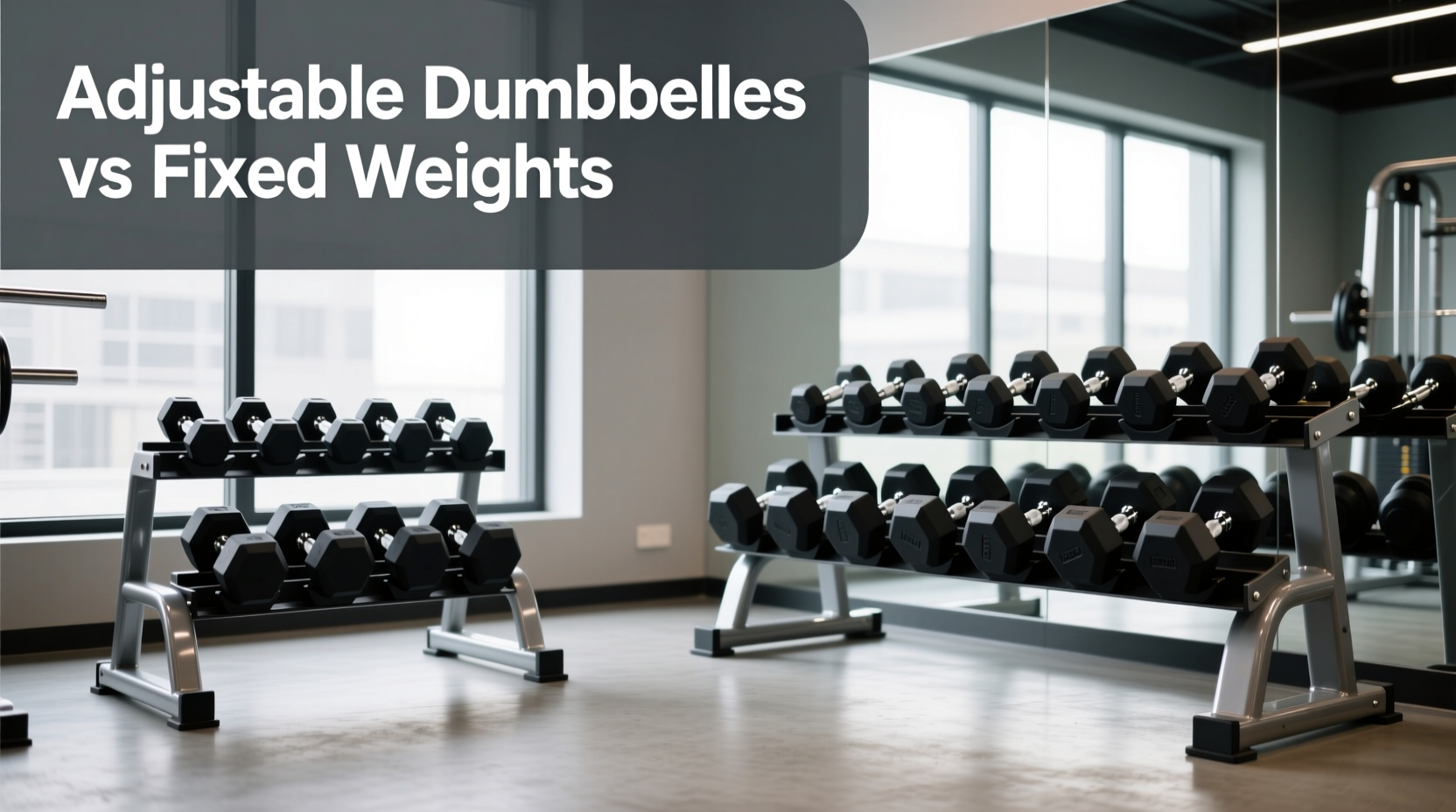
The most immediate difference between adjustable and fixed dumbbells is price. A high-quality adjustable set—such as those from Bowflex, PowerBlock, or NordicTrack—typically ranges from $300 to $600 for a pair covering 5 to 50+ pounds per dumbbell. In contrast, purchasing individual fixed dumbbells incrementally can start cheap (a single 10-pound dumbbell might cost $20), but scales quickly. To match a 5–50 lb adjustable range, you’d need at least ten pairs (5, 10, 15, up to 50 lbs), potentially costing $400–$800 depending on brand and material.
While adjustables appear more expensive upfront, they often prove more economical over time. You’re not buying multiple cast iron units with redundant handles and packaging—you’re investing in one engineered system. Additionally, entry-level fixed dumbbells made from rubber-coated composite materials may degrade faster, requiring replacement.
| Feature | Adjustable Dumbbells | Fixed Weight Dumbbells |
|---|---|---|
| Average Upfront Cost (5–50 lb range) | $300–$600 | $400–$800+ |
| Space Required | Less than 1 sq ft per pair | 3–5 sq ft for full set |
| Durability (expected lifespan) | 7–10 years (with proper care) | 5–15 years (varies by material) |
| Expansion Flexibility | Limited (max weight predefined) | Unlimited (buy any weight increment) |
| Time Between Sets | 5–15 seconds (quick dial or pin change) | Depends on storage proximity |
Space Efficiency and Home Gym Practicality
Urban apartments, shared homes, or multi-purpose rooms demand smart use of space. Fixed dumbbells, especially when stacked on racks or stored haphazardly, occupy valuable floor area. Even a modest set takes up shelf space comparable to a small suitcase. For renters or those without dedicated workout zones, this can be a dealbreaker.
Adjustable dumbbells solve this elegantly. Most models come with compact bases or stands that hold both weights upright in under a square foot. Some fold into briefcase-style carriers. This makes them ideal for closet storage, under-bed placement, or quick setup on carpeted floors. The reduction in visual clutter also encourages consistent use—fewer excuses about “not having room.”
However, space savings come with a caveat: if you frequently perform supersets (e.g., alternating bicep curls and shoulder presses with different weights), switching settings mid-circuit can slow momentum. Fixed weights allow seamless transitions when pre-positioned nearby. Strategic layout—such as placing frequently used fixed dumbbells on a rolling cart—can mitigate this, but it requires planning and discipline.
Performance and Training Experience
The feel of a weight during movement matters. Fixed dumbbells have a consistent center of gravity and balanced construction. Most are symmetrical, with even weight distribution along the handle. This predictability enhances control, especially during explosive or unilateral movements like renegade rows or clean-and-presses.
Adjustable models vary widely in ergonomics. High-end systems like the Bowflex SelectTech 552 use internal plates and precision-machined handles to maintain balance across all settings. But cheaper models—particularly older pin-selector types or basic plate-loaders—can shift slightly when adjusted, creating an uneven swing or wobble. Users report subtle differences in grip width, knurling texture, and rotational inertia.
“From a biomechanical standpoint, consistency in tool interface improves neuromuscular adaptation. If the dumbbell feels different each time, your body compensates subconsciously.” — Dr. Lena Torres, Exercise Physiologist, University of Colorado
That said, modern adjustable designs have closed the gap significantly. Many now feature hexagonal bases to prevent rolling, ergonomic grips with aggressive knurling, and noise-reducing mechanisms. For the vast majority of lifters—especially beginners and intermediates—the performance difference is negligible during standard exercises like chest presses, goblet squats, or lateral raises.
Real-World Example: Two Home Gym Setups Compared
Consider two individuals building home gyms with similar goals: strength maintenance, hypertrophy, and functional fitness.
Sarah, a software engineer in a 700-square-foot apartment, chose a pair of PowerBlock Elite adjustable dumbbells ($450). She stores them under her desk during work hours and rolls them out for 20-minute workouts after dinner. Her routine includes adjustable resistance circuits, HIIT with dumbbell thrusters, and progressive overload tracking via app integration. With no spare room for equipment, the compact footprint was non-negotiable. After 18 months, she reports high satisfaction, citing minimal wear and consistent performance.
James, a physical therapist with a finished basement gym, invested $700 in a full set of fixed hex dumbbells ranging from 10 to 100 pounds. He values precise weight increments (5-lb jumps) and uses multiple pairs simultaneously for complex training protocols. His setup supports partner workouts, group sessions, and rehabilitation drills requiring specific loads. While he appreciates the stability and tactile feedback of fixed weights, he admits the rack takes up space he could use for a foam roller station or mobility zone.
Their experiences highlight a core truth: the best choice depends on context. Sarah prioritized space and simplicity; James valued customization and readiness. Neither is wrong—each optimized for their environment.
Longevity, Maintenance, and Durability Concerns
Durability is a common concern with adjustable dumbbells. Mechanical components—dials, pins, locking mechanisms—are potential failure points. Early-generation models had issues with jammed selectors or misaligned plates. Today’s top-tier systems undergo rigorous stress testing. Brands like Bowflex offer 2–5 year warranties, and user reports suggest lifespans exceeding seven years with moderate use.
Maintenance plays a role. Regular cleaning of adjustment grooves, occasional lubrication of moving parts (if recommended), and avoiding drops on hard surfaces extend life. Fixed dumbbells, while simpler mechanically, face other risks: rubber coatings can crack, chrome plating may chip, and improper storage leads to rust on bare iron.
- Adjustable pros: Fewer individual pieces to lose or damage.
- Adjustable cons: Single point of failure—if the mechanism breaks, the entire unit is compromised.
- Fixed pros: Modular resilience—one damaged dumbbell doesn’t affect others.
- Fixed cons: Higher cumulative risk of loss, damage, or mismatched pairs.
Step-by-Step Guide: Choosing What’s Right for You
Follow this decision framework to determine which option aligns with your lifestyle and fitness goals.
- Assess your available space. Measure the intended workout area. If less than 50 sq ft, adjustables are likely the better fit.
- Define your primary training style. Do you do circuit training, supersets, or fast-paced routines? Adjustables minimize transition time. Prefer heavy compound lifts with exact loads? Fixed weights offer finer control.
- Set a realistic budget. Include not just equipment, but potential accessories (racks, mats, storage). Can you afford a $500 adjustable pair, or would $50 every few months for fixed dumbbells work better?
- Project usage frequency. Occasional users benefit more from convenience. Daily or near-daily lifters may prefer the durability and feel of fixed options.
- Test if possible. Visit a gym or friend’s home gym with both types. Perform a few reps of a shoulder press and Romanian deadlift. Note comfort, balance, and ease of adjustment.
- Make your choice—and commit. Over-analysis leads to paralysis. Pick based on current needs, knowing you can adapt later.
Frequently Asked Questions
Can adjustable dumbbells handle heavy lifting?
Yes, but within limits. Most max out at 50–70 lbs per dumbbell, sufficient for most upper-body work and accessory lifts. Powerlifters or athletes needing 100+ lb dumbbells for farmer’s walks or heavy cleans will still require fixed weights. Check manufacturer specs for load capacity and structural integrity.
Are adjustable dumbbells safe?
High-quality models are extremely safe when used correctly. Ensure plates are securely locked before lifting. Avoid jerky motions that could dislodge components. Lower-cost or poorly maintained units pose greater risk. Always follow the user manual.
Do fixed dumbbells increase resale value of my home gym?
Not significantly. While durable, fixed dumbbells are bulky and harder to transport. Adjustables, especially well-known brands, tend to retain value better due to portability and demand among urban fitness buyers.
Final Verdict: Is the Convenience Worth It?
The higher price of adjustable dumbbells isn't just for engineering—it's for time saved, space reclaimed, and mental friction reduced. For most home exercisers, especially those with limited room or fluctuating schedules, that convenience translates directly into consistency. And consistency, not equipment perfection, drives results.
Fixed weights remain the gold standard for purists, competitive lifters, and those with ample space and budget. Their unchanging form delivers unmatched reliability. But for the growing number of people integrating fitness into busy lives, adjustables represent a pragmatic evolution—a tool designed not just for lifting, but for living.
If you value streamlined workouts, hate clutter, and want to start strong without endless purchases, adjustable dumbbells are worth the premium. They aren’t perfect, but they solve real problems in ways that resonate with modern lifestyles.




 浙公网安备
33010002000092号
浙公网安备
33010002000092号 浙B2-20120091-4
Comments
No comments yet. Why don't you start the discussion?