
Strength training at home has surged in popularity, driven by convenience, cost savings, and the desire for consistent fitness routines. One of the most debated decisions among home gym enthusiasts is whether to invest in adjustable dumbbells or a set of fixed-weight dumbbells. Both options have loyal followings, but when it comes to building strength efficiently—especially within the constraints of limited space and budget—the choice isn’t always clear. The answer depends on training goals, progression style, frequency of use, and long-term adaptability.
Strength development hinges on progressive overload, proper form, and consistency. Whether using adjustable or fixed dumbbells, the equipment must support these principles without introducing limitations. This article breaks down the strengths and drawbacks of each option, evaluates real-world performance, and provides actionable insights to help you choose the right path for efficient strength gains at home.
Understanding Strength Development Mechanics
Before comparing equipment, it's essential to understand how strength is built. Muscle growth and neuromuscular adaptation occur primarily through progressive overload—the gradual increase of stress placed on the body during training. This can be achieved by increasing weight, volume (sets x reps), intensity, or reducing rest periods. For effective strength development, the chosen tool must allow precise and sustainable progression.
Dumbbells, regardless of type, offer unilateral training advantages: they improve muscle balance, enhance core stability, and reduce asymmetries that often develop with barbell-only routines. However, their value diminishes if weight increments are too large or access to needed loads is inconsistent. A 5-pound jump between sets may seem small, but for intermediate lifters working on exercises like overhead press or lateral raises, it can mean the difference between controlled progression and plateauing.
The ideal dumbbell system supports micro-loading (small weight increases), durability under repeated use, and ease of transition between exercises. It should also minimize downtime between sets—critical during supersets or circuit training. These factors directly influence training efficiency and, ultimately, strength outcomes.
Adjustable Dumbbells: Flexibility Meets Compact Design
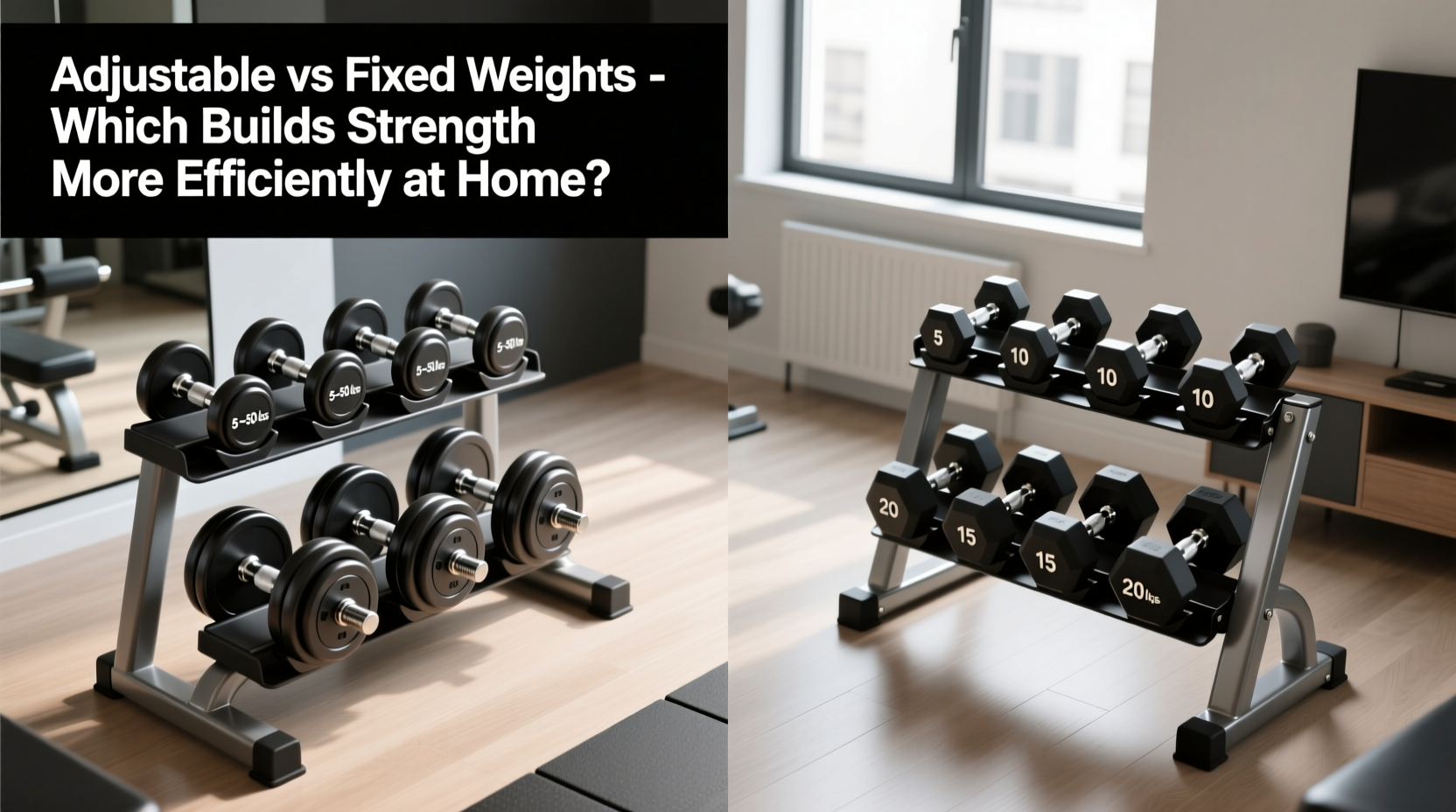
Adjustable dumbbells consist of a single handle that allows users to change the weight via dial systems, pin selectors, or magnetic locks. Brands like Bowflex, PowerBlock, and NordicTrack dominate this space, offering ranges from 5 to 90 pounds per dumbbell. Their primary appeal lies in space efficiency—a full range of weights in one compact unit.
For urban dwellers or those with limited storage, adjustables are transformative. A single pair replaces 15–20 individual dumbbells, freeing up floor space and reducing clutter. They're also cost-effective over time; purchasing multiple fixed dumbbells across a broad spectrum can easily exceed $500–$1,000, while high-end adjustables typically fall in the $300–$600 range.
Modern designs have improved significantly. Dial-based models like Bowflex SelectTech allow changes in under 10 seconds. Some newer magnetic systems enable near-instant transitions. Yet, even with these advances, certain limitations persist:
- Weight increments: Most adjustables increase in 2.5- to 5-pound jumps, which may be too coarse for fine-tuning later-stage strength work.
- Bulkiness: Higher-weight settings extend the dumbbell’s length, altering center of gravity and potentially affecting form on pressing movements.
- Durability concerns: Repeated adjustments stress internal mechanisms. Misalignment or dropped units can damage dials or locking pins.
- Grip variability: As weight plates shift outward, grip width changes slightly, which may affect shoulder mechanics over time.
“Adjustable dumbbells are excellent for general strength and hypertrophy, especially for beginners and intermediates. But advanced lifters need finer control and consistent feel—something fixed weights deliver more reliably.” — Dr. Marcus Lin, CSCS, Exercise Physiologist
Fixed-Weight Dumbbells: Consistency and Precision
Fixed-weight dumbbells are traditional free weights with permanent construction—each dumbbell is a single, solid unit with unchangeable mass. Available in cast iron, rubber-coated, or urethane finishes, they offer unmatched stability and uniformity. Olympic-style fixed dumbbells maintain consistent grip diameter and balance regardless of load.
Their greatest strength lies in reliability. Every time you pick up a 35-pound dumbbell, it feels exactly the same—same balance, same grip, same center of mass. This consistency reinforces motor learning and allows for precise tracking of strength gains. When performing complex movements like renegade rows or explosive push presses, subtle shifts in weight distribution matter.
Additionally, fixed dumbbells support smaller incremental jumps. While commercial gyms often carry 2.5-pound increases (e.g., 25, 27.5, 30 lbs), many home users build custom sets with fractional plates or micro-loading options. This granularity enables smoother progression, particularly in isolation lifts where rapid plateaus occur.
However, fixed dumbbells come with significant trade-offs:
- Space consumption: A full-range set requires substantial floor or rack space. Even a modest 5–50 lb spread takes up several square feet.
- Higher initial cost: Buying multiple pairs adds up quickly. Rubber-coated sets average $1.50–$2.50 per pound.
- Logistical friction: Switching weights mid-workout takes longer, increasing downtime and potentially disrupting flow.
Despite these challenges, serious lifters often prefer fixed dumbbells for heavy compound movements like goblet squats, bench presses, and bent-over rows. The psychological impact of handling real iron—its density, sound, and inertia—also contributes to workout engagement and focus.
Performance Comparison: Efficiency in Real Training Scenarios
To assess which system builds strength more efficiently, consider three key dimensions: progression accuracy, workout speed, and long-term adaptability.
| Factor | Adjustable Dumbbells | Fixed-Weight Dumbbells |
|---|---|---|
| Progression Granularity | Moderate (typically 2.5–5 lb jumps) | High (can include 1.25–2.5 lb jumps) |
| Setup Time Between Sets | Low to moderate (5–15 sec per change) | Moderate to high (15–30 sec to locate/select) |
| Form Consistency | Variable (changes with weight selection) | Consistent across sessions |
| Space Efficiency | Excellent (1–2 units replace many) | Poor (requires dedicated storage) |
| Durability Under Daily Use | Fair (mechanical parts may wear) | Excellent (minimal failure points) |
| Cost Over Full Range | $300–$600 for 5–90 lb range | $700+ for equivalent range |
The data suggests a hybrid reality: adjustables win on convenience and footprint, while fixed weights lead in precision and repeatability. For beginners building foundational strength, adjustables provide more than enough versatility. An exerciser progressing from 10-pound to 40-pound shoulder presses over six months will thrive with dial-based dumbbells.
Intermediate to advanced lifters, however, may hit limitations. Suppose someone deadlifts 200 pounds with dumbbells and aims to reach 250. With 5-pound increments, they face either stalling at intermediate stages or overshooting optimal loading. Fixed dumbbells with 2.5-pound jumps allow tighter control, reducing injury risk and maximizing adaptation.
Mini Case Study: Two Lifters, Two Paths
Lifter A – Sarah, 32, Intermediate Home Trainer
Sarah works full-time and trains 4 days a week in her apartment gym. She started with a pair of 5–52 lb Bowflex SelectTech dumbbells. Over 10 months, she increased her dumbbell bench press from 30 to 65 pounds per hand using linear progression. Her gains were steady until she approached 70 pounds—the next available setting. At that point, the 5-pound jump felt excessive, leading to compromised form. She plateaued for six weeks.
She eventually supplemented with a single 67.5 lb fixed dumbbell for micro-loading, then progressed to 70 lbs across both systems. This hybrid approach allowed continued growth without sacrificing technique.
Lifter B – James, 45, Former Gym Regular
After his local gym closed, James converted his garage into a home setup. He invested in a full set of fixed dumbbells from 25 to 70 pounds in 2.5-pound increments. Though the cost exceeded $800 and required wall-mounted racks, his strength curves remained smooth. Within eight months, his Arnold press increased from 45 to 55 pounds with no interruptions. He attributes his success to consistent feedback from identical implements.
Both cases highlight a truth: equipment choice shapes progression. Neither solution is universally superior—but context determines effectiveness.
Step-by-Step Guide to Choosing Your System
Follow this decision framework to determine the best fit for your strength goals:
- Assess your current strength level: Beginners benefit more from adjustables due to broader initial jumps. Advanced lifters need finer control.
- Evaluate available space: Less than 50 sq ft? Prioritize adjustables. Dedicated room or garage? Fixed weights become viable.
- Define your progression style: Do you prefer adding reps first, then weight? Or strict weekly load increases? The latter favors fixed dumbbells.
- Calculate total cost: Compare the price of a quality adjustable set versus the cumulative cost of fixed dumbbells across your target range.
- Test transition speed: Time yourself switching weights during a circuit. If adjustables save 2+ minutes per workout, efficiency improves significantly.
- Consider future needs: Will you train beyond 100 pounds per hand? Most adjustables cap at 90 lbs. Fixed options scale indefinitely.
Checklist: Optimizing Strength Gains Regardless of Equipment
- ✅ Track every workout—weight, reps, sets, and perceived exertion
- ✅ Use progressive overload: increase load or volume weekly
- ✅ Maintain full range of motion—even with heavier weights
- ✅ Limit rest periods to 60–90 seconds for metabolic efficiency
- ✅ Warm up properly to prepare joints and nervous system
- ✅ Incorporate unilateral and bilateral movements for balanced development
- ✅ Replace worn or unstable equipment before injury occurs
FAQ
Can I build serious strength with only adjustable dumbbells?
Yes—especially as a beginner or intermediate lifter. Many users achieve impressive hypertrophy and strength gains with high-quality adjustables. However, once you surpass intermediate levels, consider supplementing with fixed weights or barbells for finer progression.
Do adjustable dumbbells affect lifting form?
Slightly. At higher settings, extended length alters leverage, particularly on floor presses or fly movements. Users report mild shoulder strain if not adjusted for. Always check alignment and avoid flaring elbows excessively.
Are fixed dumbbells worth the extra cost?
If you train seriously, prioritize longevity, and value consistency, yes. The return on investment comes in sustained progress and reduced frustration. For casual users, adjustables offer better value.
Conclusion: Match Tools to Goals
There is no universal winner in the adjustable vs fixed dumbbell debate. Strength efficiency emerges not from the tool itself, but from how well it aligns with your routine, environment, and ambitions. Adjustable dumbbells excel in compact living spaces and early-stage training, offering remarkable versatility for the price. Fixed-weight dumbbells deliver unmatched consistency and precision, making them ideal for committed lifters focused on long-term progression.
The smartest approach may be phased: start with adjustables to build foundation and confidence, then gradually introduce fixed dumbbells as your program demands finer control. Alternatively, adopt a hybrid model—using adjustables for accessories and fixed weights for primary lifts.




 浙公网安备
33010002000092号
浙公网安备
33010002000092号 浙B2-20120091-4
Comments
No comments yet. Why don't you start the discussion?