
Affirmative action refers to policies and practices designed to increase opportunities for historically marginalized groups in education, employment, and government programs. Originating in the United States during the civil rights era, these measures aim to address systemic discrimination and promote diversity by considering race, gender, or other characteristics in decision-making processes. While intended as a corrective mechanism, affirmative action has sparked decades of debate over fairness, effectiveness, and constitutionality.
What Is Affirmative Action?
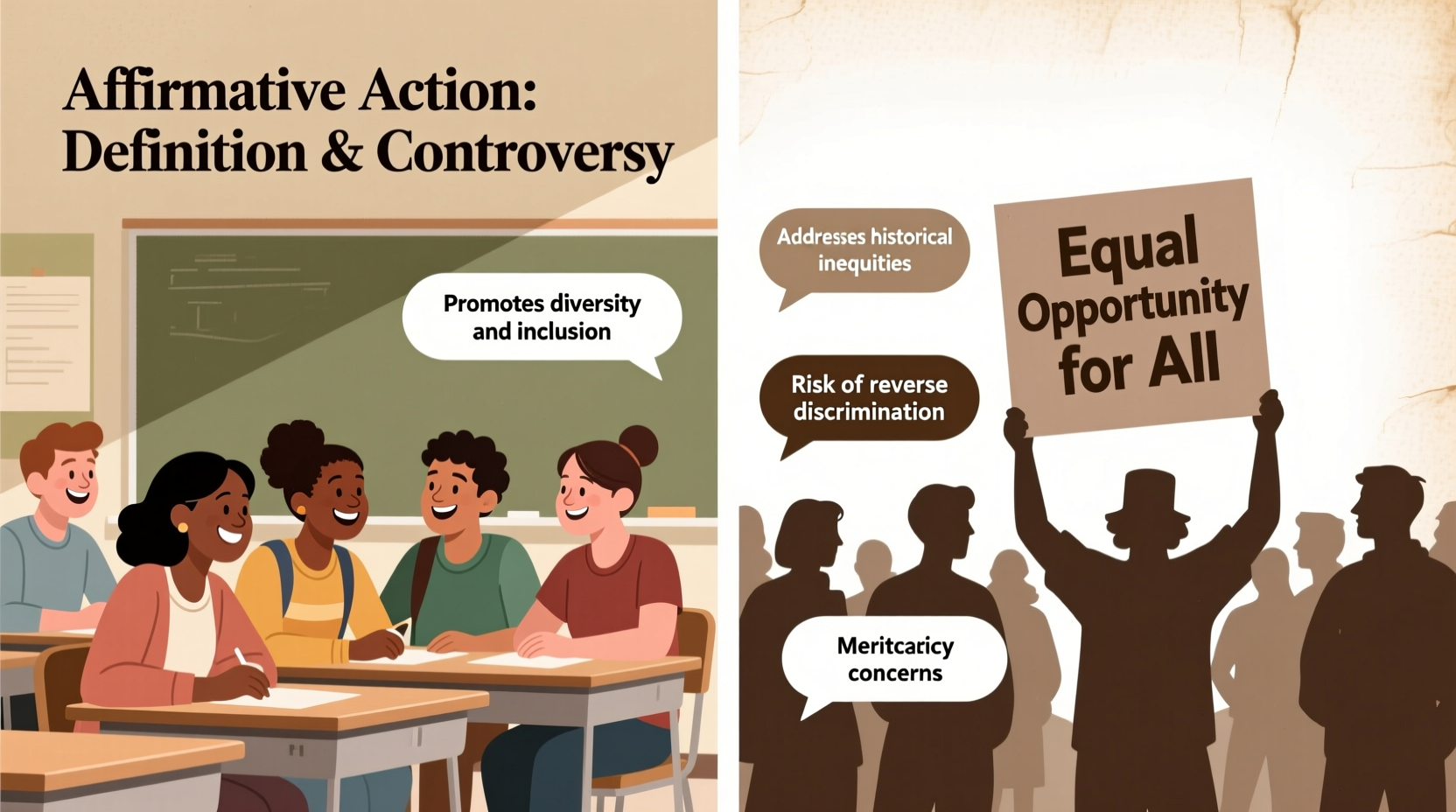
The term \"affirmative action\" was first used officially in Executive Order 10925, signed by President John F. Kennedy in 1961. It required federal contractors to \"take affirmative action to ensure that applicants are employed, and that employees are treated during employment, without regard to their race, creed, color, or national origin.\" Later expanded under President Lyndon B. Johnson, the policy evolved into proactive steps to redress past discrimination.
Today, affirmative action manifests in various forms:
- College admissions offices considering race as one factor among many in holistic reviews.
- Employers setting diversity goals or outreach initiatives for underrepresented communities.
- Government agencies requiring inclusion plans in public contracting.
It’s important to clarify what affirmative action is not: it does not mandate quotas (which the Supreme Court has ruled unconstitutional), nor does it guarantee admission or hiring based solely on identity. Instead, it allows institutions to consider demographic factors within broader assessments of merit and potential.
The Legal Evolution of Affirmative Action
The legal landscape surrounding affirmative action has shifted significantly through landmark U.S. Supreme Court rulings. These decisions have shaped how institutions implement such policies while balancing constitutional principles like equal protection under the Fourteenth Amendment.
| Case | Year | Key Ruling |
|---|---|---|
| Regents of the University of California v. Bakke | 1978 | Racial quotas banned; race can be a “plus” factor in admissions. |
| Grutter v. Bollinger | 2003 | University of Michigan Law School’s use of race upheld as promoting diversity. |
| Fisher v. University of Texas | 2016 | Reaffirmed that race-conscious admissions must withstand strict scrutiny. |
| Students for Fair Admissions v. Harvard / UNC | 2023 | Struck down race-based college admissions, effectively ending affirmative action in higher education. |
The 2023 ruling marked a turning point. In a 6–3 decision, the Supreme Court held that Harvard and the University of North Carolina’s admissions programs violated the Equal Protection Clause because they did not meet the standard of narrow tailoring. Chief Justice John Roberts wrote: “The way to stop discrimination on the basis of race is to stop discriminating on the basis of race.” This statement encapsulates the core argument made by opponents and signals a new chapter in American social policy.
“We conclude that race-based admissions programs lack sufficiently focused and measurable objectives warranting the use of race.” — Chief Justice John G. Roberts Jr., Majority Opinion in *Students for Fair Admissions v. Harvard* (2023)
Supporters’ Key Arguments
Proponents of affirmative action argue that it remains essential for achieving equity in systems still influenced by historical and structural inequalities. Their central claims include:
- Diversity enhances learning and workplace environments. Research shows diverse classrooms improve critical thinking, empathy, and problem-solving skills. A study by the Century Foundation found students exposed to racial diversity reported greater civic engagement and cross-cultural understanding.
- It corrects entrenched disadvantages. Generational poverty, unequal K–12 education, and housing segregation continue to affect access to opportunity. Affirmative action helps level the playing field for qualified candidates who face systemic barriers.
- Merit is more than test scores. Advocates emphasize that standardized metrics often reflect privilege rather than pure ability. Considering life experience, resilience, and background offers a fuller picture of an applicant's potential.
- Representation matters. Seeing people of different backgrounds in leadership roles inspires future generations and improves institutional trust, especially in fields like medicine, law, and public service.
Critics’ Key Arguments
Opponents challenge affirmative action on philosophical, practical, and legal grounds. Their primary concerns include:
- Reverse discrimination. Critics argue that using race in admissions or hiring can disadvantage individuals from non-preferred groups, even if they are equally or more qualified. The 2023 case was brought by a white applicant claiming bias in Harvard’s process.
- Stigma and mismatch theory. Some scholars suggest that beneficiaries may be placed in environments where they struggle academically due to gaps in preparation—a phenomenon known as the “mismatch effect.” Though contested, this idea fuels skepticism about long-term benefits.
- Perpetuates racial categorization. Opponents claim that relying on race reinforces divisions instead of moving toward a colorblind society. They advocate for class-based alternatives that target economic disadvantage across all races.
- Inconsistent application. Policies vary widely between institutions, leading to perceptions of arbitrariness. Without clear standards, some view affirmative action as preferential treatment lacking transparency.
Mini Case Study: The Impact at UC Berkeley Post-Ban
After California voters banned affirmative action in public education via Proposition 209 in 1996, enrollment of underrepresented minorities at elite campuses like UC Berkeley and UCLA dropped sharply. At Berkeley’s law school, Black student enrollment fell from 17% in 1995 to just 6% in 1997. The university responded with alternative strategies: expanding outreach to underserved high schools, eliminating legacy preferences, and adopting holistic review emphasizing adversity and perseverance.
Over time, these race-neutral methods helped rebuild diversity, but full representation has yet to return. As of 2022, Black students made up only about 3% of Berkeley’s undergraduate population despite comprising 5.2% of California’s youth. This example illustrates both the immediate impact of banning affirmative action and the limits of workarounds in overcoming deep inequities.
Alternatives and Future Directions
With race-conscious admissions now prohibited, institutions are exploring new pathways to diversity. Promising approaches include:
- Socioeconomic-based admissions. Prioritizing students from low-income families, regardless of race, can indirectly boost racial diversity given overlapping disparities.
- Percent plans. States like Texas admit top graduates from every high school, ensuring geographic and socioeconomic variety.
- Investment in pipeline programs. Early outreach to K–12 students in underserved communities builds readiness and expands the talent pool.
- Implicit bias training for decision-makers. Educating admissions officers and hiring managers helps reduce unconscious preferences that may favor dominant groups.
“If we want diversity without explicit race considerations, we must invest earlier—in schools, neighborhoods, and opportunity structures.” — Dr. Angela Onwuachi-Willig, Dean and Professor of Law, Boston University
Checklist: Evaluating Equity Initiatives Post-Affirmative Action
- ✅ Assess current diversity metrics across departments or programs.
- ✅ Expand outreach to high schools and community colleges in underserved areas.
- ✅ Review admissions or hiring rubrics for implicit biases.
- ✅ Implement need-based scholarships or mentorship programs.
- ✅ Track outcomes annually to measure progress and adjust strategies.
Frequently Asked Questions
Does affirmative action mean unqualified people get preferred treatment?
No. Affirmative action does not lower standards or admit unqualified individuals. It allows institutions to consider race as one factor among many—such as essays, extracurriculars, work experience, and personal challenges—in evaluating competitive candidates.
Can employers still pursue diversity goals after the 2023 ruling?
Yes, but cautiously. The Supreme Court decision applies primarily to college admissions. Employers may still run diversity initiatives, provided they do not rely on rigid racial classifications or exclude individuals based on race. Voluntary efforts focused on recruitment, training, and inclusive culture remain permissible.
Are there countries that successfully implemented race-neutral equity policies?
Some nations, like Finland and Sweden, focus on universal welfare and education reforms to reduce inequality without explicitly race-based policies. However, their homogenous populations make direct comparisons difficult. In diverse societies like the U.S., race-neutral tools alone have so far fallen short of achieving proportional representation.
Conclusion: Moving Forward with Intentional Equity
The end of affirmative action as traditionally practiced marks not the end of the conversation about equity, but a pivot toward more nuanced, systemic solutions. While the controversy reflects deep philosophical divides, the shared goal—fair access to opportunity—remains within reach. Institutions must now innovate responsibly, replacing race-conscious criteria with robust, transparent, and evidence-based strategies that uphold excellence and inclusion.




 浙公网安备
33010002000092号
浙公网安备
33010002000092号 浙B2-20120091-4
Comments
No comments yet. Why don't you start the discussion?