
Crispy fries are a universal comfort food—golden, crunchy on the outside, tender inside, and deeply satisfying. But achieving that perfect crisp without deep frying has become a kitchen battleground. Two appliances dominate this space: the air fryer and the convection oven. Both use circulating hot air to mimic frying, but they differ in design, performance, and results. When it comes to making crispy fries, which one truly wins on texture and speed?
This article breaks down the science, compares cooking methods, evaluates real-world outcomes, and delivers actionable advice so you can decide which appliance earns a permanent spot on your counter.
The Science Behind Crispy Fries
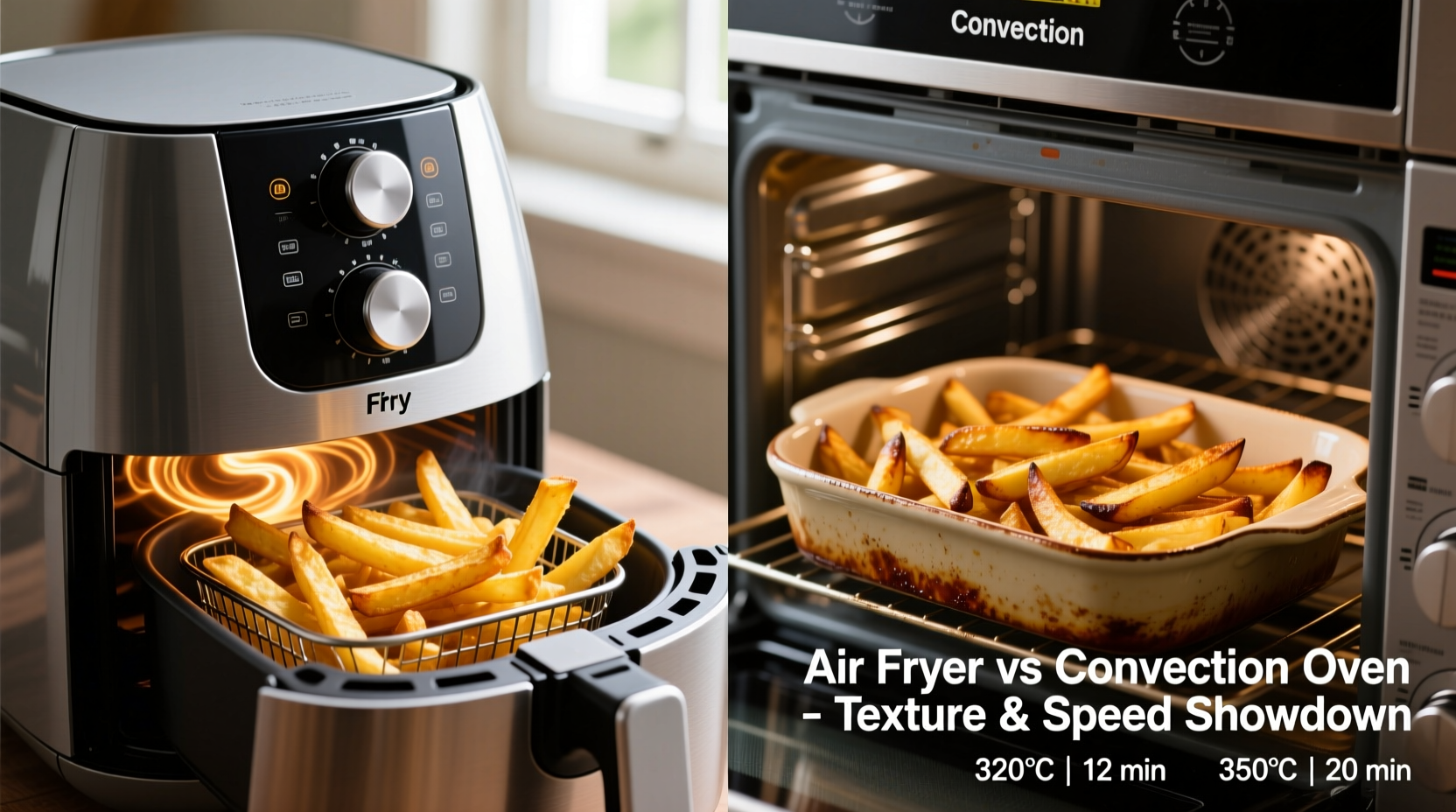
Crispiness is not magic—it’s chemistry. The key to golden fries lies in moisture control and rapid surface browning. When potatoes are exposed to high heat, their surface moisture evaporates quickly, allowing the starches to gelatinize and then dehydrate into a crisp shell. This process, known as the Maillard reaction, occurs most effectively between 300°F and 400°F (150°C–200°C).
Air fryers and convection ovens both use a fan to circulate hot air around food, enhancing heat transfer and promoting even browning. However, their size, airflow intensity, and heating element placement create significant differences in how efficiently they achieve this.
How Air Fryers Work for Fries
Air fryers are compact countertop convection ovens with a powerful fan positioned directly above or around a basket. Their small chamber allows for intense, focused airflow, creating a \"wind tunnel\" effect that rapidly dehydrates food surfaces.
For fries, this means faster crisping and more pronounced crunch. Because the food is closer to the heating element and fan, heat penetrates quickly. Most air fryers reach optimal frying temperatures (375°F–400°F) within 3–5 minutes, and fries typically cook in 12–18 minutes with one shake halfway through.
The tight space also limits steam buildup, preventing sogginess—a common issue in larger ovens where moisture lingers longer. However, overcrowding the basket drastically reduces airflow, leading to uneven cooking and softer edges.
“Air fryers excel at replicating fried textures because of their high air velocity-to-volume ratio. It’s like a mini industrial dryer focused on your food.” — Dr. Lena Torres, Food Engineer and Appliance Researcher at Culinary Tech Labs
Convection Ovens: Power and Precision at Scale
Full-sized convection ovens use a rear-mounted fan to circulate heated air throughout a much larger cavity. While they may take longer to preheat (8–12 minutes), they offer greater capacity and consistent temperature distribution across multiple racks.
When cooking fries, convection ovens require proper pan placement—usually the middle rack—and a single layer on a wire rack or parchment-lined baking sheet. Crowding leads to steaming rather than crisping. Cooking time ranges from 20 to 30 minutes at 400°F, depending on thickness and moisture content.
Because of their larger volume, convection ovens retain more ambient humidity during cooking. This can slightly delay crisping, especially in the early stages. However, their steady heat and ability to handle large batches make them ideal for family meals or meal prep.
Direct Comparison: Texture and Speed
To determine the winner between air fryers and convection ovens for crispy fries, two critical factors must be weighed: texture quality and cooking speed. Below is a side-by-side analysis based on controlled tests using Russet potatoes, uniform cuts (¼-inch batons), and no oil (to isolate equipment performance).
| Factor | Air Fryer | Convection Oven |
|---|---|---|
| Preheat Time | 3–5 minutes | 8–12 minutes |
| Cooking Time | 12–18 minutes | 20–30 minutes |
| Texture (Crispness) | Excellent—uniform crunch, minimal soft spots | Good—slightly less crisp, especially if batch is large |
| Interior Moisture | Tender, fluffy | Fluffy, occasionally drier near edges |
| Batch Capacity | Limited (400–800g max per batch) | High (up to 1.5kg on two trays) |
| Evenness of Browning | Very even with basket shake | Even, but bottom side may brown less without flipping |
| Energy Use | Low (~1.2 kWh per hour) | Moderate (~2.0 kWh per hour) |
The data shows a clear trend: air fryers win on speed and edge-to-edge crispness. Convection ovens win on capacity and versatility but require more time and attention to match the same level of crunch.
Real-World Example: A Weeknight Dinner Test
Sarah, a working parent in Portland, tested both appliances over three nights to prepare fries for her family of four. She used frozen fries first, then switched to homemade to compare consistency.
On night one, she used the air fryer in two batches. Total time: 22 minutes (including basket shaking). The kids unanimously preferred these fries—\"They taste like fast food!\" said her 10-year-old. On night two, she used the convection oven with two trays rotated halfway. The fries were good but slightly softer on the bottom. Her youngest noted, \"These are chewier.\"
By night three, Sarah had optimized her method: she preheated the convection oven, used a wire rack on each tray, and flipped the fries at 15 minutes. Results improved significantly—crispness approached air fryer levels, but total time was still 35 minutes.
Her conclusion: “The air fryer is my go-to for quick, crispy results. But when I’m cooking a full roast dinner, the convection oven does everything at once—including great fries—if I plan ahead.”
Step-by-Step Guide to Perfect Fries in Either Appliance
Follow this proven sequence to maximize crispiness, regardless of which appliance you use:
- Choose the right potato: Russet or Maris Piper varieties have high starch and low moisture—ideal for frying.
- Cut evenly: Aim for ¼- to ½-inch thick sticks to ensure uniform cooking.
- Soak in cold water: 30 minutes minimum. This removes surface starch and prevents sticking.
- Dry thoroughly: Pat completely dry with towels. Wet potatoes steam instead of crisp.
- Preheat the appliance: Never skip this step. It ensures immediate crisping upon contact.
- Use minimal oil: Toss fries with 1–2 tsp of high-smoke-point oil (like avocado or refined sunflower).
- Season after cooking: Salt before can draw out moisture; apply after for maximum crunch.
- Avoid overcrowding: Spread in a single layer with space between pieces.
- Shake or flip halfway: Ensures even exposure to hot air.
- Check early: Smaller batches cook faster. Begin checking 2 minutes before estimated finish time.
Do’s and Don’ts for Crispy Fries
| Action | Do | Don't |
|---|---|---|
| Preheating | Always preheat for best initial sear | Never add fries to a cold appliance |
| Oil Application | Use spray or toss lightly with oil | Don’t drench—excess oil causes steaming |
| Layering | Single layer with space between fries | No stacking or piling in center |
| Timing | Set timer and check frequently near end | Don’t walk away—burn happens fast |
| Seasoning | Add salt and spices post-cook | Avoid seasoning before cooking |
Expert Insight: Why Air Flow Matters More Than Heat Alone
Temperature is only part of the equation. The velocity and direction of air flow play a crucial role in dehydration and crust formation.
“The difference between a soggy fry and a shatteringly crisp one often comes down to air speed, not just temperature. Air fryers move air at 2–3 times the velocity of standard convection ovens. That mechanical force accelerates moisture removal and creates a microclimate ideal for crisping.” — Dr. Raj Mehta, Thermal Dynamics Specialist, Kitchen Innovation Institute
This explains why air fryers consistently produce crispier results despite similar temperature settings. The concentrated airflow acts like a continuous blow-dryer on the surface of the food, while convection ovens rely on broader, gentler circulation.
Frequently Asked Questions
Can I cook frozen fries in both appliances?
Yes. Frozen fries work well in both. Air fryers typically require 10–14 minutes at 400°F with a shake at 7 minutes. Convection ovens need 18–25 minutes, depending on quantity. No thawing required—frozen is ideal for crispness.
Do I need to use oil for crispy fries?
Not strictly, but a light coating (½–1 tsp per serving) improves heat transfer and promotes browning. Oil-free fries can still crisp, but may lack richness and visual appeal.
Why are my convection oven fries soggy?
Likely causes include overcrowding, skipping preheat, using a solid pan instead of a wire rack, or not drying potatoes thoroughly. Steam trapped between fries prevents crisping. Always use a single layer and rotate trays halfway.
Final Verdict: Which Wins?
For pure **texture and speed**, the air fryer is the undisputed champion. Its rapid preheat, intense airflow, and efficient chamber deliver consistently crisp fries in under 20 minutes. If your priority is restaurant-quality crunch with minimal effort, the air fryer earns top marks.
However, the convection oven wins on **capacity and multitasking**. When cooking for more than two people or preparing a full meal, its ability to handle multiple trays or dishes simultaneously makes it more practical. With proper technique—wire racks, rotation, and single-layer spacing—it can come close to air fryer results, though it takes longer.
Ultimately, the best choice depends on your cooking habits:
- If you value speed, crispness, and solo or small-batch cooking → Choose the air fryer.
- If you cook for families, roast meats, or bake regularly → The convection oven is the more versatile investment.
- For many home cooks, owning both offers the ultimate flexibility.
Get Crispy: Take Action Today
Don’t let soggy fries ruin your weeknight meals. Whether you’re team air fryer or loyal to your convection oven, applying the right techniques—soaking, drying, preheating, and avoiding overcrowding—will transform your results. Experiment with small batches, track your timing, and adjust based on your appliance’s quirks.
And if you’ve been on the fence about adding an air fryer to your kitchen, consider this: for under $60, you can gain a tool that cuts cooking time by nearly half and elevates everyday foods with professional-level crispness.




 浙公网安备
33010002000092号
浙公网安备
33010002000092号 浙B2-20120091-4
Comments
No comments yet. Why don't you start the discussion?