
For years, Apple’s AirPods Pro have set the standard for premium wireless earbuds—especially among iPhone users. Their seamless integration, reliable ANC, and intuitive controls make them a natural choice. But as Samsung’s Galaxy Buds 2 Pro continue to gain acclaim for their superior audio fidelity, a pressing question emerges: are iPhone users unknowingly sacrificing better sound by staying loyal to the Apple ecosystem?
This isn’t just about brand preference. It’s about what you’re hearing—or not hearing—when you press play. Let’s break down the real differences in sound quality, noise cancellation, comfort, and functionality between the AirPods Pro 2 and Galaxy Buds 2 Pro to see whether switching—or sideloading—could elevate your listening experience.
Sound Quality: The Core of the Debate
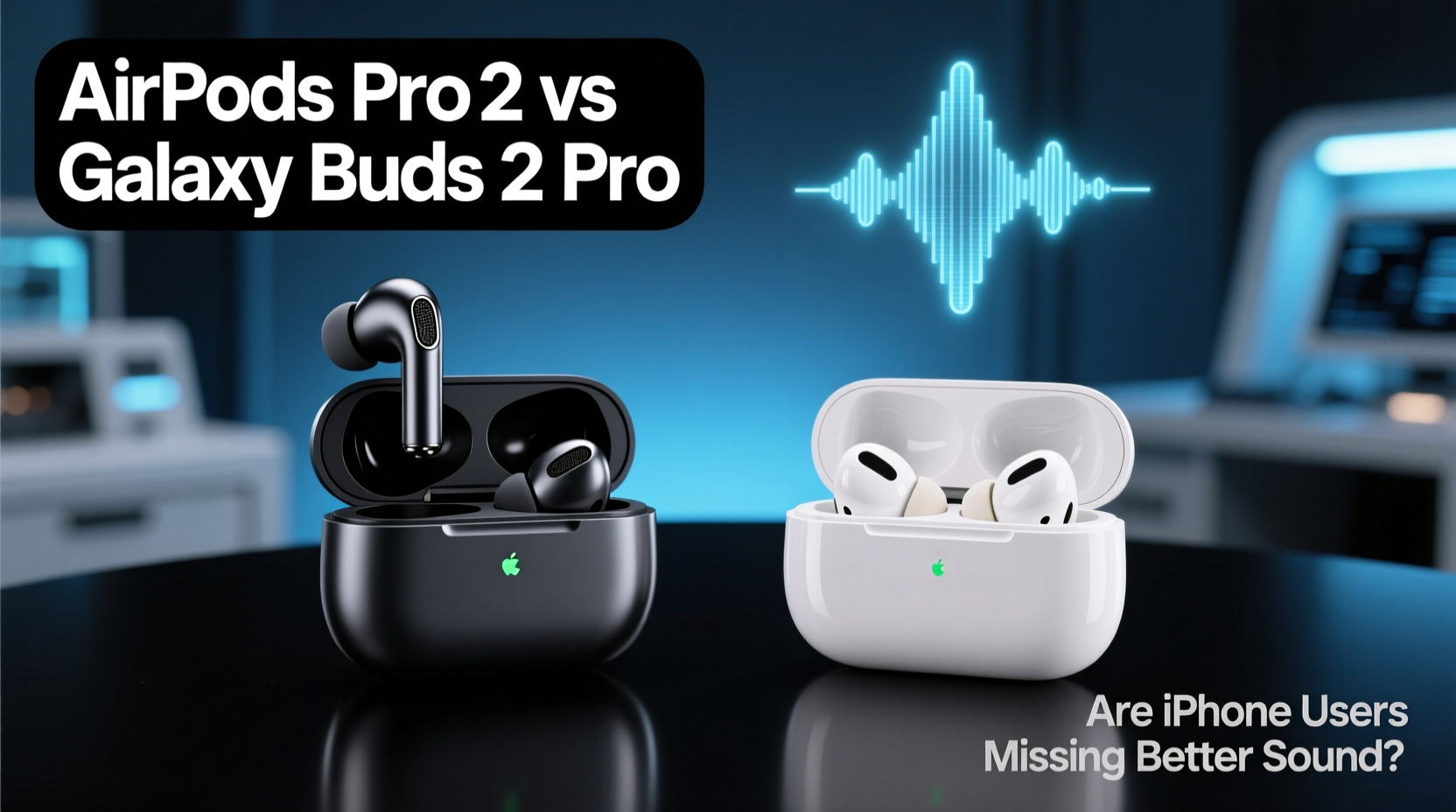
When it comes to pure audio performance, the Galaxy Buds 2 Pro consistently score higher in independent reviews for dynamic range, bass depth, and instrument separation. Equipped with 5.3mm two-way speakers and support for 24-bit Hi-Fi audio (via Samsung’s Seamless Codec), they deliver richer tonality and more immersive spatial imaging than the AirPods Pro 2.
The AirPods Pro 2, while refined, still rely on Apple’s AAC codec—a solid performer but not optimized for high-resolution audio streaming. Even with firmware updates enhancing adaptive EQ and spatial audio, the sonic signature remains balanced and safe, sometimes at the expense of emotional impact.
“Samsung’s investment in driver technology and audio tuning has given the Galaxy Buds 2 Pro a noticeable edge in musicality. They don’t just reproduce sound—they interpret it.” — David Lin, Senior Audio Analyst at SoundReview Hub
For listeners who value detail in vocals, clarity in classical arrangements, or punch in electronic beats, the Buds 2 Pro offer a more engaging experience. This doesn’t mean the AirPods Pro 2 sound bad—they don’t. But if audiophile-grade reproduction is a priority, the Buds 2 Pro deliver where Apple plays it conservatively.
Noise Cancellation and Transparency: Close, But Not Equal
Active noise cancellation (ANC) is another battleground. Apple has long led here, and the AirPods Pro 2 remain among the best at blocking low-frequency hums like airplane engines or AC units. Their updated H2 chip enables more granular sound processing, making ANC both powerful and adaptive.
Samsung’s Galaxy Buds 2 Pro have closed the gap significantly. Their ANC is effective, particularly in mid-to-high frequencies, though they fall slightly short in deep noise suppression. However, the Buds 2 Pro introduce a unique advantage: voice pickup optimization that reduces background chatter during calls without muffling the speaker—ideal in crowded environments.
Transparency mode is where Apple still shines. The AirPods Pro 2 offer the most natural-sounding pass-through, making conversations feel immediate and spatially accurate. The Buds 2 Pro transparency is functional but can sound slightly hollow or compressed in comparison.
Comfort, Fit, and Long-Term Wearability
Physical comfort can make or break daily use. The AirPods Pro 2 feature a stem design that some find protrusive, but their lightweight build (5.3g per bud) and silicone tips ensure stability for most ear shapes. The fit is secure enough for workouts, though aggressive movements may require readjustment.
The Galaxy Buds 2 Pro take a different approach with a compact, bean-shaped design weighing 5.8g each. Their ergonomic curve conforms well to the inner ear, often providing a more “invisible” feel. Many users report being able to wear them for hours without fatigue—a win for extended listening sessions.
Both come with multiple ear tip sizes, but Samsung includes wingtips for added grip, which can be crucial during physical activity. Apple’s fit test helps optimize seal detection via the iPhone, a feature Android users miss—but iPhone users benefit from here.
Ecosystem Lock-In: The Hidden Trade-Off
This is where loyalty becomes a limitation. While the Galaxy Buds 2 Pro technically work with iPhones via Bluetooth, doing so strips away nearly all their advantages. No 24-bit audio. No seamless codec. No head tracking for spatial audio. No fast pairing. You’re left with basic SBC/AAC streaming—essentially using a high-performance car with the engine capped at 30 mph.
Conversely, AirPods on Android function as generic Bluetooth earbuds. No automatic switching, no battery pop-up, no Siri. But iPhone users get the full suite: instant pairing, device handoff, Find My integration, and personalized spatial audio.
The result? iPhone owners are effectively discouraged from exploring superior hardware outside Apple’s walled garden. Meanwhile, Android users can enjoy both ecosystems—many use AirPods on their Samsung phones despite suboptimal integration.
“Ecosystem lock-in isn’t just about convenience—it’s a strategic barrier that prevents consumers from objectively evaluating alternatives, even when those alternatives outperform in key areas like sound.” — Dr. Lena Torres, Consumer Tech Ethicist at MIT Media Lab
Detailed Comparison Table
| Feature | AirPods Pro 2 | Galaxy Buds 2 Pro |
|---|---|---|
| Driver Size | Custom high-excursion driver | 5.3mm two-way dynamic driver |
| Audio Codec Support | AAC | SCMS, AAC, SBC, 24-bit/48kHz LHDC 5.0 (on Android) |
| ANC Performance | Excellent (H2 chip-enhanced) | Very good (adaptive ANC) |
| Transparency Mode | Natural, spatially accurate | Functional, slightly artificial |
| Battery Life (with ANC) | Up to 6 hours | Up to 5 hours |
| Fast Pairing on iPhone | Yes | No |
| Find My Integration | Yes | No |
| Hi-Res Audio Support | No | Yes (on Android) |
| Water Resistance | IPX4 | IPX7 |
Real-World Example: The Audiophile Who Switched Back
Take Mark, a freelance sound designer and long-time iPhone user. Curious about the hype around the Galaxy Buds 2 Pro, he bought a pair to test during his daily subway commute. He was stunned by the depth of cello notes in a classical playlist and the crispness of brushed snare hits in jazz tracks—details he’d never noticed with his AirPods Pro 2.
But within a week, frustration set in. No quick pairing. No automatic switching between his iPad and iPhone. The battery level required opening a third-party app. And worst of all, no lossless audio—even when using high-end streaming services.
He kept the Buds 2 Pro for critical listening at home via wired connection, but returned to the AirPods Pro 2 for daily use. “The sound is better,” he admitted, “but the experience isn’t worth the friction.”
Frequently Asked Questions
Can I use Galaxy Buds 2 Pro with an iPhone effectively?
You can pair them via Bluetooth, but you’ll lose advanced features like 24-bit audio, seamless codec, fast pairing, and firmware updates. Call quality and basic playback work fine, but the full potential is locked on iOS.
Do AirPods Pro 2 support lossless audio?
No. Despite Apple Music offering lossless tracks, the AirPods Pro 2 use AAC over Bluetooth, which is lossy. True lossless requires wired connections or AirPlay-compatible speakers.
Which earbuds last longer on a single charge?
The AirPods Pro 2 offer up to 6 hours with ANC enabled, compared to 5 hours on the Galaxy Buds 2 Pro. With the charging case, both exceed 20 hours, but Apple edges ahead in efficiency.
Conclusion: Are iPhone Users Missing Out?
The answer is nuanced, but yes—iPhone users are missing out on better sound quality, particularly in richness, dynamics, and high-resolution detail. The Galaxy Buds 2 Pro represent a genuine leap in audio engineering, especially for discerning listeners.
However, “better sound” doesn’t exist in a vacuum. It competes with ecosystem cohesion, usability, and reliability. For many, the seamless magic of AirPods—opening the case, seeing the battery, switching devices—is worth the sonic compromise.
If you're an iPhone user who values audio excellence above all else, consider this: the best sound might lie outside your ecosystem. You don’t have to abandon your AirPods entirely. Use them for calls and convenience. But for late-night listening, critical work, or truly immersive music experiences, try the Galaxy Buds 2 Pro—even with their limitations on iOS. Your ears might thank you.




 浙公网安备
33010002000092号
浙公网安备
33010002000092号 浙B2-20120091-4
Comments
No comments yet. Why don't you start the discussion?