
Apple’s AirTag is designed to simplify item tracking with precision finding and seamless integration into the Find My network. But when your AirTag won’t connect during setup or suddenly stops responding, it can disrupt your routine. The good news: most connection issues are fixable with systematic troubleshooting. This guide walks you through proven methods—from basic checks to full resets—to get your AirTag working again.
Common Reasons Why an AirTag Won’t Connect
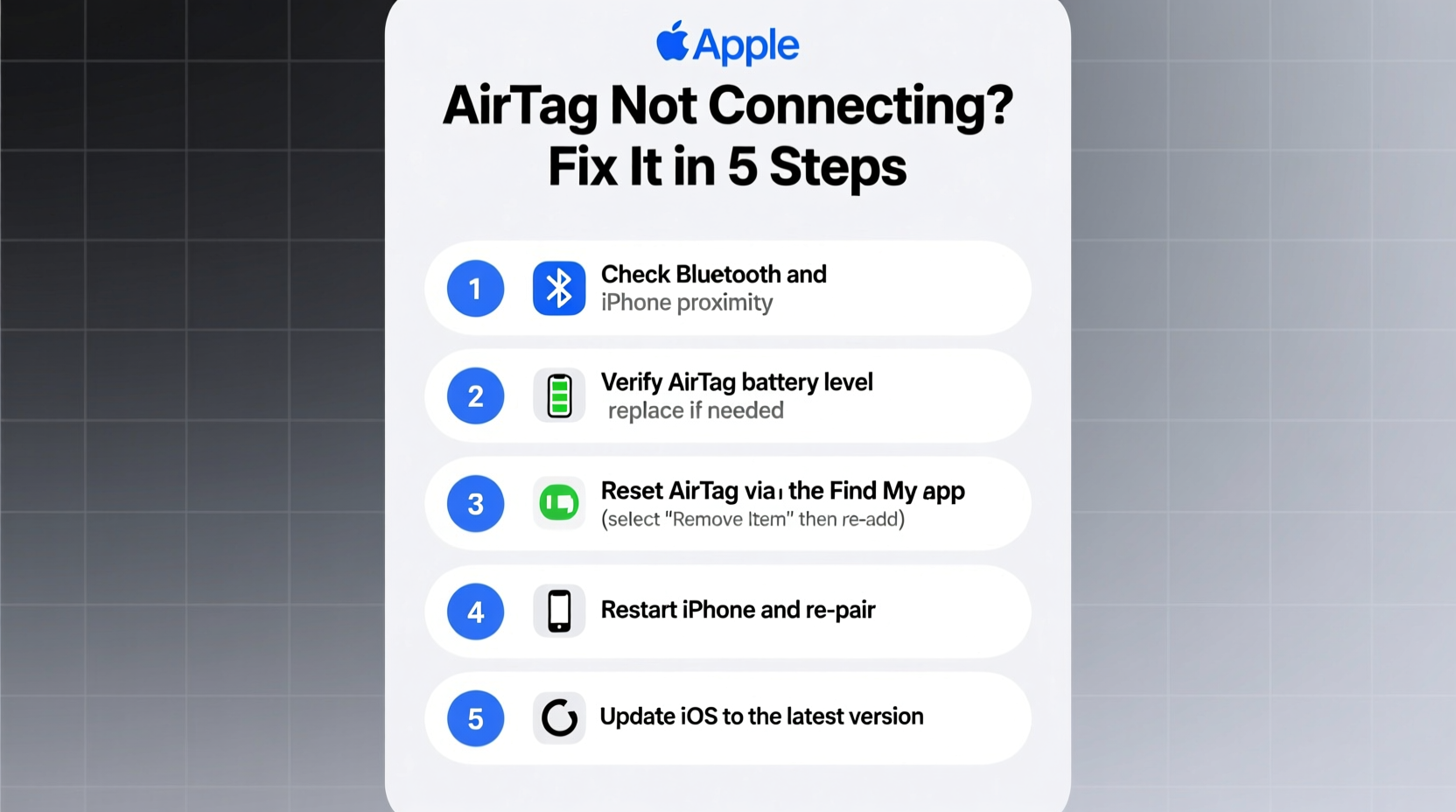
Before jumping into fixes, understand what might be causing the problem. AirTag connectivity depends on multiple factors, including device compatibility, Bluetooth signal strength, battery status, and software settings. Common culprits include:
- Incompatible iOS version (AirTags require iOS 14.5 or later)
- Bluetooth disabled or unstable on the iPhone
- Low or dead battery in the AirTag
- Interference from other wireless devices
- Physical obstructions between the AirTag and iPhone
- Find My network restrictions or account issues
- Damaged or improperly seated battery
Identifying the root cause streamlines recovery. Start with simple diagnostics before moving to advanced steps.
Step-by-Step Troubleshooting Checklist
Follow this logical sequence to isolate and resolve connection problems. Most users regain functionality within minutes using these steps.
- Verify your iPhone runs iOS 14.5 or higher
- Enable Bluetooth and Location Services in Settings
- Restart your iPhone to refresh wireless modules
- Hold the AirTag close to your iPhone (within 2 inches)
- Listen for the chime when pressing the AirTag button
- Check that the battery is properly inserted and charged
- Ensure no metal objects are blocking the signal
- Try pairing with another compatible iPhone if available
If the AirTag still doesn’t appear during setup, proceed to deeper diagnostics.
Resetting Your AirTag: A Complete Guide
A factory reset clears any corrupted pairing data and returns the AirTag to its original state. This is essential if the device was previously linked to another Apple ID or stuck in a failed setup loop.
How to Reset an AirTag
- Remove the silver back cover by twisting it counterclockwise.
- Pull out the battery completely.
- Wait 10 seconds, then reinsert the battery.
- Press and hold the button on the AirTag until you hear a sound.
- Release and repeat this process four more times (five total).
- After the fifth press, you’ll hear a different tone—this confirms reset.
Once reset, the AirTag emits a soft “ready” chime. Now bring it near your iPhone to begin fresh pairing via the Find My app.
“Resetting an AirTag forces it to broadcast its availability like a new device. It’s the most reliable way to clear hidden software glitches.” — David Lin, Senior Apple Support Technician
Advanced Fixes When Basic Steps Fail
If the AirTag still refuses to connect after resetting, consider these less common but effective interventions.
Check Find My Network Status
Apple occasionally experiences outages in the Find My service. Visit Apple System Status to confirm all services—including Find My—are operational. If there's an ongoing issue, wait until resolved before retrying setup.
Sign Out and Back Into iCloud
An outdated iCloud session can block accessory registration. To refresh:
- Go to Settings > [Your Name]
- Scroll down and tap Sign Out
- Confirm and enter your password
- Reboot the phone
- Sign back in with your Apple ID
- Reopen Find My and attempt pairing again
This often resolves silent authentication errors preventing AirTag detection.
Test with Another Device
Borrow a friend’s iPhone running iOS 14.5+ to test the AirTag. If it pairs successfully, the issue lies with your original device—not the tracker. In such cases, focus on updating or restoring your iPhone rather than replacing the AirTag.
Do’s and Don’ts During AirTag Setup
| Do’s | Don’ts |
|---|---|
| Use a fresh CR2032 battery with full charge | Don’t use third-party batteries with non-standard voltage |
| Keep the AirTag within direct contact range of the iPhone | Don’t place it inside metal containers or thick wallets |
| Update your iPhone to the latest iOS version | Don’t skip software updates before pairing |
| Perform a full reset if previous owner info appears | Don’t repeatedly tap without completing the 5-click cycle |
| Enable Location Services and Bluetooth permanently during setup | Don’t rely solely on Wi-Fi; cellular helps verify identity |
Real-World Example: Recovering a “Stuck” AirTag
Sarah purchased a used backpack with an embedded AirTag. When she tried to set it up, her iPhone showed “This AirTag is already connected to an Apple ID.” Despite multiple attempts, it wouldn’t pair.
She followed the five-click reset procedure precisely. After hearing the final confirmation chime, she opened the Find My app. This time, the AirTag appeared as a new device. She completed setup without further issues. Later, she learned the seller hadn’t properly deregistered the tag—a common oversight in secondhand sales.
Sarah’s experience highlights why resetting is critical when acquiring pre-owned items with built-in trackers.
Frequently Asked Questions
Why does my AirTag say “No Devices Found”?
This message usually means Bluetooth isn’t detecting the AirTag. Ensure Bluetooth is enabled, restart your iPhone, and hold the AirTag directly against the screen. Also verify iOS compatibility and perform a reset if needed.
Can I connect an AirTag to an Android phone?
No. AirTags only pair with iPhones, iPads, or iPod touches running iOS 14.5 or later. However, Android users can detect unknown AirTags in Lost Mode using NFC scanning.
How do I know if my AirTag battery is dead?
If the AirTag makes no sound when pressing the button, or fails to chime during setup, the battery may be depleted. Replace it with a new CR2032 lithium coin cell. AirTags typically last about one year under normal usage.
Conclusion: Regain Control of Your Tracking Experience
An AirTag that won’t connect doesn’t mean it’s broken. With methodical troubleshooting—starting from basic checks to full resets—most issues resolve quickly. The key is patience and following each step accurately, especially the five-click reset which many users miss entirely.
Whether you’re setting up a brand-new tracker or reviving one from a secondhand purchase, these strategies restore functionality and trust in Apple’s ecosystem. Don’t give up after one failed attempt. Often, success comes just one reboot or battery swap away.




 浙公网安备
33010002000092号
浙公网安备
33010002000092号 浙B2-20120091-4
Comments
No comments yet. Why don't you start the discussion?