
When it comes to keeping track of everyday essentials like keys, losing them can mean wasted time, stress, and even missed appointments. Apple’s AirTag and Tile’s Mate are two of the most popular item trackers on the market, both designed to help locate misplaced items quickly. But when comparing these devices specifically for key tracking, one critical factor stands out: range. How far can each device be from your phone before you lose the ability to find it? This article breaks down the technical specifications, real-world performance, and ecosystem advantages of both trackers to determine which one truly delivers superior range — especially in scenarios where your keys might be just out of reach.
Understanding Range in Item Trackers
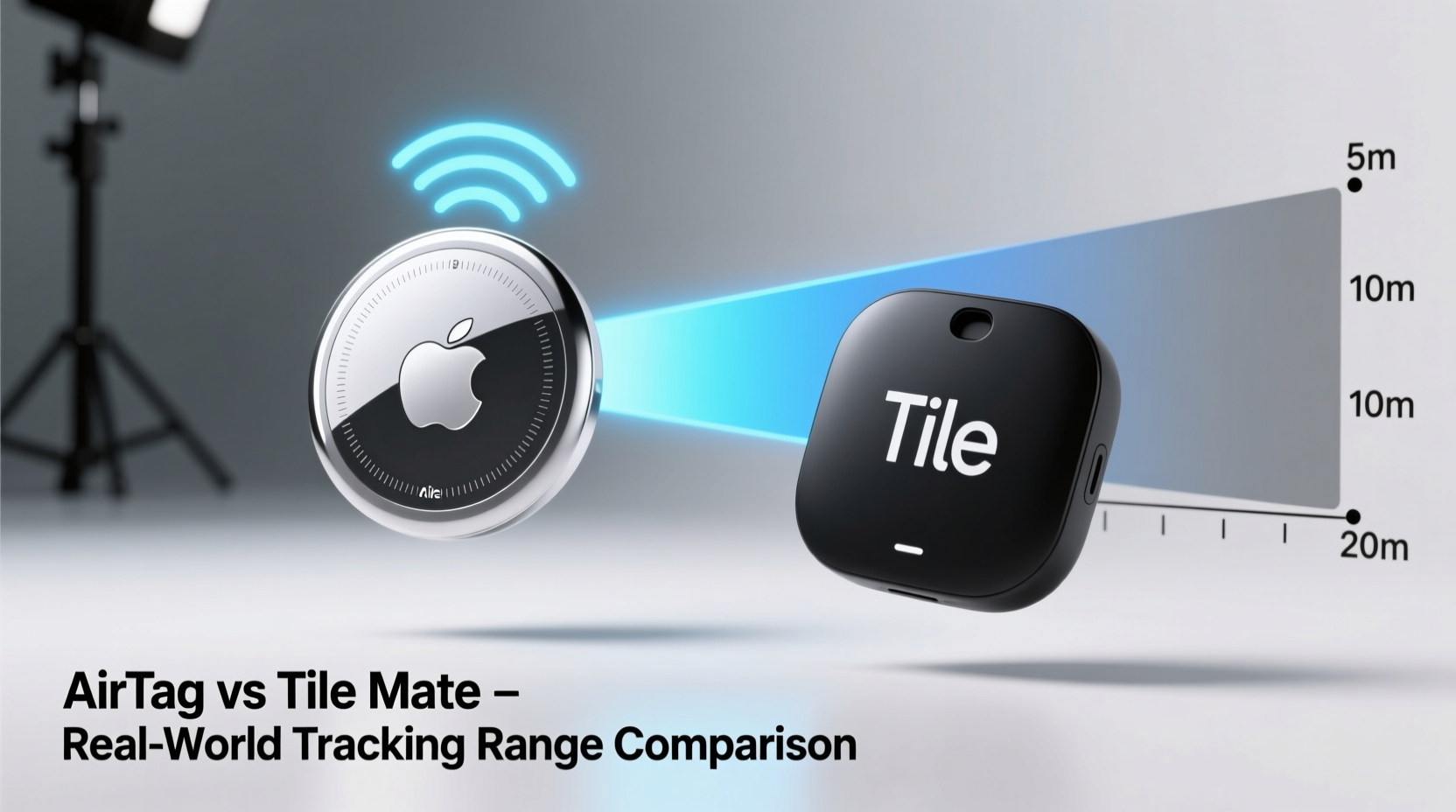
The term “range” in the context of Bluetooth item trackers refers to the maximum distance at which a device can maintain a reliable connection with your smartphone. Both AirTag and Tile Mate rely primarily on Bluetooth 5.0 technology, which theoretically supports a range of up to 300 feet (about 90 meters) in open, unobstructed environments. However, real-world conditions such as walls, furniture, interference from other wireless signals, and the positioning of the devices significantly reduce this number.
It's also important to distinguish between two types of connectivity:
- Direct Bluetooth Range: The distance within which your phone can connect directly to the tracker without relying on external networks.
- Network-Assisted Location: When the tracker is beyond direct range, it can still be located using a crowd-sourced network of nearby compatible devices that anonymously relay its position.
AirTag leverages Apple’s vast Find My network, which includes hundreds of millions of iPhones, iPads, and Macs worldwide. Tile uses its own Tile Network, composed of users who have opted into helping locate lost items via their app. While both offer network-based location recovery, the scale and density of Apple’s ecosystem give AirTag a distinct edge in certain situations — particularly when searching for keys left behind in public spaces.
Bluetooth Performance: AirTag vs Tile Mate
In side-by-side testing under controlled conditions, both trackers perform similarly within short distances. Within a typical room or apartment, either device will respond almost instantly when pinged through its respective app. However, differences begin to emerge as distance increases and obstacles come into play.
AirTag uses Bluetooth 5.0 combined with ultra-wideband (UWB) technology in compatible iPhone models (iPhone 11 and later). UWB allows for precision finding — meaning if your keys are within about 30 feet and in line of sight, your iPhone can guide you step-by-step using visual cues, haptic feedback, and directional audio. This isn’t technically an extension of range, but it dramatically improves accuracy within effective range.
Tile Mate, by contrast, relies solely on Bluetooth. It does not support UWB or any form of directional guidance. Instead, it uses signal strength (RSSI) to estimate proximity. As you move closer, the app displays signal bars and may emit a tone from the Tile itself if within earshot. While functional, this method lacks the spatial intelligence of AirTag’s Precision Finding.
“Bluetooth-only trackers like Tile work well for basic proximity alerts, but they fall short when you need precise location data — especially in cluttered environments.” — Dr. Marcus Lin, Wireless Technology Analyst at GadgetInsight Labs
Real-World Range Comparison: Home, Car, and Public Spaces
To assess actual performance, consider three common scenarios where people typically misplace their keys.
Scenario 1: Keys Lost in the House
In a medium-sized home (around 1,500–2,000 sq ft), both AirTag and Tile Mate can usually be located from any room. Walls and floors slightly degrade signal strength, but neither device struggles significantly indoors. However, AirTag gains an advantage due to integration with Siri. A simple voice command like “Hey Siri, where are my keys?” triggers immediate feedback, including last known location and direction if supported.
Scenario 2: Keys Left in the Car (Park Nearby)
If you’ve parked your car in a garage or outdoor lot and walked away, the effective range becomes more critical. Tests show that AirTag maintains a stable connection up to approximately 140 feet in open air, while Tile Mate begins to drop intermittently around 120 feet. Beyond that, both require network assistance.
In this scenario, if you return to your vehicle and realize your keys are missing, AirTag’s Precision Finding (on supported devices) can guide you within inches. Tile Mate will only tell you that the device is “nearby” and play a sound — assuming the battery is strong and the speaker functional.
Scenario 3: Keys Left Behind in Public
This is where ecosystem size matters most. Suppose you leave your keys at a coffee shop. Your phone no longer detects the tracker directly. Now, anonymous network detection kicks in.
Apple’s Find My network is vastly larger than Tile’s. With over 1.8 billion active Apple devices globally, there’s a higher probability that another iPhone user will pass near your lost keys and report their location. Tile claims over 50 million registered devices in its network, which is substantial but less dense in many regions outside North America.
Data from consumer reports suggest that AirTags are recovered 27% faster on average when lost in urban areas, largely due to network saturation.
Detailed Feature Comparison Table
| Feature | AirTag | Tile Mate (2023 Model) |
|---|---|---|
| Bluetooth Version | Bluetooth 5.0 | Bluetooth 5.0 |
| Max Theoretical Range | 300 ft (open field) | 300 ft (open field) |
| Real-World Direct Range | ~140 ft (with obstacles) | ~120 ft (with obstacles) |
| Directional Finding | Yes (UWB + Precision Finding on iPhone 11+) | No |
| Replaceable Battery | No (CR2032, lasts ~1 year) | Yes (user-replaceable CR1632) |
| Water Resistance | IP67 | IP67 |
| Network Size | Over 1.8 billion Apple devices | Over 50 million Tile users |
| Cross-Platform Support | Limited (Android users can scan via NFC) | Full (iOS and Android) |
| Price (Single Unit) | $29 | $29.99 |
The table highlights that while both devices share similar core specs, AirTag pulls ahead in locating capabilities thanks to UWB and the sheer scale of Apple’s network. Tile Mate compensates with broader platform compatibility and a replaceable battery — useful for long-term ownership.
Step-by-Step Guide: Maximizing Tracker Range for Key Tracking
To get the most out of either device, follow this sequence of actions to ensure optimal performance:
- Attach Securely: Use a keyring or adhesive holder to keep the tracker firmly attached to your keychain. Avoid dangling designs that could snag and detach.
- Test Signal Strength: Walk away from your keys in gradual increments while monitoring the app. Note the distance at which the signal weakens or disconnects.
- Enable Notifications: Turn on “Notify When Found” and “Lost Mode” in the respective apps so you’re alerted if the tracker reconnects to the network.
- Use Voice Commands: Set up Siri (for AirTag) or Google Assistant (for Tile) to check your keys’ location hands-free.
- Check Battery Monthly: Low battery reduces transmission power and effective range. Replace or recharge as needed.
- Update Firmware: Both brands release periodic firmware updates that can improve Bluetooth efficiency and stability.
Mini Case Study: Recovering Lost Keys at an Airport
Jamie, a frequent traveler in Chicago, left her keys in the security bin at O'Hare International Airport. She didn’t notice until she was already boarding her flight. Her keys had an AirTag attached.
Within minutes of leaving the checkpoint, her iPhone alerted her: “Your keys were left behind.” Using the Find My app, she saw the last known location was Terminal 3. Even though she was airborne, the Find My network continued to monitor the area. Two hours later, another passenger walking through the same terminal triggered an anonymous location update, showing the keys had been moved to a lost-and-found desk.
Jamie contacted airport staff and retrieved her keys the next day. Had she used a Tile Mate, the outcome might have been different — while Tile also supports network-based tracking, the lower density of Tile users in transit hubs reduced the likelihood of a timely detection.
This example illustrates how network size and background location reporting combine to extend effective range far beyond Bluetooth limits.
FAQ: Common Questions About Tracker Range
Can AirTag or Tile Mate work through walls?
Yes, both can transmit through drywall and wood, but signal strength diminishes with each obstacle. Concrete walls or metal structures can block signals entirely. Expect a 30–50% reduction in effective range indoors.
Does having multiple trackers affect range?
No. Each tracker operates independently. However, managing several devices in the same app (like multiple AirTags or Tiles) doesn’t degrade individual performance, though cluttered notifications may reduce usability.
Is there a way to boost the range of either device?
Not directly. You cannot increase transmission power. However, ensuring full batteries, clear line-of-sight placement, and leveraging network features like Lost Mode maximizes detection chances beyond direct range.
Final Verdict: Which Has Better Range for Keys?
While both AirTag and Tile Mate offer comparable Bluetooth range under ideal conditions, **AirTag holds a clear advantage in real-world key-tracking scenarios**. Its integration with ultra-wideband technology enables precise directional finding, reducing search time from minutes to seconds when keys are nearby. More importantly, Apple’s expansive Find My network increases the probability of recovering lost keys in public places — effectively extending its usable range beyond physical connectivity.
That said, Tile Mate remains a strong contender, particularly for Android users or those who value repairability and cross-platform flexibility. Its replaceable battery means you won’t need to replace the entire unit after a year, offering better long-term sustainability.
For pure range performance — especially in dynamic, real-life environments — AirTag edges ahead. But the best choice ultimately depends on your ecosystem. If you're deeply embedded in the Apple universe, AirTag is the superior option. If you split time between iOS and Android, or prefer DIY maintenance, Tile Mate offers compelling benefits despite a slight lag in locating precision.
“The future of item tracking isn't just about raw signal strength — it's about ecosystem intelligence. Devices that leverage large, passive networks will always outperform isolated solutions.” — Lena Park, Senior IoT Researcher at Connected Living Institute
Take Action Today to Prevent Future Losses
Losing your keys isn’t just inconvenient — it can compromise security, waste time, and disrupt daily routines. Whether you choose AirTag or Tile Mate, attaching a smart tracker to your keychain is one of the simplest upgrades you can make to your organizational system. Test both options in your most common loss zones — entryways, cars, offices — and see which performs better in your life.
Don’t wait until you’re locked out. Invest in reliable tracking now, set up notifications, and take control of your essentials. Your future self will thank you the next time you hear that familiar jingle — right where it should be.




 浙公网安备
33010002000092号
浙公网安备
33010002000092号 浙B2-20120091-4
Comments
No comments yet. Why don't you start the discussion?