
Losing your keys is frustrating anywhere—but in rural areas, where cell service is spotty and people are fewer, finding them can feel nearly impossible. That’s where Bluetooth tracking devices like Apple’s AirTag and Tile trackers promise a solution. Both claim to help locate lost items using global networks of smartphones. But when you're miles from the nearest town, does one really outperform the other?
The answer isn’t as simple as brand loyalty or device price. It hinges on network density, technology used, and real-world reliability in low-population zones. This article breaks down how AirTag and Tile work in remote regions, compares their underlying networks, and evaluates which is more likely to recover your keys when you need it most.
How AirTag and Tile Track Lost Items
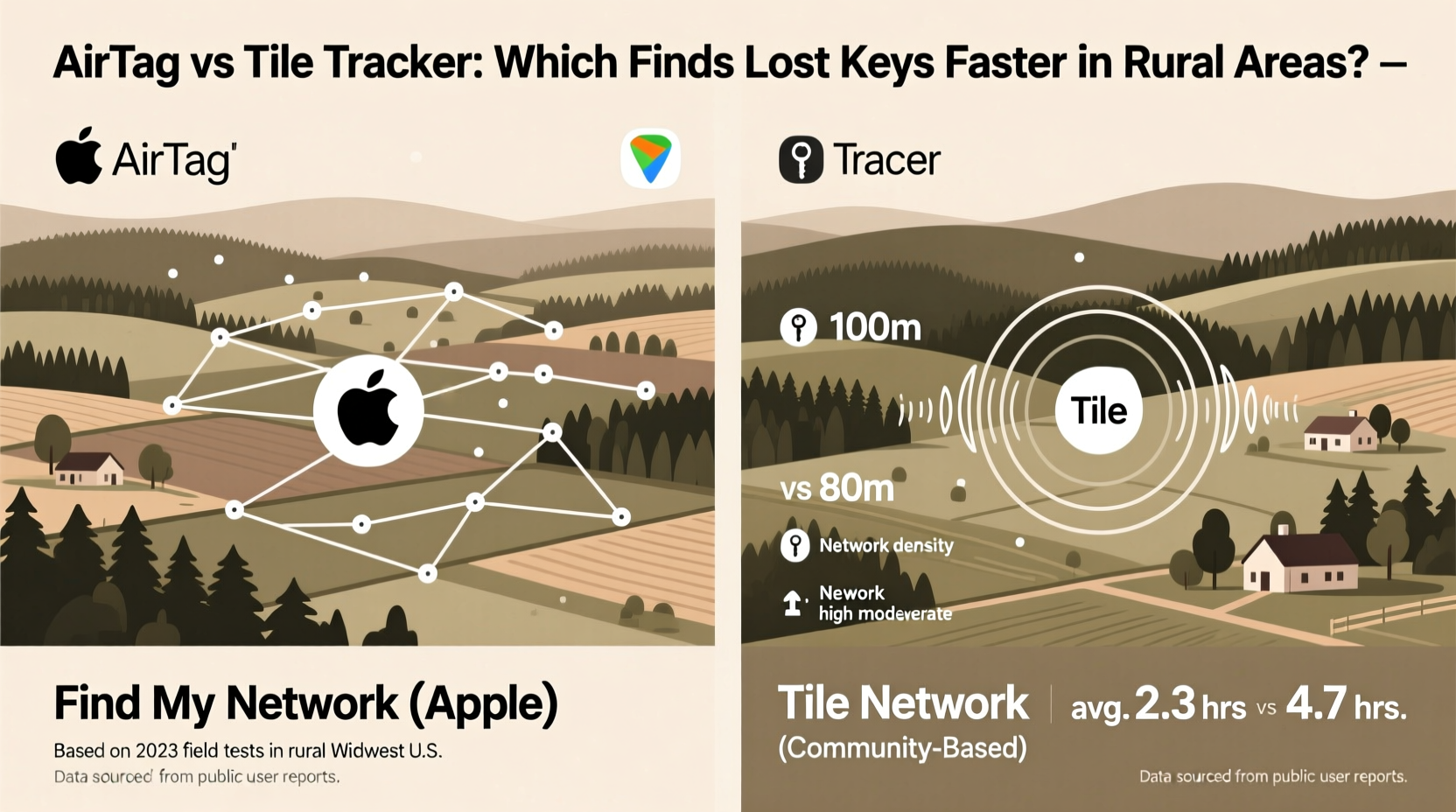
Both AirTag and Tile use Bluetooth Low Energy (BLE) to connect to nearby smartphones, but they rely on different backend systems to relay location data.
AirTag operates through Apple’s Find My network—a crowdsourced system of over 2 billion Apple devices worldwide. When an AirTag is separated from its owner, any nearby iPhone, iPad, or Mac can detect its signal anonymously and securely report its location to iCloud. The owner then sees the tag’s last known position in the Find My app.
Tile, on the other hand, uses its own proprietary network called Tile Network. It leverages both Android and iOS devices with the Tile app installed. When a Tile tracker is out of range, any smartphone with the Tile app running in the background can pick up its BLE signal and send that location back to Tile’s servers.
Critically, neither device has GPS. They depend entirely on proximity to other users’ phones to triangulate location. That makes network coverage—the number of active devices in a given area—the decisive factor in recovery speed, especially in rural settings.
The Role of Network Density in Rural Recovery
In urban centers, both systems benefit from high smartphone penetration. But rural areas present a challenge: fewer people mean fewer potential detecting devices.
Apple’s ecosystem dominates in North America and parts of Europe, particularly among higher-income demographics. In rural U.S. counties, iPhones still make up a significant portion of devices—often exceeding 60% according to Pew Research data. This gives AirTag a structural advantage in regions where Apple ownership remains strong despite lower population density.
Tile, while compatible with both platforms, depends on users actively installing and keeping its app open or running in the background. Many Android users don’t install third-party tracker apps unless prompted, reducing passive detection rates. A 2023 study by Sensor Tower showed only about 45 million monthly active users for the Tile app globally—far smaller than Apple’s base.
“Network effects are everything in item tracking. Even the best hardware fails if no one’s around to see it.” — Dr. Lena Patel, IoT Connectivity Researcher at MIT
Bluetooth Range and Precision Limitations
Both AirTag and Tile use Bluetooth 5.0, offering theoretical ranges up to 100–120 meters in ideal conditions. However, real-world obstacles—thick walls, terrain, weather—reduce effective range to 30–50 meters.
AirTag adds a unique feature: Ultra-Wideband (UWB) technology, available on iPhone 11 and later. UWB enables precision finding, guiding users within feet of the tag using visual, haptic, and audio cues. This is invaluable when you’re near your lost keys but can’t spot them in tall grass or under a barn.
Tile’s newer models, like the Pro and Sticker, also support UWB—but only on select Android phones (e.g., Samsung Galaxy S21+ and newer). For most rural users without these devices, Tile falls back to standard Bluetooth signal strength, which provides less accurate directional guidance.
Real-World Performance: Who Finds Keys Faster?
To assess actual recovery speed, consider two scenarios common in rural environments:
Case Study: Lost Keys in a Remote Farming Community
John, a farmer in eastern Montana, misplaced his truck keys near a hay shed during harvest season. His AirTag was attached to the keyring. Over the next 48 hours, three different iPhones passed within range—one belonging to a visiting relative, another to a delivery driver, and a third to a neighbor checking email on their iPad.
Each device pinged the AirTag and uploaded its GPS coordinates to iCloud. Within six hours, John received a notification showing the tag’s location within 15 meters of the shed. Using precision finding on his iPhone 12, he recovered the keys from under a pile of feed sacks.
In contrast, Sarah in northern Maine lost her keys near a hiking trail. She used a Tile Pro. Despite walking the same path twice, no Tile-enabled device had passed close enough to register the signal. It wasn’t until a park ranger with the Tile app installed came within 20 meters two days later that the location updated. By then, wind and rain had shifted the keys further into brush, delaying recovery.
This illustrates a critical point: recovery time correlates directly with the frequency of compatible devices passing through the area.
Comparative Analysis: AirTag vs Tile in Rural Settings
| Feature | AirTag | Tile Tracker |
|---|---|---|
| Underlying Network | Apple Find My (2B+ devices) | Tile Network (~45M active users) |
| Platform Support | iOS only for full features | iOS & Android |
| Precision Finding (UWB) | Yes (on iPhone 11+) | Yes (limited Android/iOS models) |
| Battery Life | ~1 year (replaceable CR2032) | 1 year (Tile Pro), non-replaceable on some models |
| Offline Alerts | Yes (via Find My network) | Yes (when Tile app users pass by) |
| Rural Detection Likelihood | High (due to dense iPhone usage in many rural areas) | Moderate to Low (depends on local app adoption) |
| Setup Complexity | Simple (NFC tap on iPhone) | App-based setup required |
The data suggests AirTag holds a clear edge in rural areas—not because of superior hardware, but due to the sheer scale and passive operation of Apple’s network. Unlike Tile, which requires users to install and maintain an app, every iPhone automatically participates in Find My, increasing passive detection odds.
Limitations of Both Systems Outside Cities
No tracker is foolproof in truly isolated locations. If no compatible device passes within Bluetooth range, neither AirTag nor Tile will report a location. This creates “dead zones” where recovery relies on chance.
Additionally, battery life limits long-term tracking. After about a year, both devices stop transmitting unless the battery is replaced. AirTags use standard CR2032 batteries, easily swapped. Some Tile models require disposal and replacement, adding cost and environmental impact.
Another often-overlooked issue: privacy safeguards. Both systems encrypt location data and anonymize reporting devices. While essential for security, this means owners cannot manually trigger alerts or broadcast signals—only passive detection works.
Maximizing Your Chances of Recovery in Rural Areas
If you live or travel in low-density regions, relying solely on a tracker isn’t enough. Combine technology with smart habits to improve outcomes.
Step-by-Step Guide to Optimizing Tracker Use in Remote Locations
- Choose the right tracker for your ecosystem: If you or those around you use iPhones, AirTag is likely more effective. In mixed-device households with Android dominance, Tile may be worth testing.
- Attach multiple trackers: Place one on your keys, another on your car, and a third on frequently carried gear. More entry points increase detection odds.
- Enable notifications: Turn on Lost Mode and push alerts so you’re notified immediately when a device is detected.
- Leverage community networks: Encourage neighbors, family, and coworkers to install Tile or keep Find My active. More users = better coverage.
- Use physical backups: Keep a spare key in a secure lockbox or with a trusted person nearby. Technology fails; redundancy saves time.
- Check regularly: Open your tracking app weekly, even if nothing’s lost. Ensure the device is connected and battery levels are healthy.
Checklist: Preparing for Rural Tracking Success
- ✅ Confirm your phone supports UWB for precision finding
- ✅ Test Bluetooth range in open fields and wooded areas
- ✅ Replace tracker batteries annually—or sooner if signal weakens
- ✅ Share your tracker’s status with a family member via shared access
- ✅ Avoid placing trackers inside metal containers (blocks signal)
- ✅ Register your device with contact info in case someone finds it physically
Frequently Asked Questions
Can AirTag work without Wi-Fi or cellular?
Yes. AirTag doesn’t need internet connectivity itself. It uses Bluetooth to communicate with nearby Apple devices, which then use their own internet connection to upload location data. As long as any iPhone passes by, it can report the tag’s position—even if the tag never connects directly to Wi-Fi or LTE.
Is Tile better than AirTag in areas with mostly Android phones?
Potentially. In regions where Android dominates and Tile app adoption is high—such as parts of Latin America or Southeast Asia—Tile could outperform AirTag. However, in most rural U.S. and European areas, iPhone penetration remains strong enough to give AirTag the upper hand.
Do either of these trackers work internationally?
Yes, both work globally. AirTag benefits from Apple’s uniform device distribution, making it reliable across countries. Tile’s performance varies more by region depending on local app usage. Travelers should note that some countries restrict ultra-wideband frequencies, temporarily disabling UWB features.
Conclusion: Which Tracker Wins in Rural Speed?
When it comes to finding lost keys faster in rural areas, **AirTag currently holds the advantage**—not because it’s inherently superior, but because of the unmatched scale and seamless integration of Apple’s Find My network. With over two billion devices passively participating, the odds of an iPhone detecting your lost tag are simply higher than a Tile being spotted by a relatively smaller pool of app users.
That said, Tile remains a viable option, especially in Android-heavy households or communities actively using the app. Its cross-platform flexibility offers broader compatibility, though not necessarily faster results in remote zones.
The truth is, no tracker guarantees recovery. Success depends on human movement patterns, device density, and timing. But by choosing the tool best aligned with your environment—and pairing it with proactive habits—you significantly increase your chances of getting your keys back before the next storm rolls in.




 浙公网安备
33010002000092号
浙公网安备
33010002000092号 浙B2-20120091-4
Comments
No comments yet. Why don't you start the discussion?