
Choosing a smartphone isn’t just about picking the most expensive option—it’s about understanding what you’re actually paying for. The Alcatel Onyx and Samsung Galaxy S8 represent two ends of the market spectrum: one is an affordable entry-level device, while the other was a flagship powerhouse at its launch. But does spending significantly more on the Galaxy S8 translate into a noticeably better experience? Let’s break down the real differences in design, performance, camera quality, software, and longevity to determine whether the extra cost is truly justified.
Design and Build Quality
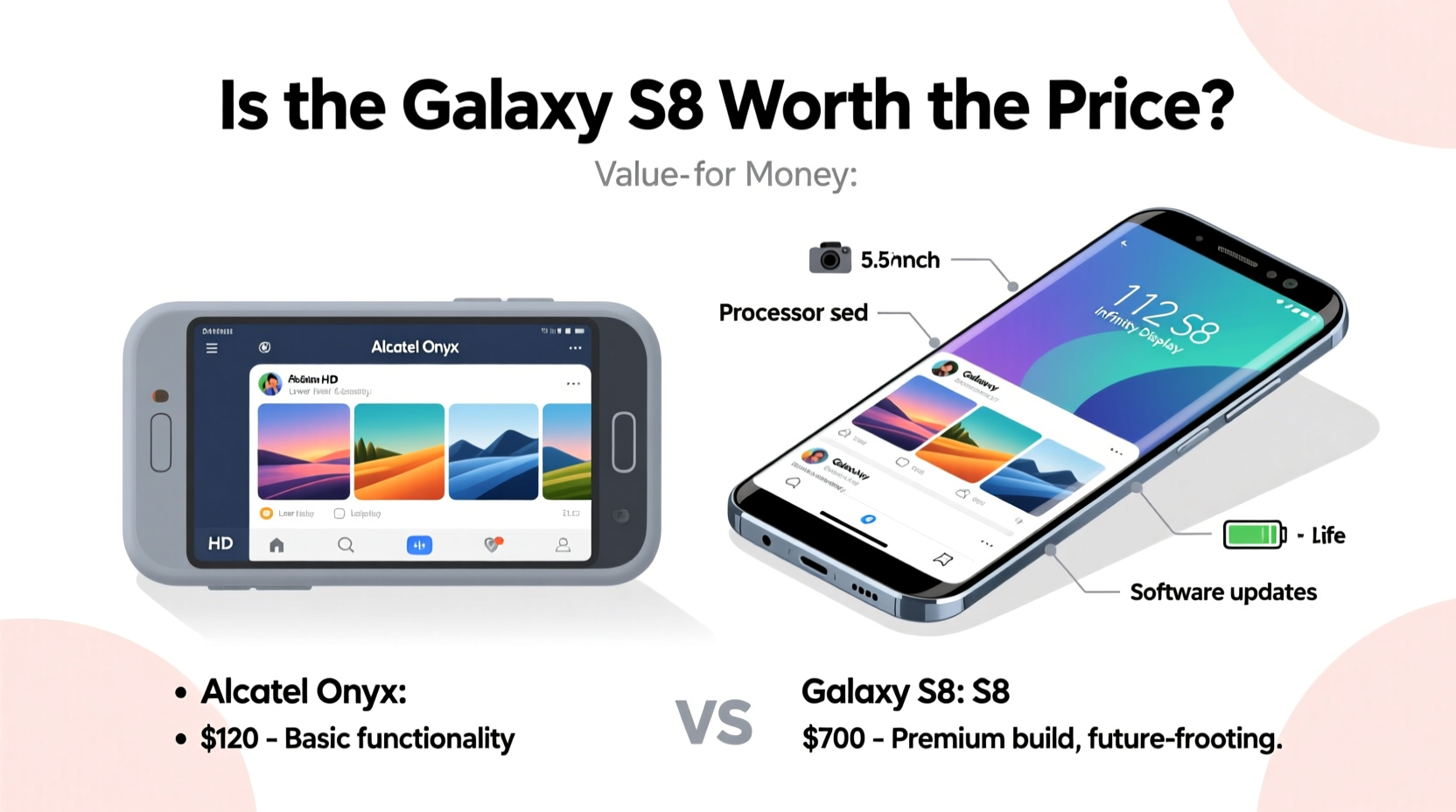
The first thing users notice is how a phone feels in hand. The Alcatel Onyx, released as a budget-friendly model, uses a polycarbonate plastic body with minimal embellishments. It’s lightweight and functional but lacks the premium feel many associate with high-end devices. At 5.5 inches, it offers a decent screen size for media consumption, though the display resolution caps at HD (720p), resulting in less sharp visuals compared to modern standards.
In contrast, the Samsung Galaxy S8 was a design milestone when it launched in 2017. With its nearly bezel-less Infinity Display, curved edges, and glass-metal sandwich construction, it set a new benchmark for smartphone aesthetics. The 5.8-inch Quad HD+ (1440p) AMOLED screen delivers vibrant colors, deep blacks, and excellent brightness—ideal for streaming, gaming, or photo editing. The build exudes sophistication, even if the glass back makes it more prone to drops.
Performance and Daily Usability
Under the hood, the gap widens. The Alcatel Onyx runs on a modest quad-core MediaTek processor paired with 2GB of RAM. This setup handles basic tasks like calls, messaging, and light web browsing adequately. However, multitasking is sluggish, app launches are slow, and modern apps—especially social media platforms or streaming services—can stutter or crash.
The Galaxy S8, powered by either the Snapdragon 835 or Exynos 8895 (depending on region), comes with 4GB of RAM. Even by today’s standards, this configuration ensures smooth navigation, fast app switching, and reliable performance across demanding applications. Whether editing photos, playing mobile games, or using augmented reality features, the S8 responds instantly. Its internal storage options (64GB base, expandable via microSD) also outpace the Onyx’s limited 16GB.
“Flagship processors from even five years ago often outperform current budget chips due to architectural advantages and optimization.” — David Lin, Mobile Hardware Analyst
Camera Comparison: Photos That Speak Volumes
For many users, camera quality is a deciding factor. The Alcatel Onyx features an 8MP rear camera with LED flash and basic autofocus. In good lighting, it captures usable images, but details are soft, dynamic range is narrow, and low-light performance is poor. The front-facing 5MP camera struggles with facial exposure and produces grainy selfies.
The Galaxy S8’s 12MP rear sensor, equipped with Dual Pixel technology and an f/1.7 aperture, excels in multiple conditions. It captures richly detailed photos with accurate color reproduction and excellent low-light clarity. Optical image stabilization reduces blur, and advanced software processing enhances HDR and night shots. The 8MP front camera supports auto-focus and face detection, delivering sharper selfies and smoother video calls.
If photography matters—even casually—the Galaxy S8 provides a dramatically superior experience. It’s not just about megapixels; it’s about sensor quality, lens design, and computational photography working together.
Detailed Feature Comparison
| Feature | Alcatel Onyx | Samsung Galaxy S8 |
|---|---|---|
| Display | 5.5\", HD (720p) IPS LCD | 5.8\", Quad HD+ (1440p) Curved AMOLED |
| Processor | MediaTek MT6737, Quad-core | Snapdragon 835 / Exynos 8895, Octa-core |
| RAM | 2GB | 4GB |
| Storage | 16GB (expandable) | 64GB (expandable) |
| Rear Camera | 8MP, f/2.0 | 12MP, f/1.7, OIS, Dual Pixel |
| Front Camera | 5MP | 8MP, Auto-Focus |
| Battery | 3000 mAh | 3000 mAh (Fast Charging Supported) |
| Software | Android 7.0 (No major updates) | Launched on Android 7, Upgradable to Android 9 |
| Biometrics | Rear fingerprint sensor | Fingerprint, Iris Scanner, Face Unlock |
| Water Resistance | No | IP68 Rated |
Longevity and Software Support
One of the most overlooked aspects of smartphone value is long-term usability. The Alcatel Onyx shipped with Android 7.0 Nougat and received no major OS upgrades. App compatibility degrades over time, security patches are no longer available, and newer versions of popular apps may not run smoothly—or at all. This limits the device’s lifespan to roughly two years of reliable use.
The Galaxy S8, despite being older in release date, enjoyed four years of major Android updates (up to Android 10 in some regions) and monthly security patches until early 2021. Even now, many users report stable performance with current apps. Samsung’s commitment to software support means the S8 remained functional and secure far longer than budget counterparts like the Onyx.
Real-World Example: Maria’s Upgrade Dilemma
Maria, a freelance writer and student, needed a reliable phone for research, note-taking, and staying connected. She initially considered the Alcatel Onyx due to its $120 price tag. After using it for three months, she found herself frustrated: apps froze during lectures, her notes wouldn’t sync properly, and the camera couldn’t capture whiteboard content clearly. She ended up reselling it and purchasing a used Galaxy S8 for $180. The difference was immediate—faster typing, seamless multitasking between browsers and cloud apps, and a camera that made document scanning effortless. Though she spent more upfront, the S8 lasted her over two additional years without issues, proving more economical in the long run.
Is Paying More for the Galaxy S8 Worth It?
The answer depends on your needs. If you only require a phone for calls, texts, and occasional YouTube viewing—and plan to replace it within a year—the Alcatel Onyx might suffice. But if you rely on your phone for productivity, photography, entertainment, or want a device that lasts, the Galaxy S8 delivers tangible benefits that justify its higher cost.
Consider these factors:
- Display quality affects eye comfort and immersion.
- Processing power determines how smoothly your daily apps perform.
- Camera capability impacts everything from social media to work documentation.
- Software support influences security and app compatibility over time.
- Resale value tends to be higher for flagships, reducing long-term cost.
Checklist: When the Galaxy S8 Is Worth the Investment
- You use your phone for more than basic communication.
- You take photos or record videos regularly.
- You want a device that stays updated and secure for 3+ years.
- You value a premium design and immersive display.
- You multitask across apps or use productivity tools.
Frequently Asked Questions
Can the Alcatel Onyx handle social media apps?
Yes, but expect lag when scrolling through Instagram or Facebook. Video loading is slower, and background app refresh is limited due to lower RAM. Heavy usage leads to overheating and crashes.
Is the Galaxy S8 still usable in 2024?
Absolutely. While it won’t match new flagships, it runs core apps like WhatsApp, Gmail, Chrome, and Zoom efficiently. Battery life may degrade depending on usage, but replacements are available. Performance remains solid for everyday tasks.
Does the Galaxy S8 have Bluetooth and NFC?
Yes. It supports Bluetooth 5.0, NFC for Samsung Pay, GPS, and USB-C. The Onyx has Bluetooth 4.2 and lacks NFC entirely.
Final Verdict
Paying more for the Samsung Galaxy S8 wasn’t just about brand prestige—it was an investment in better materials, faster performance, superior imaging, and longer software relevance. While the Alcatel Onyx serves a niche for ultra-budget buyers, its limitations become apparent quickly in real-world use. The Galaxy S8, even years after release, continues to offer a balanced, capable experience that justifies its original premium price.
Smartphone value isn’t measured solely by upfront cost. It’s calculated over time—through reliability, functionality, and how well the device integrates into your life. For most users, the Galaxy S8 proves that sometimes, paying more upfront saves money and frustration in the long term.




 浙公网安备
33010002000092号
浙公网安备
33010002000092号 浙B2-20120091-4
Comments
No comments yet. Why don't you start the discussion?