
Teaching children how to tell time is a foundational skill that supports their understanding of daily routines, sequencing, and even early math concepts. But in an age where digital devices dominate—phones, tablets, microwaves, and smartwatches—parents and educators face a critical question: should kids first learn time using an analog clock or a digital display?
The answer isn’t as simple as choosing one over the other. While digital clocks offer clarity and precision, analog clocks provide a visual and spatial representation of time that aligns with how children naturally grasp abstract concepts. Understanding the strengths and limitations of each can help adults make informed decisions about how to introduce time effectively.
Why Learning Time Is More Than Just Reading Numbers
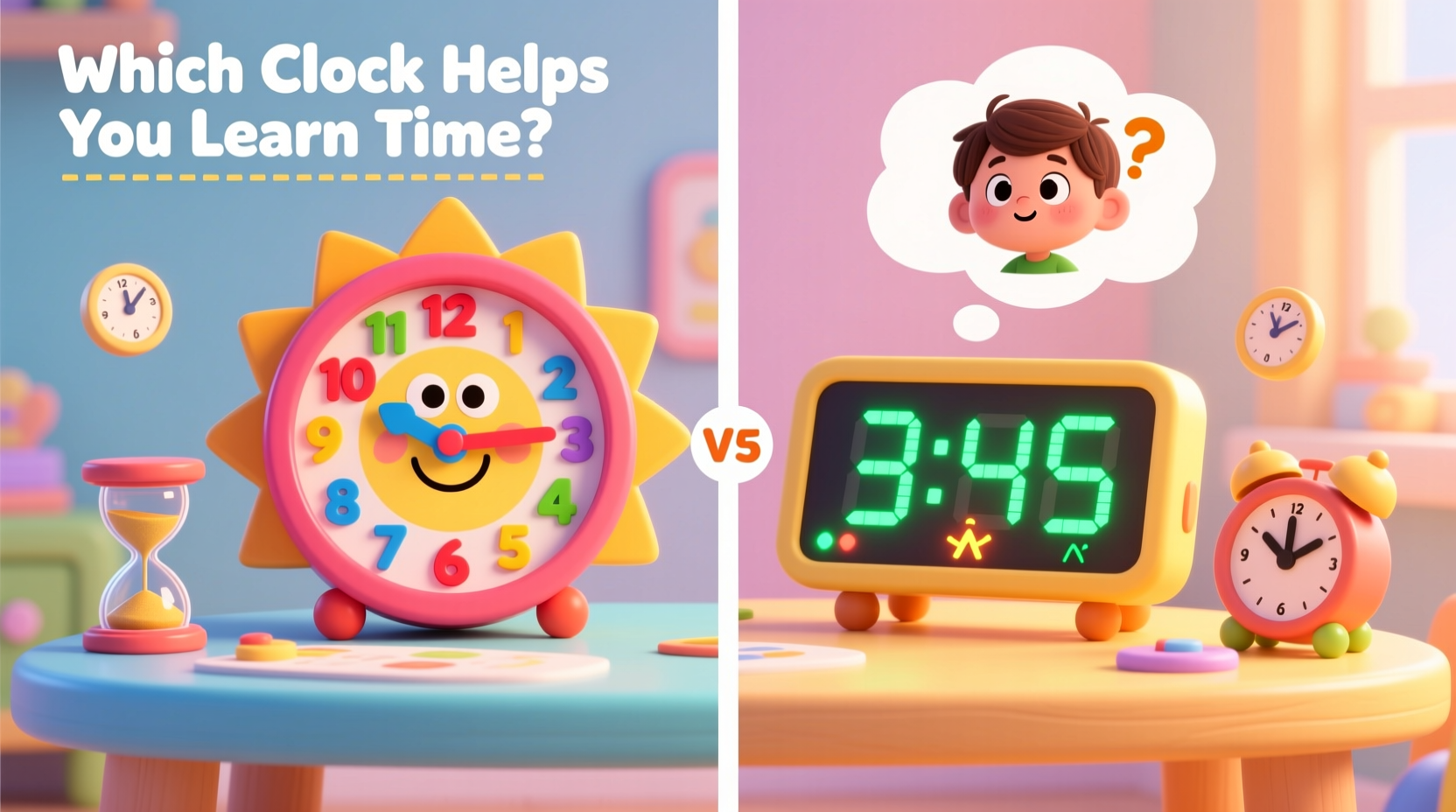
Telling time is not just about recognizing digits. It involves comprehension of duration, sequence, intervals, and relative terms like “half past” or “quarter to.” These concepts are inherently relational and continuous—not discrete. Digital displays show time in isolated numeric chunks (e.g., 3:45), while analog clocks represent time as a flowing cycle through the position of hands on a circular face.
This distinction matters for cognitive development. Young learners often struggle with abstract ideas because their brains are still developing the ability to think symbolically and spatially. The analog clock’s design mirrors real-world cycles—like the sun moving across the sky—and offers a concrete model for these intangible experiences.
“Children need visual metaphors to understand time. The analog clock acts like a timeline they can see and follow—it turns minutes into something they can almost touch.” — Dr. Linda Harper, Child Development Psychologist
Cognitive Advantages of Analog Clocks for Children
Analog clocks support several core learning domains essential for young minds:
- Spatial reasoning: The circular layout teaches directionality (clockwise movement), estimation, and proportional thinking.
- Fractional understanding: Concepts like “half past” or “a quarter to” directly relate to fractions—a major math standard in early grades.
- Time perception: Kids can visually gauge how much time has passed or remains before an event based on hand positions.
- Memory anchoring: Visual patterns (e.g., both hands pointing up at 12:00) create mental anchors that aid recall.
A study published in the Journal of Educational Psychology found that students who learned time primarily through analog instruction demonstrated stronger conceptual understanding of elapsed time compared to peers relying solely on digital formats. They were also better at estimating durations and solving word problems involving time.
In contrast, digital clocks present time as static data. There's no visible transition from 3:59 to 4:00—just an abrupt change. For a child trying to internalize the passage of time, this lack of continuity can hinder deeper comprehension.
Digital Displays: Clarity Over Context
Digital clocks have undeniable practical advantages. They eliminate ambiguity, especially for children with learning differences such as dyscalculia or attention challenges. Seeing “7:30” clearly displayed removes the need to interpret overlapping hands or estimate between marks.
Moreover, digital time is ubiquitous. From school schedules to kitchen timers, most modern interfaces use digital readouts. Familiarity with this format prepares children for everyday life and reinforces number recognition.
However, digital displays do little to teach the underlying structure of time. They don’t illustrate that 60 minutes make an hour or that two half-hours complete a full cycle. As a result, children may become proficient at reading numbers but remain confused when asked questions like, “How long until dinner if it’s 5:10 now and dinner is at 6?”
Still, digital tools can be valuable supplements. Many interactive apps combine digital output with animated analog visuals, helping bridge the gap between precision and conceptual depth.
Comparing Teaching Approaches: A Practical Breakdown
| Feature | Analog Clock | Digital Display |
|---|---|---|
| Conceptual Depth | High – shows relationships between units of time | Low – presents time as isolated values |
| Reading Accuracy | Moderate – requires interpretation of hand positions | High – exact numbers displayed instantly |
| Math Skill Support | Strong – ties into fractions, counting by fives, addition | Limited – mainly number recognition |
| Real-World Relevance | Mixed – common in schools and homes, less so in public spaces | Very high – used in transportation, devices, appliances |
| Learning Curve | Steeper – multiple steps involved in reading time | Gentler – immediate readability once numbers are known |
This comparison doesn’t declare a clear winner. Instead, it underscores the importance of a balanced approach. Relying exclusively on digital displays risks skipping foundational skills, while insisting only on analog may frustrate children accustomed to instant information.
Step-by-Step Guide to Teaching Time Using Both Formats
The most effective method integrates both analog and digital tools in a structured progression. Here’s a proven five-step sequence used by elementary educators:
- Introduce the concept of time through routine
Use daily activities (“We eat lunch at noon,” “School starts at 8”) to build awareness without focusing on clocks yet. - Start with the analog clock: focus on hours
Use a simplified clock showing only hour hands. Practice identifying whole hours (“It’s 3 o’clock when the hand points to 3”). Reinforce with stories or songs. - Add the minute hand gradually
Explain that the long hand counts minutes around the clock. Teach key benchmarks: 12 = 0 minutes, 3 = 15, 6 = 30, 9 = 45. Introduce phrases like “half past” and “quarter to.” - Pair analog practice with digital equivalents
Show that 3:30 on an analog clock matches “3:30” on a digital screen. Use side-by-side clocks or flashcards with both versions. - Practice elapsed time and real-life scenarios
Ask questions like, “If we leave at 4 and the trip takes 20 minutes, what time will we arrive?” Use both clock types to solve problems.
Real Example: How One Classroom Mastered Time Through Blended Learning
In Ms. Rivera’s second-grade class in Portland, Oregon, students initially struggled with telling time. A pre-assessment showed that 70% could read digital clocks accurately, but fewer than 30% understood analog representations.
She implemented a six-week unit combining physical analog clocks, digital timers, and interactive whiteboard games. Each morning began with “Clock Check”: students adjusted paper plate clocks to match the classroom digital display. Midweek lessons focused on elapsed time using story-based word problems involving recess, TV shows, and soccer practice.
By the end of the unit, post-test results revealed a dramatic shift: 85% of students could correctly read analog clocks, and nearly all demonstrated improved reasoning about time intervals. Notably, those who had previously shown frustration with abstract thinking made the greatest gains—thanks to the tactile, visual nature of the analog tools.
“They weren’t just memorizing,” Ms. Rivera noted. “They started saying things like, ‘The long hand is halfway around, so it must be half past.’ That kind of language tells me they truly get it.”
Essential Checklist for Parents and Educators
To ensure children develop strong time literacy, follow this actionable checklist:
- ✅ Begin instruction with analog clocks, emphasizing hours and half-hours
- ✅ Use large, clear clocks with color-coded hands (red for hour, blue for minute)
- ✅ Incorporate movement—have kids “be the hands” by positioning arms like clock hands
- ✅ Pair every digital time seen (on phones, ovens) with its analog equivalent
- ✅ Practice daily with real-life moments: “Look at the clock—what time is it now?”
- ✅ Introduce AM/PM distinctions after mastery of basic reading
- ✅ Limit reliance on voice assistants (“Siri, what time is it?”) during learning phases
FAQ: Common Questions About Teaching Time
At what age should children start learning to tell time?
Most children begin grasping time concepts between ages 5 and 7. Start with basic hour recognition in kindergarten, then progress to minutes and elapsed time in first and second grade. Every child develops differently, so adapt pacing to individual readiness.
Can children learn time effectively using only digital clocks?
While children can learn to *read* time digitally, they often miss out on conceptual understanding. Without exposure to analog models, they may struggle with fractions, duration estimation, and scheduling tasks. Digital should complement—not replace—analog instruction.
My child finds analog clocks confusing. What should I do?
Break the process into smaller steps. Focus first on the hour hand alone. Use storytelling (“The hour hand is sleepy and moves slowly”) or gamification (digital apps with gradual unlocking levels). Celebrate small wins and avoid rushing.
Conclusion: Building a Foundation That Lasts
When it comes to teaching time, the goal isn’t just accuracy—it’s understanding. Analog clocks offer a rich, visual framework that nurtures cognitive growth, mathematical thinking, and real-world reasoning. Digital displays provide clarity and modern relevance but fall short in conveying the essence of time as a continuous flow.
The best approach embraces both. Start with analog to build deep comprehension, then reinforce with digital to ensure fluency in today’s world. By doing so, children gain not only the ability to read clocks but also the confidence to manage their days, plan ahead, and think critically about how time shapes their lives.




 浙公网安备
33010002000092号
浙公网安备
33010002000092号 浙B2-20120091-4
Comments
No comments yet. Why don't you start the discussion?