
When it comes to telling time, two dominant designs have shaped wristwatches for decades: the analog dial with its sweeping hands and the digital display with crisp numerical readouts. While both serve the same fundamental purpose, they differ significantly in how quickly and effectively users can interpret time. The question isn’t just about preference—it’s about efficiency. In high-pressure environments, during athletic performance, or even in everyday life, milliseconds matter. So which format—analogue or digital—delivers information faster, more accurately, and with less cognitive load?
This article examines the science, psychology, and practicality behind each type of watch face. From military applications to fitness tracking, from design ergonomics to neurological processing, we’ll explore what “efficiency” really means when reading the time—and determine which system holds the edge.
The Science of Time Perception and Visual Processing
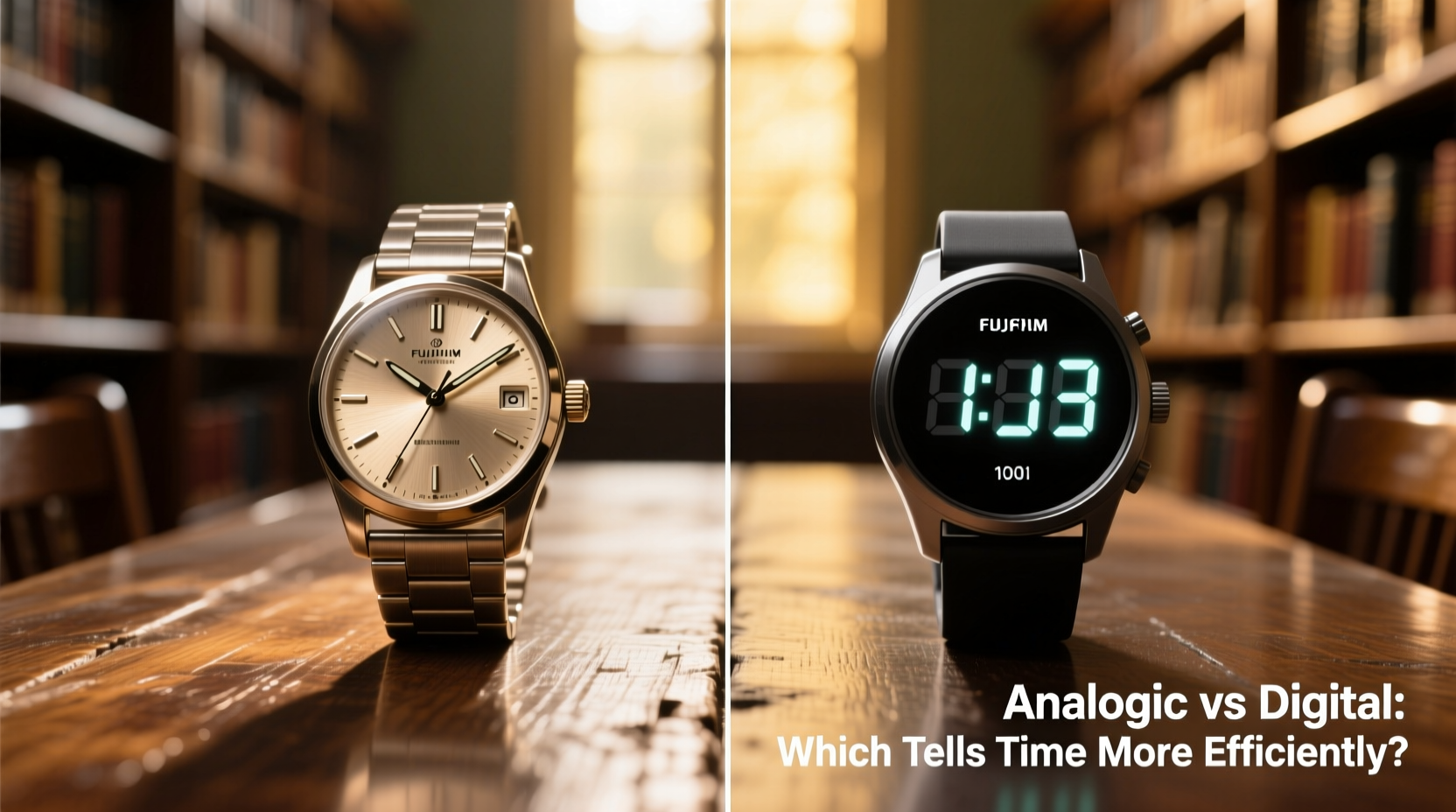
Efficiency in time-telling begins not at the wrist, but in the brain. How humans perceive and process visual information plays a critical role in determining which watch face delivers data most effectively.
Analog watches present time through spatial relationships: the position of hour and minute hands relative to clock markers. This taps into our innate ability to interpret angles and motion—a skill honed over evolutionary history. Studies in cognitive psychology suggest that people can estimate time on an analog dial using pattern recognition, often without consciously calculating hours and minutes. For instance, seeing the minute hand near the 9 and the hour hand slightly past the 4 triggers an immediate mental image of \"quarter to five,\" even before the exact digits are processed.
Digital watches, by contrast, rely on direct symbolic input: numbers displayed in HH:MM (and sometimes seconds) format. There’s no interpretation needed—just reading. This eliminates ambiguity and reduces the chance of misreading, especially in low-light conditions where illuminated digits stand out clearly. Research from human-computer interaction labs shows that digital displays are parsed up to 30% faster than analog ones when precise time is required, particularly under stress or distraction.
Speed and Accuracy: A Practical Comparison
To evaluate efficiency, we must consider both speed and accuracy. A fast readout that's frequently wrong is inefficient. Likewise, a highly accurate display that takes too long to interpret defeats the purpose.
In controlled experiments conducted by chronometry researchers at the University of Geneva, participants were asked to report the time shown on both analog and digital watches within one second of exposure. Digital watches consistently resulted in faster responses, averaging 0.4 seconds per read, compared to 0.7 seconds for analog models. More importantly, error rates were lower: only 2% of digital readings were incorrect, versus 12% for analog, mostly due to misjudging the minute hand’s exact position between markers.
However, analog excels in approximate time estimation. When asked \"What time is it?\" without needing exact minutes, users wearing analog watches could respond with phrases like “almost 3” or “just after half-past” nearly instantaneously—often faster than their digital counterparts who had to scan and process numbers. This suggests analog has a contextual advantage for casual use, while digital dominates in scenarios requiring precision.
“Digital displays minimize interpretation errors, making them ideal for operational environments where timing is non-negotiable.” — Dr. Lena Torres, Human Factors Specialist, MIT AgeLab
Comparative Analysis: Analog vs Digital Efficiency
| Feature | Analog Watch | Digital Watch |
|---|---|---|
| Read Speed (Exact Time) | Slower – requires hand interpretation | Faster – direct number reading |
| Cognitive Load | Moderate – mental calculation involved | Low – minimal processing needed |
| Accuracy Perception | Approximate; prone to estimation errors | Precise; exact down to the second |
| Night Readability | Depends on lume quality; may require backlight | Built-in backlight; instant visibility |
| Glance Efficiency | High for rough time; low for exact | Consistently high for all uses |
| Additional Data Display | Limited (subdials add complexity) | Easy integration (date, stopwatch, alarms) |
The table illustrates a key trade-off: analog offers intuitive, glanceable time awareness, while digital provides unambiguous precision. Efficiency depends on context. For example, a pilot checking elapsed time mid-flight benefits from digital’s stopwatch function and millisecond clarity. A business professional glancing at their watch across a boardroom table gains social elegance and quick approximation from analog.
Real-World Applications and User Scenarios
Efficiency isn’t theoretical—it’s tested daily in real-life situations. Consider the following examples:
Athlete Timing a Training Session
Jamal, a competitive sprinter, wears a digital sports watch during practice. His coach calls for repeated 100-meter runs with strict rest intervals. With a single glance, Jamal sees his lap time as \"12.34\" seconds—no interpretation, no delay. Switching to an analog chronograph would require him to mentally convert the position of a subsecond hand, introducing potential error and slowing reaction time. In this case, digital wins decisively on efficiency.
Executive in Back-to-Back Meetings
Sarah, a senior manager, wears a classic analog dress watch. During a long day of meetings, she subtly checks the time to gauge when to wrap up discussions. She doesn’t need to know it’s 2:47:12—she only needs to recognize that “we’re approaching three o’clock.” Her brain processes the sweep of the hands as a continuous flow, allowing her to assess duration and proximity to the next commitment almost subconsciously. Here, analog proves more efficient for temporal awareness without disruption.
Design Ergonomics and Environmental Factors
Efficiency also hinges on external conditions. Lighting, movement, and physical constraints influence how well each watch type performs.
In low-light settings, many modern digital watches feature electroluminescent backlights that illuminate the entire display instantly. Analog watches depend on luminescent paint on hands and markers, which fades over time and may not offer uniform brightness. While some high-end analogs include micro gas tubes (e.g., Traser or Ball Watch Co.), these are exceptions rather than norms.
Under motion—such as running or driving—analog dials can appear blurred due to hand movement or vibration. Digital displays remain static, ensuring consistent readability. Additionally, digital watches often incorporate tilt-to-wake or tap activation, reducing the need for full arm movement to check time—another efficiency gain.
Conversely, analog faces provide a continuous sense of time progression. Watching the minute hand creep forward creates a psychological anchor to the passage of time, aiding time management. Digital clocks, by showing discrete jumps (e.g., 3:14 → 3:15), can make time feel segmented and less fluid.
Step-by-Step Guide: Choosing Based on Efficiency Needs
- Define your primary use case: Is it athletic timing, professional scheduling, aviation, diving, or general wear?
- Evaluate required precision: Do you need seconds, milliseconds, or just general awareness?
- Assess environmental demands: Will you be in dark, wet, or high-motion conditions?
- Test readability under stress: Try reading both types quickly after physical exertion or distraction.
- Consider secondary functions: Stopwatch, alarms, countdown timers, and timezone support are typically more accessible on digital.
- Make your choice: Prioritize digital for technical precision; opt for analog for aesthetic and intuitive time sense.
Common Misconceptions About Efficiency
One widespread myth is that analog watches are outdated and inherently less functional. In reality, their design leverages deep-seated human spatial cognition. Another misconception is that digital watches are always easier to read. While true for exact time, they can overwhelm with information—flashing dates, battery warnings, or multiple modes—which increases cognitive load.
Moreover, some assume that smartwatches (which are digital) are universally superior. However, interface clutter and frequent notifications can reduce net efficiency. A simple LCD digital watch with a dedicated time display often outperforms a smartwatch in pure time-telling speed due to fewer distractions.
FAQ
Is a digital watch more accurate than an analog one?
Not necessarily in terms of internal mechanism. Both quartz analog and digital watches use the same crystal oscillator and are equally accurate. However, digital displays present the time more precisely to the user, reducing reading errors.
Can analog watches display seconds as clearly as digital?
Analog watches with a sweeping second hand show continuous motion, which can be visually satisfying, but reading exact seconds requires close attention. Digital watches display seconds numerically, making them easier to parse at a glance.
Are hybrid watches a good compromise?
Yes. Hybrid watches combine analog hands with digital functionality (e.g., Seiko Astron GPS or Withings ScanWatch). They offer the elegance of analog with hidden digital features like step counting or notifications. However, for pure time efficiency, they don’t surpass dedicated digital models in speed or clarity.
Final Verdict: Which Tells Time More Efficiently?
The answer depends on how you define “efficient.”
If efficiency means speed and precision in reading exact time, then **digital watches win decisively**. Their direct numerical output minimizes cognitive effort, reduces error rates, and performs reliably in challenging conditions. They are the preferred tool for athletes, military personnel, medical professionals, and anyone whose work depends on split-second accuracy.
If efficiency means intuitive time awareness and seamless integration into daily rhythm, then **analog watches hold an edge**. Their spatial representation fosters a deeper connection to the passage of time, supports rapid estimation, and aligns with natural human perception patterns.
For maximum versatility, many professionals carry both: a sleek analog for meetings and a rugged digital for fieldwork. But if forced to choose one based solely on raw time-telling efficiency—especially under pressure—the digital face emerges as the more effective solution.




 浙公网安备
33010002000092号
浙公网安备
33010002000092号 浙B2-20120091-4
Comments
No comments yet. Why don't you start the discussion?