
When it comes to fitness tracking, the choice between an analog and a digital watch isn’t just about style or functionality—it’s also about endurance. Battery life plays a crucial role in how reliably a device supports your active lifestyle. While digital smartwatches offer advanced metrics like heart rate monitoring, GPS, and step counting, they often demand frequent charging. On the other hand, traditional analog watches are known for their longevity, but can they truly compete when fitness tracking enters the equation?
The answer depends on what kind of fitness tracking you need and how much data you want at your fingertips. This article breaks down the battery performance, technological limitations, and practical trade-offs between analog and digital timepieces in the context of health and activity monitoring.
Digital Watches: Power-Hungry but Feature-Rich
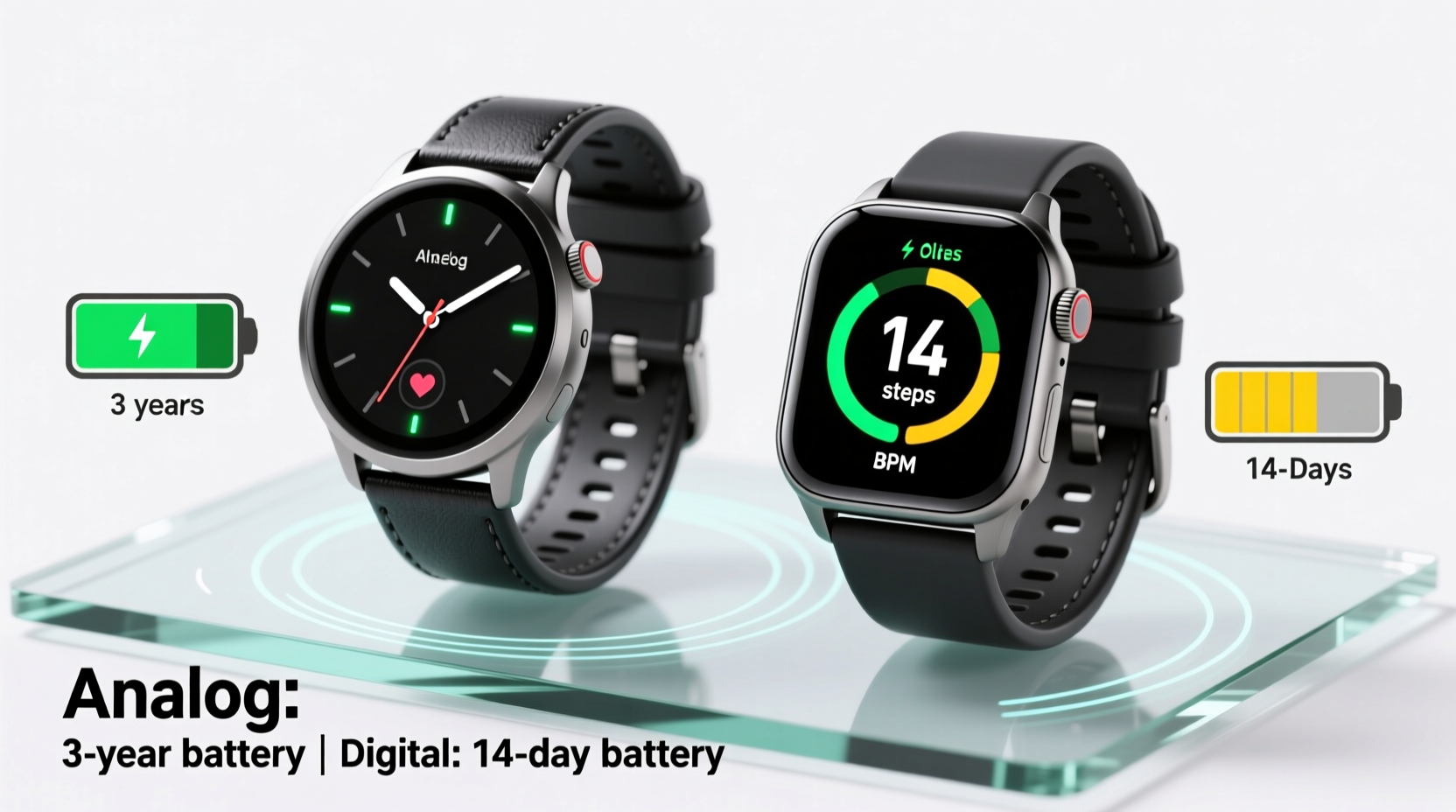
Digital fitness watches—such as those from Garmin, Apple, Fitbit, and Samsung—are engineered to deliver comprehensive health insights. They track steps, sleep patterns, heart rate, blood oxygen levels, stress indicators, and even menstrual cycles. Many include built-in GPS for outdoor workouts and sync seamlessly with smartphones for notifications and app integration.
However, this level of functionality comes at a steep energy cost. Most digital fitness trackers require daily or every-other-day charging. High-end models like the Apple Watch Series 9 typically last around 18–36 hours on a single charge under normal use. Even more efficient devices, such as the Garmin Forerunner series, max out at 7–14 days depending on GPS usage and screen brightness settings.
The primary reasons for short battery life in digital watches include:
- Constant sensor activation: Heart rate monitors and accelerometers run continuously.
- Bright displays: OLED or LCD screens consume significant power, especially when always-on.
- Wireless connectivity: Bluetooth, Wi-Fi, and cellular connections drain batteries quickly.
- Background processing: Apps and operating systems require ongoing CPU activity.
Analog Watches: Simplicity Equals Longevity
Traditional analog watches—especially mechanical or quartz-powered ones—are not designed for fitness tracking. Their appeal lies in craftsmanship, timeless design, and exceptional battery (or mainspring) life. A standard quartz analog watch can run for 2–5 years on a single battery. Mechanical watches, if wound regularly, can operate indefinitely without any battery at all.
But here's where the line blurs: hybrid analog watches. These are timepieces that look like classic analog watches but include subtle digital components for basic fitness tracking. Brands like Withings, Fossil (Hybrid HR), and Citizen have introduced models that blend hands-driven dials with internal sensors for step counting, sleep tracking, and activity recognition.
These hybrids typically last 4–12 months on a single battery, far surpassing most full-featured digital smartwatches. The reason? Minimalist electronics. Instead of vibrant screens and constant wireless syncing, they use low-energy Bluetooth, passive motion sensors, and occasional haptic feedback. Data is synced periodically to a smartphone app, reducing continuous power draw.
“Hybrid analog watches represent a sweet spot for users who value both aesthetics and light-touch health monitoring without sacrificing weeks—or months—of uptime.” — Dr. Alan Zhou, Wearable Technology Researcher, MIT Media Lab
Comparative Analysis: Battery Life vs. Functionality
To understand the trade-offs, consider the following comparison of typical battery performance across categories:
| Watch Type | Avg. Battery Life | Fitness Features | Rechargeable? | Sync Frequency |
|---|---|---|---|---|
| Standard Digital Smartwatch (e.g., Apple Watch) | 1–2 days | Full suite: HR, GPS, SpO₂, sleep, apps | Yes | Continuous |
| Fitness-Focused Digital (e.g., Garmin Venu) | 5–14 days | Advanced tracking with GPS & training metrics | Yes | Regular (daily) |
| Basic Fitness Tracker (e.g., Fitbit Inspire) | 5–10 days | Steps, sleep, HR, basic goals | Yes | Daily |
| Hybrid Analog (e.g., Withings ScanWatch) | 4–12 months | Steps, sleep, HR (intermittent), ECG | No (replaceable battery) | Manual or periodic |
| Classic Analog (no tech) | 2–5 years (quartz); indefinite (mechanical) | None | No | N/A |
The data shows a clear inverse relationship: the more advanced the fitness tracking, the shorter the battery life. If your priority is uninterrupted monitoring and rich data analytics, digital is the way to go—but expect frequent charging. If you prefer minimal intervention and long-term reliability, hybrid analogs offer a compelling compromise.
Real-World Example: Marathon Training with Limited Charging Access
Consider Sarah, a long-distance runner preparing for a trail marathon in remote mountain regions. She needs reliable step and heart rate tracking but has limited access to electricity during weekend training camps. Her initial choice was a high-end digital sports watch with GPS and VO₂ max estimation. However, she found herself unable to complete back-to-back long runs without recharging—a major setback.
She switched to a hybrid analog model with ECG and sleep tracking. While it didn’t provide real-time pace alerts or animated workout summaries, it accurately logged her daily activity and rest quality. Most importantly, it lasted over six months without maintenance and never failed her during multi-day excursions. For Sarah, the slightly reduced feature set was a fair trade for dependable battery performance.
This case illustrates a growing trend: athletes and outdoor enthusiasts are reevaluating whether “more data” truly enhances performance, or if consistent, long-lasting tracking provides greater practical value.
Step-by-Step Guide: Choosing Based on Battery Needs
Selecting the right watch involves aligning your fitness goals with battery expectations. Follow this decision framework:
- Define your tracking needs: Do you want continuous heart rate, GPS routes, or just step count and sleep duration?
- Assess your charging habits: Are you diligent about nightly charging, or do you forget devices for days?
- Evaluate your environment: Will you be traveling, camping, or in areas without easy power access?
- Test usability vs. longevity: Can you accept syncing less frequently for longer uptime?
- Compare hybrid options: Look for analog-style watches with essential sensors and replaceable batteries.
For instance, someone with a desk job who walks 8,000 steps daily may find a hybrid analog sufficient. In contrast, a triathlete needing swim stroke analysis and interval training metrics will benefit more from a digital watch despite its charging demands.
Tips for Maximizing Battery Life Across Devices
Regardless of your choice, small adjustments can significantly extend battery performance:
- Reduce screen brightness and timeout duration.
- Turn off vibration alerts for non-essential notifications.
- Limit GPS use to key workouts instead of all-day tracking.
- Use airplane mode overnight if sleep tracking doesn’t require connectivity.
- For hybrid watches, ensure firmware is updated—older versions sometimes have inefficient background processes.
Frequently Asked Questions
Can an analog watch track fitness at all?
Traditional analog watches cannot track fitness. However, hybrid analog models incorporate internal sensors to monitor steps, sleep, and sometimes heart rate or ECG. They appear like classic watches but connect to apps via Bluetooth for data review.
Why do digital watches die so fast compared to analog?
Digital watches run complex operating systems, bright displays, and multiple active sensors simultaneously. Analog watches—especially non-smart ones—have minimal electronic components. Even hybrid analogs use ultra-low-power chips and infrequent data transmission, preserving battery life.
Is it worth switching to a hybrid for better battery life?
If you don’t rely on real-time coaching, voice assistants, or streaming music from your wrist, then yes. Hybrids offer meaningful health insights with dramatically longer uptime. You’ll sacrifice some immediacy in feedback but gain months of uninterrupted use.
Final Verdict: Analog Wins on Battery Life—But Context Matters
In a head-to-head comparison focused solely on battery life, analog watches—particularly hybrid models—outperform digital fitness trackers by a wide margin. A single battery lasting up to a year dwarfs the few days offered by even the most efficient digital smartwatches.
Yet, superiority in battery life doesn’t automatically make analog the better choice. It depends on your definition of “better.” If you prioritize deep analytics, instant feedback, and seamless integration with health ecosystems, digital remains unmatched. But if you value simplicity, durability, and freedom from daily charging rituals, analog hybrids present a mature, elegant solution.
The future of wearable tech may lie in balancing these extremes. Emerging technologies like e-paper displays, solar charging (as seen in Garmin’s Instinct series), and AI-driven power management are narrowing the gap. Still, today’s reality is clear: for sheer battery efficiency in fitness tracking, analog—especially in hybrid form—holds the edge.




 浙公网安备
33010002000092号
浙公网安备
33010002000092号 浙B2-20120091-4
Comments
No comments yet. Why don't you start the discussion?