
Teaching children how to tell time is a foundational life skill that supports independence, time management, and mathematical reasoning. Yet, in an era dominated by digital displays—on phones, tablets, and smartwatches—parents and educators face a growing dilemma: should kids learn time using analog or digital watches? While both have their place, research and classroom experience suggest that analog watches offer distinct advantages in helping children truly understand the concept of time. Digital displays may show the hour and minute numerically, but they lack the visual representation crucial for grasping duration, intervals, and the passage of time.
The Cognitive Benefits of Analog Time-Telling
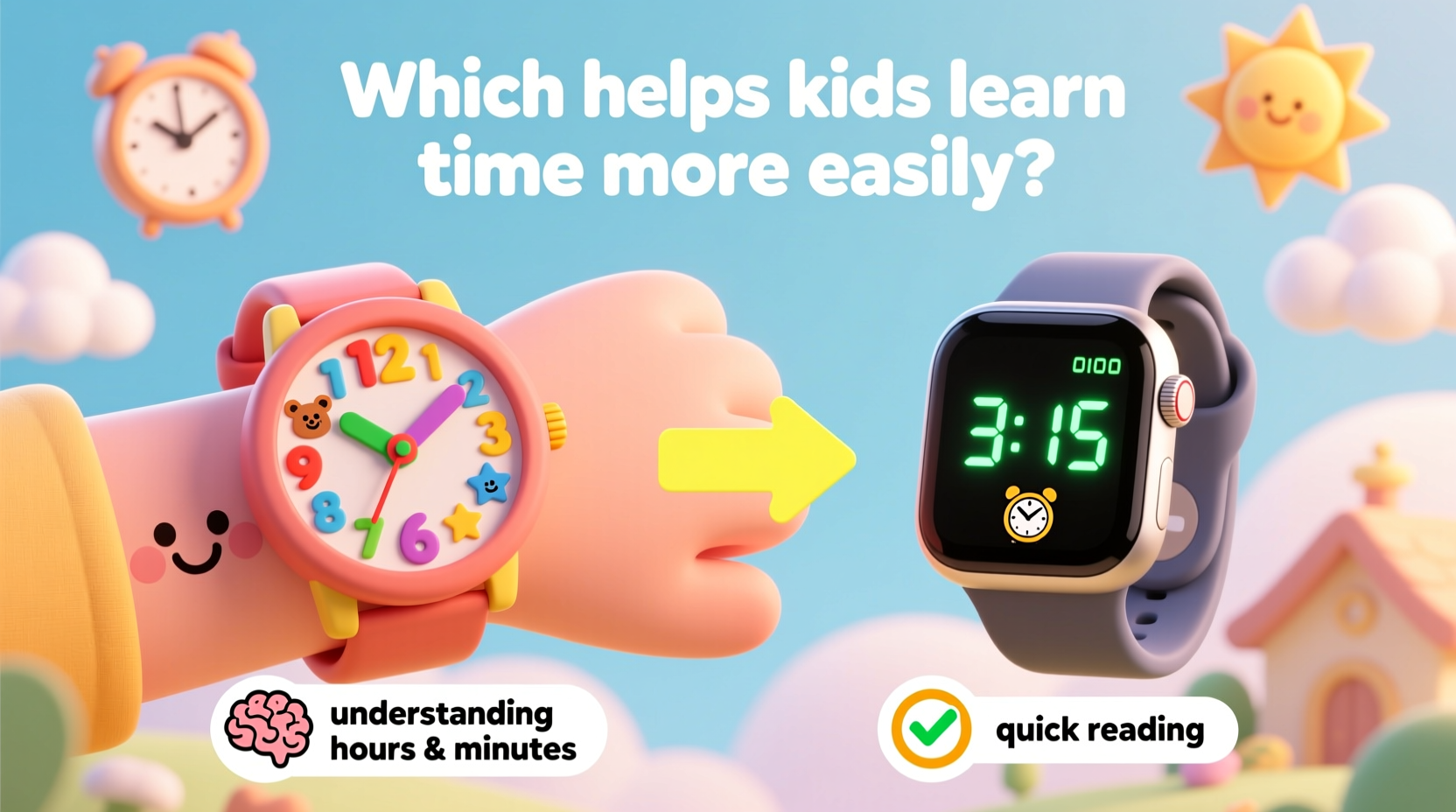
Learning to read an analog clock engages multiple areas of a child’s brain. Unlike digital clocks, which present time as isolated numbers (e.g., “3:45”), analog clocks use spatial relationships and movement to convey meaning. The circular layout mimics a number line bent into a loop, reinforcing concepts like sequencing, fractions, and estimation. When a child sees the minute hand halfway around the clock, they begin to internalize what “half past” means—not just as a phrase, but as a measurable portion of an hour.
Studies in educational psychology show that children who learn time on analog clocks develop stronger number sense and better estimation skills. According to Dr. Linda Griffin, a developmental education specialist at the University of Michigan:
“Analog clocks serve as dynamic math tools. They help children visualize abstract units like 60 minutes in an hour and support early fraction learning—like seeing a quarter of the clock for ‘quarter past.’ Without this foundation, time becomes a series of disconnected digits.”
This conceptual understanding is harder to achieve with digital clocks, which bypass the mental processing needed to interpret elapsed time. For example, when a child sees 3:45 on a digital display, there’s no visual cue indicating how close it is to 4:00. But on an analog clock, the proximity of the hands to the next hour makes this relationship clear.
Digital Watches: Simplicity vs. Depth
Digital watches are undeniably easier to read. The numbers are large, direct, and require no interpretation. This simplicity can be beneficial for older children or those with learning differences who need straightforward information. However, ease of reading doesn’t equate to deeper comprehension.
Digital time displays often reinforce rote memorization rather than understanding. A child might know that “7:30” means school starts, but not grasp that 30 minutes is half an hour—or that 15 minutes later will be 7:45. There’s no intuitive way to estimate how much time remains before an event when relying solely on digital formats.
Moreover, digital clocks disconnect time from its cyclical nature. On an analog face, children see the continuous flow of minutes and hours. The rotation of hands illustrates that time doesn’t just jump from one number to the next—it moves. This continuity supports the development of time awareness, which is essential for planning, punctuality, and self-regulation.
Comparing Learning Outcomes: Analog vs Digital
To better understand the impact of each format, consider how they influence key aspects of time literacy. The table below outlines critical learning dimensions and compares the effectiveness of analog and digital methods.
| Learning Dimension | Analog Watch | Digital Watch |
|---|---|---|
| Understanding Duration | Strong — visual motion shows passing time | Limited — static numbers don’t illustrate flow |
| Fraction Concepts | High — “half past,” “quarter to” are visually reinforced | Low — no visual link to fractional parts |
| Estimation Skills | Developed — children learn to approximate time between marks | Minimal — exact numbers reduce need for estimation |
| Clockwise Sequence | Reinforced through hand movement | No spatial sequence presented |
| Problem-Solving (e.g., “What time in 20 min?”) | Promotes mental calculation and visualization | Relies on counting up without context |
The data suggests that while digital watches deliver information efficiently, analog clocks foster deeper cognitive engagement. This doesn’t mean digital should be excluded—but rather that it should follow, not precede, analog instruction.
A Step-by-Step Guide to Teaching Time with an Analog Watch
Introducing time through an analog watch works best when broken into manageable stages. Here’s a proven five-step approach used by elementary educators:
- Start with the Hour Hand Only: Use a simplified clock showing only the hour hand. Practice identifying whole hours (e.g., “The hand points to 3, so it’s 3 o’clock”). This builds confidence before introducing complexity.
- Add the Minute Hand Gradually: Once the child masters hours, introduce the minute hand. Focus first on :00 and :30 (“o’clock” and “half past”) to emphasize symmetry and halves.
- Divide the Clock into Quarters: Teach “quarter past” and “quarter to” using visual cues. Color-code the clock face into four sections to reinforce fractional language.
- Practice Elapsed Time Visually: Use the clock to demonstrate how time passes. Ask questions like, “If we start at 2:15, where will the hand be in 30 minutes?” Move the hands together to show progression.
- Transition to Real-World Application: Incorporate time-telling into daily routines. Have the child check the analog clock before meals, bedtime, or TV time. Make it functional, not just academic.
This scaffolded method allows children to build understanding incrementally, reducing frustration and boosting retention.
Real Example: How One Classroom Mastered Time-Telling
In Ms. Elena Rivera’s second-grade classroom in Portland, Oregon, students struggled with time concepts despite repeated lessons. After switching from digital practice sheets to hands-on analog clock kits, she noticed a dramatic shift within six weeks.
“We started each morning by setting our mini-clocks to the current time,” she explains. “I’d ask, ‘Where will the minute hand be when recess ends?’ Kids had to move the hands themselves. Suddenly, they weren’t just reading numbers—they were predicting, calculating, and visualizing.”
By the end of the unit, 92% of her students could accurately tell time to the nearest five minutes, compared to 58% the previous year when digital-first methods were used. More importantly, they could explain their reasoning: “The long hand goes from 12 to 6—that’s half the circle, so it’s 30 minutes.”
This case underscores a key principle: physical interaction with analog tools deepens conceptual learning in ways digital interfaces cannot replicate.
When Digital Can Support Learning
While analog is superior for initial instruction, digital watches and devices can play a supportive role once core concepts are established. For instance:
- Digital timers help children track short durations (e.g., brushing teeth for two minutes).
- Smartwatch alarms can reinforce schedule adherence in older children developing independence.
- Dual-display watches (showing both analog and digital time) bridge the gap during transition phases.
The key is sequencing: teach the concept with analog, then use digital as a reinforcement tool. Introducing digital too early risks creating dependency on numeric output without underlying understanding.
Parent Checklist: Setting Up Your Child for Time Success
Use this checklist to ensure your child develops strong time-telling skills:
- ✅ Purchase a simple analog watch designed for kids (avoid smart features initially)
- ✅ Hang an analog clock in their room and common areas (kitchen, playroom)
- ✅ Label the clock with sticky notes: “o’clock,” “half past,” “quarter to”
- ✅ Practice daily: “What time is it now? What time will it be in 15 minutes?”
- ✅ Play time games: “Beat the clock” challenges or matching digital to analog times
- ✅ Avoid saying only digital times; use phrases like “quarter till” or “ten past” in conversation
- ✅ Be patient—mastery takes weeks, not days
Frequently Asked Questions
Can children with dyslexia or ADHD benefit from analog clocks?
Yes, but with tailored support. Children with attention or learning differences may find the visual structure of analog clocks helpful, especially when paired with color coding and consistent routines. However, some may initially respond better to digital displays for clarity. The key is individualized pacing—start with what reduces anxiety, then gradually introduce analog elements as confidence grows.
At what age should kids start learning to read an analog clock?
Most children are ready between ages 6 and 8 (first to third grade). By this stage, they typically understand basic numbers, sequencing, and the concept of time passing. Introducing analog clocks earlier—as decorative or interactive toys—can build familiarity, but formal instruction is most effective when aligned with school math curricula covering addition, subtraction, and fractions.
Are smartwatches bad for learning time?
Not inherently, but they can hinder foundational learning if introduced too soon. Smartwatches often default to digital time, notifications, and apps that distract from intentional time awareness. If used, disable non-essential features and encourage the child to refer to the analog mode (if available). Treat the device as a tool, not a replacement for direct learning.
Conclusion: Building a Lifelong Understanding of Time
The choice between analog and digital isn’t just about preference—it’s about building a meaningful relationship with time. While digital watches offer convenience, analog clocks provide the mental framework children need to understand how time works, not just what it says. By starting with analog, parents and educators equip kids with more than a skill; they foster spatial reasoning, estimation, and the ability to plan ahead.
Time is one of the first abstract concepts children encounter. How they learn to measure it shapes how they manage their days, meet responsibilities, and develop self-discipline. Choosing the right tool at the right time makes all the difference.




 浙公网安备
33010002000092号
浙公网安备
33010002000092号 浙B2-20120091-4
Comments
No comments yet. Why don't you start the discussion?