
In an age where digital screens dominate our perception of time, the analog watch remains a quiet statement of style, precision, and intentionality. Yet even within this classic format, a subtle but meaningful debate persists: should you choose a timepiece with a date window for added functionality, or opt for a minimalist dial that strips away all but the essentials? The answer isn’t just about aesthetics—it’s about clarity, cognitive load, and how quickly and accurately you can read the time in everyday situations.
This question matters not only to watch enthusiasts but also to professionals, travelers, and anyone who values efficiency in their daily tools. A watch is more than jewelry; it's a functional instrument. And like any instrument, its design directly affects performance. Let’s explore how these two styles compare when it comes to telling time clearly—and which one might serve you better depending on your lifestyle.
The Science of Time Perception and Dial Design
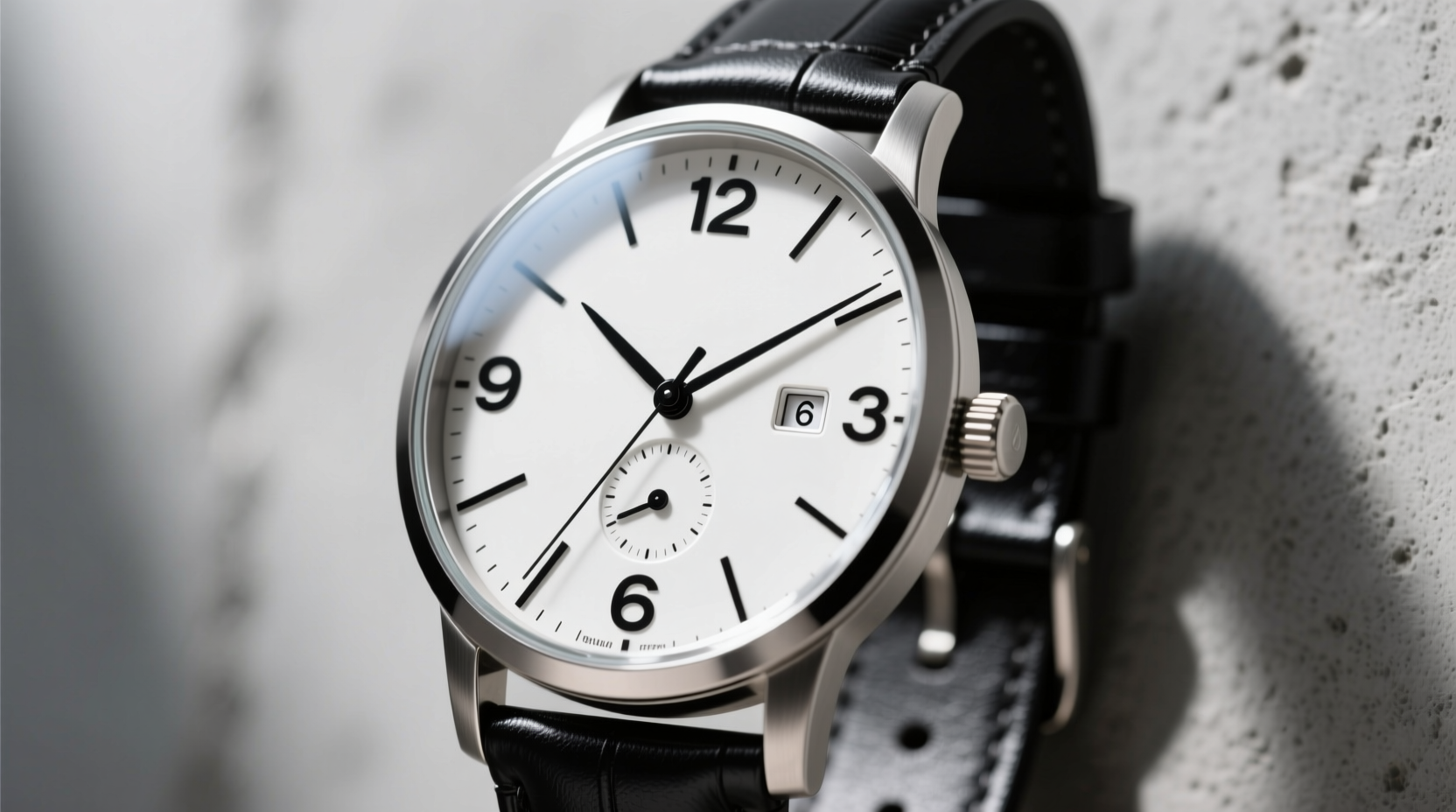
Reading time from an analog dial is a learned skill involving spatial recognition. Unlike digital displays, which present information numerically and instantly, analog watches require the brain to interpret positions of hands relative to markers. This process relies on pattern recognition and visual processing speed—both of which are influenced by clutter, symmetry, and contrast.
Studies in human factors engineering suggest that minimal visual noise leads to faster interpretation. In practical terms, this means fewer distractions on the dial allow quicker comprehension of the current hour and minute. When elements like date windows, subdials, logos, or excessive text compete for attention, they create what designers call “cognitive friction”—a delay caused by having to filter out irrelevant details.
A 2017 study published in *Ergonomics in Design* found that participants identified time 18% faster on minimalist dials compared to those with complications such as date indicators or day-of-week apertures. While the difference may seem small, in high-pressure environments—emergency response, aviation, or surgery—even fractions of a second matter.
“Time is a single data point we need to access instantly. Any deviation from clean symmetry reduces legibility.” — Dr. Lena Peterson, Human Factors Researcher at MIT Media Lab
Functional Trade-offs: Date Window vs Minimalist Clarity
The date window adds utility. For many users, knowing the day without reaching for a phone is convenient. But convenience comes at a cost: asymmetry. Most date windows are placed at the 3 o’clock position, disrupting the balance of the dial. This breaks radial harmony—the natural flow from center outward—which the human eye expects in circular designs.
Moreover, the aperture itself often introduces visual noise. Reflections inside the cutout, low-contrast numerals, or poorly aligned fonts can make the date hard to read while simultaneously distracting from the primary function: telling time.
In contrast, minimalist watches eliminate nearly everything non-essential. No brand logo (or a micro-logo), no date, no secondary numerals, sometimes no numerals at all—just indices or simple markers. The result is a field of unbroken clarity. Hands glide across open space, making angular relationships easier to parse.
Comparison Table: Key Differences at a Glance
| Feature | Analog Watch with Date Window | Minimalist Face Watch |
|---|---|---|
| Time Legibility | Moderate – distracted by date placement | High – unobstructed view of hands and markers |
| Dial Symmetry | Often broken by 3 o'clock aperture | Typically balanced and harmonious |
| Visual Noise | Higher – includes text, date numbers, frame lines | Lower – reduced to essential elements only |
| Functionality | Added feature: date display | Pure time-telling focus |
| Style Versatility | Balanced between formal and casual | Easily pairs with modern, professional attire |
| User Distraction | Potential glance drift toward date window | Focus remains centered on time |
Real-World Example: The Commuter’s Dilemma
Consider Mark, a financial analyst in Chicago who commutes daily via train. He wears a stainless steel Seiko with a prominent date window at 3 o’clock. During rush hour, he frequently checks his watch while standing, balancing a coffee, and navigating crowds. Over several weeks, he notices he often misreads the time—mistaking 8:47 for 8:15 because his eye locks onto the bold \"17\" in the date window before registering the minute hand.
Frustrated, he switches to a minimalist Nomos model with no date and delicate Roman numerals. Within days, his time-checking becomes instinctive. There’s no competing focal point. The absence of the date forces him to internalize the day through routine, and he finds himself glancing less often—because each glance delivers immediate clarity.
This shift didn’t improve accuracy alone; it reduced mental fatigue. By removing a minor but persistent source of confusion, the minimalist dial made time-checking a seamless part of his workflow rather than a moment of hesitation.
When the Date Window Makes Sense
Despite the advantages of minimalism, there are scenarios where a date window is genuinely useful:
- International travel – crossing time zones disrupts circadian rhythm, making it easy to lose track of the calendar day.
- Medical or legal professions – documentation often requires precise dates, and frequent verification helps avoid errors.
- People with memory-related conditions – mild cognitive impairment or ADHD can benefit from constant environmental cues.
For these users, the trade-off in legibility may be worth the functional gain. However, some premium brands mitigate the issue with clever design: placing the date at 6 o’clock (preserving 3 o’clock symmetry), using magnifiers for better readability, or integrating the date into a recessed subdial.
Still, even well-executed date functions introduce complexity. The aperture requires additional machining, increases susceptibility to moisture ingress, and limits dial finishing options. From a horological purity standpoint, simplicity wins—not just for beauty, but for durability and focus.
Step-by-Step Guide: Choosing Based on Your Needs
Deciding between these two styles shouldn’t be arbitrary. Follow this decision framework:
- Assess your daily routine. Do you check the date multiple times a day? Or do you rely on digital calendars?
- Test readability under stress. Try reading a friend’s watch with a date window in low light or while moving. Note if your eyes jump to the date first.
- Consider long-term use. Will you wear this watch for years? Simpler designs tend to age better aesthetically.
- Evaluate wardrobe alignment. Minimalist dials pair well with modern tailoring; date-equipped watches suit traditional business wear.
- Try both. Visit a retailer and hold examples side by side. Notice which feels more intuitive.
Expert Insight: What Watchmakers Say
Horologists often emphasize that a watch’s primary purpose is to tell time. Additional features, while appealing, are secondary.
“A complication should never compromise the fundamentals. If you can’t read the time at a glance, nothing else matters.” — Henri Dubois, Master Watchmaker, Geneva Institute of Horology
Dubois points to vintage military watches—such as the German B-Uhr or British Ministry of Defence models—as exemplars of functional design. These timepieces were engineered for instant readability under extreme conditions. None included date windows. Instead, they prioritized luminous markers, high-contrast dials, and bold typography.
Modern interpretations like the Junghans Max Bill or the Braun BN0128 follow this philosophy. Their dials are so sparse they border on architectural. Yet they remain among the most legible watches available—proving that less truly is more when clarity is the goal.
Checklist: Is a Minimalist Watch Right for You?
Answer yes to three or more of these questions, and a minimalist dial is likely the better choice:
- Do you value clean, modern design over traditional watch styling?
- Are you comfortable using your phone or computer to check the date?
- Do you find yourself squinting at small date numerals in dim light?
- Have you ever misread the time due to visual clutter on your watch?
- Do you prefer watches that feel timeless rather than trendy?
If you answered mostly no, a date-equipped model may better align with your habits. But consider opting for one with a symmetrical layout—perhaps with the date at 6 o’clock—or a discreet dot-date rather than a framed window.
Frequently Asked Questions
Does a date window affect watch accuracy?
No, the presence of a date function does not inherently impact timekeeping precision. However, mechanical movements with date mechanisms have slightly more complex gear trains, which may require more frequent servicing. Quartz movements handle dates efficiently without compromising battery life or accuracy.
Can I get a minimalist watch with a hidden date feature?
Yes—some high-end brands offer “inverted” or “reverse” date mechanisms visible only when the case back is removed. Others use peripheral date rings around the edge of the dial, though these are rare and often harder to read. True minimalists usually accept that eliminating the date entirely offers the cleanest solution.
Is a watch without a date seen as less formal?
Not necessarily. Many dress watches—especially ultra-thin models from Patek Philippe, Jaeger LeCoultre, or Cartier—omit the date to preserve elegance. In fact, purists often regard dateless dials as more refined, particularly in evening or ceremonial settings.
Conclusion: Prioritize Purpose Over Features
The choice between an analog watch with a date window and a minimalist face ultimately hinges on your definition of clarity. If your priority is speed, accuracy, and effortless readability, the minimalist dial has a decisive advantage. Its uncluttered design supports rapid cognition, reduces distraction, and embodies the principle that form should follow function.
That said, functionality matters too. If knowing the date throughout the day improves your productivity or peace of mind, a well-designed date window can be justified—especially if positioned thoughtfully.
But before defaulting to convention, ask yourself: how often do I actually need the date on my wrist? For most people, the answer reveals that simplicity isn’t a sacrifice—it’s a refinement. And in the world of analog timekeeping, the clearest path forward is often the one with the fewest interruptions.




 浙公网安备
33010002000092号
浙公网安备
33010002000092号 浙B2-20120091-4
Comments
No comments yet. Why don't you start the discussion?