
In 2025, the battle between Android Auto and Apple CarPlay has evolved beyond simple screen mirroring. With deeper vehicle integration, over-the-air updates, AI-powered assistants, and native app ecosystems, both platforms now function as core components of the driving experience. The question is no longer just about convenience—it’s about which system integrates more seamlessly into your daily life, your car’s dashboard, and the broader ecosystem of smart devices.
For years, Apple CarPlay dominated early adoption due to its polished interface and tight iPhone integration. Android Auto countered with flexibility and wider device compatibility. But today, the lines are blurring. Both systems have moved toward embedded, built-in implementations rather than relying solely on smartphone projection. As automakers design next-gen infotainment systems from the ground up with these platforms in mind, integration depth has become the defining factor.
The Shift from Projection to Embedded Systems
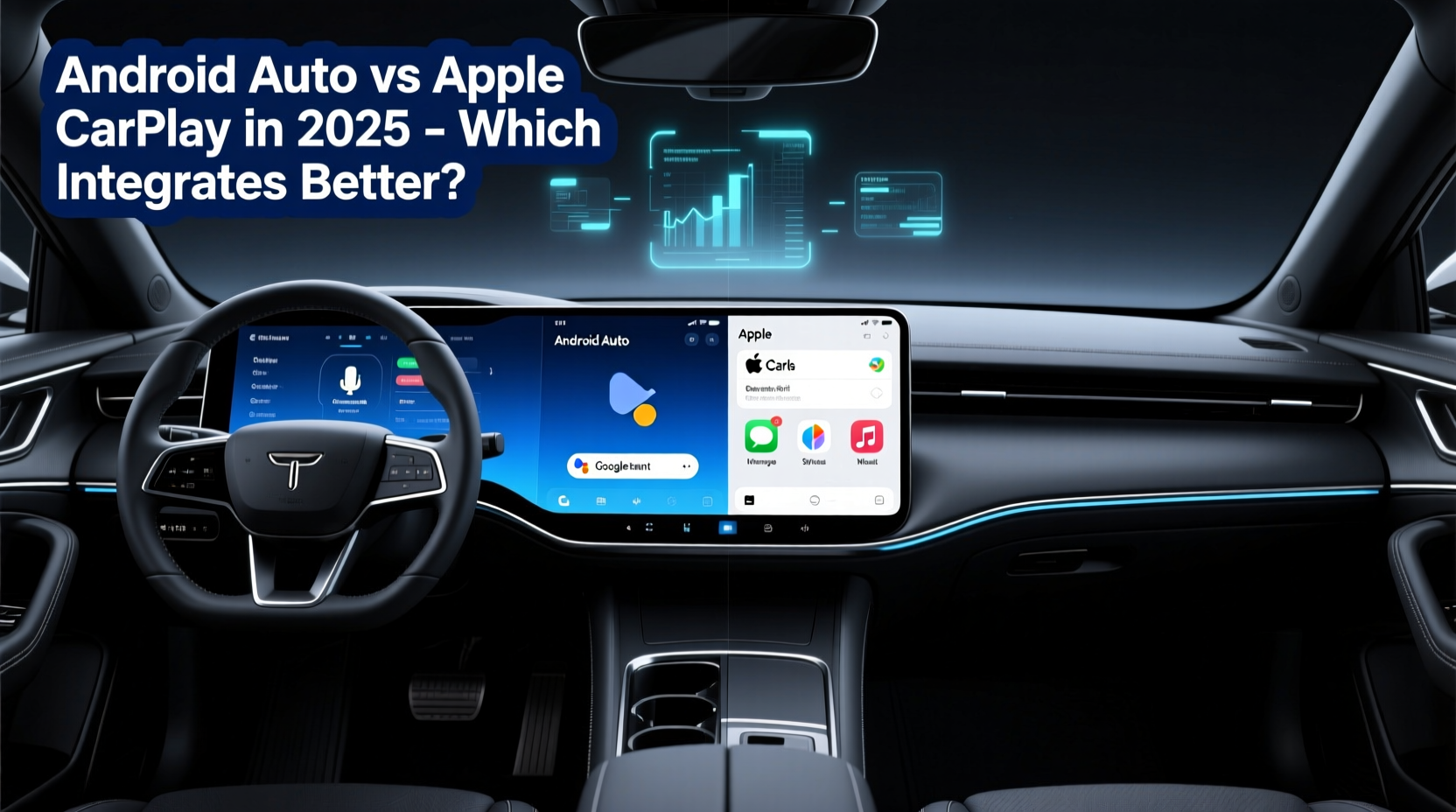
Historically, Android Auto and Apple CarPlay operated as projected interfaces—your phone powered the software, and the car’s display served as a mirror. In 2025, this model is being replaced by deeply integrated, vehicle-native versions of both platforms. Google and Apple now license their frameworks directly to automakers, allowing them to embed CarPlay and Android Automotive OS (AAOS) at the firmware level.
Android Automotive OS powers entire infotainment systems in cars like the Polestar 3, Volvo EX90, and upcoming GM models. It runs independently of a phone, supports Google Assistant natively, enables app downloads via the Play Store, and integrates with vehicle sensors for climate control, battery management (in EVs), and driver monitoring.
Apple CarPlay, while still largely dependent on an iPhone connection, has expanded significantly. Starting in 2024, Apple began rolling out \"full-vehicle integration\" CarPlay, giving automakers access to instrument clusters, HVAC controls, seat settings, and even tire pressure displays—all controllable through the CarPlay interface. Brands like Ford, Nissan, and Porsche have announced support for this deeper version.
“By 2025, we’re seeing a fundamental shift: consumers don’t want a 'phone in the dash'—they want the car to feel like an extension of their digital identity.” — Lena Torres, Senior Analyst at AutoTech Insights
Integration Depth: Ecosystem, Voice, and Personalization
The true measure of integration lies in how well each platform anticipates user needs, adapts to context, and connects across devices.
Apple CarPlay: Seamless but Controlled
CarPlay excels in consistency and polish. Its UI remains uniform across all vehicles, reducing cognitive load when switching cars. Siri’s voice recognition has improved dramatically in 2025, now capable of handling complex multi-step commands like “Set the cabin temperature to 72, play jazz from Apple Music, and let Sarah know I’ll be 10 minutes late.”
With iCloud integration, CarPlay syncs recent destinations, calendar events, and preferred apps across iPhones, iPads, and HomePods. Start navigation on your iPhone while walking to the car, and it automatically transfers to the dashboard—a feature known as Continuity Handoff.
However, CarPlay’s strength is also its limitation: Apple maintains strict control over the experience. Third-party developers face tighter restrictions, and customization options are minimal. You can't change the home screen layout or install non-Apple-approved apps.
Android Auto & Android Automotive OS: Flexible and Adaptive
Android Automotive OS offers greater flexibility. Users can install apps directly onto the car’s system—Spotify, Waze, YouTube Music, even third-party EV charging networks like PlugShare. Voice commands via Google Assistant go beyond media and navigation; they can adjust blinds in compatible smart homes or start pre-conditioning an electric vehicle based on weather forecasts.
Google’s AI engine learns driving patterns. For example, if you charge your EV every Tuesday night after work, the system begins suggesting optimal charging times based on electricity rates and grid load. This kind of proactive intelligence sets AAOS apart.
Moreover, Android Automotive supports multiple user profiles. Each driver gets personalized home screens, voice models, and connected services—ideal for families or shared vehicles.
| Feature | Apple CarPlay (2025) | Android Automotive OS (2025) |
|---|---|---|
| Phone Dependency | Required (iPhone) | Optional (fully functional standalone) |
| App Installation | No (apps must come from iPhone) | Yes (via Google Play Store) |
| Voice Assistant | Siri (on-device processing improved) | Google Assistant (context-aware, predictive) |
| User Profiles | Limited (per iPhone) | Full multi-user support |
| Vehicle Control Integration | Full cluster + HVAC in supported models | Native support across all functions |
| Updates | Tied to iPhone iOS updates | OTA updates independent of phone |
Real-World Example: Daily Commute in 2025
Consider Maria, a marketing executive in Seattle who drives a 2025 Toyota RAV4 Hybrid equipped with full-integration Apple CarPlay. Every morning, her iPhone detects she’s approaching the car. CarPlay wakes up, pulls her calendar event (“Client Meeting – Downtown”), checks traffic, and suggests leaving in 12 minutes. She says, “Hey Siri, start navigation,” and the route loads instantly. Her seat adjusts automatically via CarKey integration with her Apple Watch.
Now consider James, an engineer in Austin with a 2025 Chevrolet Blazer EV running Android Automotive OS. His car boots up before he enters. The system knows from his routine that he commutes at 7:45 a.m. It pre-heats the cabin slightly due to cold morning temps and starts preconditioning the battery for faster charging later. He says, “Hey Google, play my commute playlist and check if my garage door is closed.” The car confirms the door is shut via his Nest integration and launches music from YouTube Music.
Both experiences are smooth—but James’ system acts without needing his phone. When his phone battery dies mid-day, the car continues functioning normally. Maria, however, loses CarPlay functionality when her iPhone disconnects.
Which Integrates Better? A Practical Checklist
Determining which platform integrates better depends on your priorities. Use this checklist to decide:
- Do you own an iPhone exclusively? → CarPlay integration will feel more natural.
- Do you use Android phones or multiple devices? → Android Automotive OS offers broader compatibility.
- Do you want the car to operate independently of your phone? → Choose a vehicle with embedded AAOS.
- Do you value customization and third-party apps? → Android wins hands-down.
- Is simplicity and consistency more important than flexibility? → CarPlay delivers a uniform experience.
- Do you drive an electric vehicle? → AAOS provides superior energy management tools.
- Do you share the car with others? → AAOS user profiles make transitions seamless.
Future Readiness and Automaker Support
Looking ahead, integration isn’t just about today’s features—it’s about longevity and upgrade paths.
Google has committed to seven years of security and feature updates for Android Automotive OS, aligning with typical vehicle ownership cycles. Automakers like Renault, Stellantis, and Honda have signed long-term agreements to deploy AAOS across dozens of models.
Apple, meanwhile, is expanding CarPlay aggressively. Over 150 car models now support some version of CarPlay, and the company is pushing hard for full-vehicle integration contracts. However, legal scrutiny over antitrust concerns—particularly around limiting competitor access to vehicle data—has slowed adoption among European manufacturers.
Additionally, Google’s partnership with Qualcomm ensures that AAOS runs efficiently on the Snapdragon Digital Chassis platform, which powers many 2025 luxury and EV models. This hardware-software synergy results in faster boot times, smoother animations, and better thermal management.
Frequently Asked Questions
Can I use Android Auto without an Android phone?
No—if you're using traditional Android Auto (projected mode), you need an Android phone. However, vehicles with embedded Android Automotive OS do not require any phone to function. They run Google apps and services natively.
Will Apple CarPlay work if my iPhone battery dies?
No. CarPlay requires an active iPhone connection. If the phone shuts down, CarPlay stops working immediately. This includes loss of navigation, calls, and media playback unless the car has a separate entertainment system.
Are there privacy differences between the two platforms?
Yes. Apple emphasizes on-device processing and data minimization. Most CarPlay interactions stay on the iPhone. Android Automotive OS collects anonymized usage data to improve services and personalize experiences, though users can opt out during setup. Both allow granular permission controls for location, contacts, and microphone access.
Step-by-Step Guide: Choosing the Right System for Your Needs
- Inventory your devices: List all smartphones, tablets, and smart home systems you use regularly. If everything is Apple-based, CarPlay integration will be smoother.
- Test drive both systems: Visit dealerships with demo units. Try sending a message via voice, launching navigation, and adjusting climate settings.
- Check for embedded vs. projected: Ask whether the car runs Android Automotive OS natively or only supports phone-connected Android Auto.
- Evaluate update policies: Find out how often the car receives software updates and whether they include new CarPlay or AAOS features.
- Assess long-term needs: Consider if you’ll keep the car for five+ years. Prioritize systems with strong OTA update commitments.
- Review app availability: If you rely on specific services (e.g., Spotify, Tesla App, GasBuddy), confirm they’re available and fully functional on the platform.
“The best integration isn’t about flashy features—it’s about invisibility. The system should disappear into the background, doing what you need before you ask.” — Raj Mehta, UX Lead at Ford Mobility Division
Conclusion: Integration Is Contextual, But Android Leads in Autonomy
In 2025, Android Auto—specifically in its embedded Android Automotive OS form—integrates more deeply into the vehicle itself. It operates independently, learns from behavior, supports multiple users, and evolves through regular updates. For drivers seeking a self-sufficient, intelligent cockpit, it’s the superior choice.
Apple CarPlay remains unmatched in elegance and iPhone synergy. For those entrenched in Apple’s ecosystem, it offers a frictionless bridge between devices. However, its reliance on the iPhone limits its potential as a standalone platform.
Ultimately, the answer depends on your digital lifestyle. If you value autonomy, customization, and future-proofing, Android Automotive OS is the more integrated solution. If you prioritize simplicity, design consistency, and seamless handoffs within Apple’s world, CarPlay still holds strong appeal.




 浙公网安备
33010002000092号
浙公网安备
33010002000092号 浙B2-20120091-4
Comments
No comments yet. Why don't you start the discussion?