
As winter approaches and homes begin to glow with seasonal charm, the choice between decorative lighting options becomes more than aesthetic—it’s about atmosphere. Two popular contenders for creating a wintry ambiance are animated LED snowflake projectors and static frosted window decals. Both promise a touch of frosty magic, but when it comes to immersion—especially after dark—the differences become pronounced. One relies on movement, light, and dynamic projection; the other on texture, subtlety, and stillness. This article explores their strengths, limitations, and emotional impact to determine which delivers a truly immersive nighttime experience.
The Science of Visual Immersion
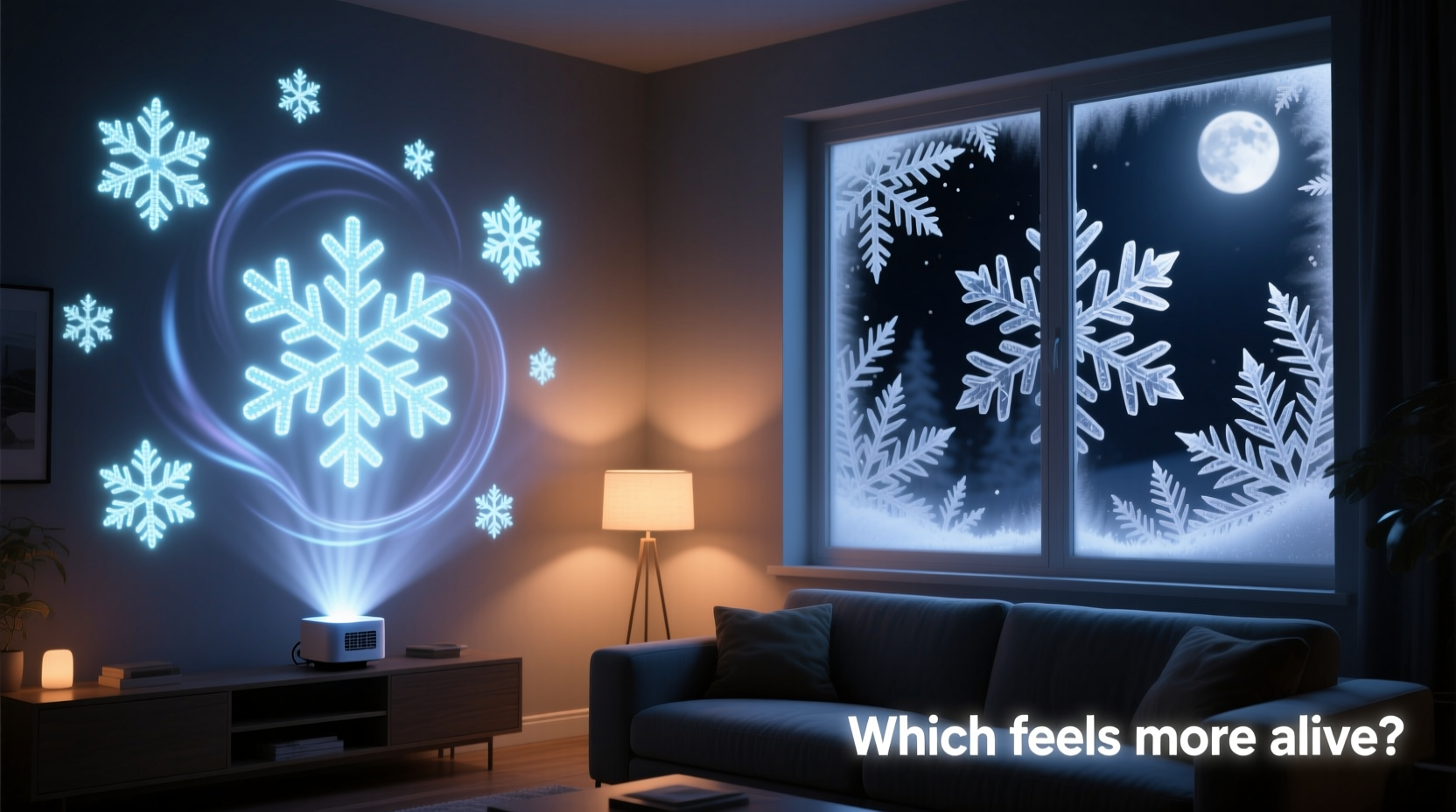
Immersion in decor isn’t just about how something looks—it’s about how it makes you feel. True visual immersion occurs when an environment captures attention, reduces awareness of surroundings, and evokes emotion through sensory engagement. In the context of holiday lighting, this means drawing the viewer into a moment: slowing them down, sparking nostalgia, or simulating the quiet wonder of a snowy evening.
Movement plays a crucial role. The human eye is naturally drawn to motion, especially rhythmic or organic patterns like falling snow. Animated projectors exploit this instinct by casting drifting, rotating flakes across walls and ceilings, mimicking the unpredictability of real snowfall. In contrast, static decals offer no motion. They rely on reflected ambient light and surface texture to suggest frost or ice. While elegant, they don’t command attention in the same way.
Lighting quality also affects immersion. Projectors typically use high-lumen LEDs with wide dispersion, transforming entire rooms into glowing winter scenes. Decals, unless backlit or placed near strong indoor lighting, remain passive elements. Their visibility diminishes in low-light conditions, making them less effective once full darkness sets in.
“Dynamic light and motion trigger deeper cognitive engagement than static visuals. That’s why moving projections feel more ‘real’ even when they’re technically simpler.” — Dr. Lena Torres, Cognitive Psychologist specializing in environmental perception
How Animated LED Snowflake Projectors Work
LED snowflake projectors function by combining a bright LED light source with a rotating diffraction disc or digital animation chip. As the disc spins—or as frames cycle digitally—patterns of snowflakes are cast outward through a lens, covering large surfaces with shimmering, drifting lights. Most models offer multiple speed settings, color modes (cool white, warm white, multicolor), and remote controls for ease of use.
Installation is straightforward. The unit typically sits on a windowsill, tripod, or outdoor stand, aimed toward a wall, ceiling, or exterior surface. Range varies from 15 to 30 feet, depending on model and ambient light. Higher-end versions include timers, automatic dusk-to-dawn sensors, and weather-resistant casings for outdoor deployment.
The effect is cinematic. When projected onto a textured wall or ceiling, the snowflakes appear to float in three-dimensional space. Some users report that the gentle flicker and slow descent mimic actual snowfall so convincingly that guests pause to look up, expecting real flakes. Indoors, the glow fills corners and casts soft shadows, creating depth and warmth. Outdoors, the projection can cover facades, trees, or driveways, turning entire yards into immersive displays.
The Aesthetic of Static Frosted Window Decals
Frosted window decals take a minimalist approach. Made from adhesive vinyl or static cling material, they replicate the look of frost etched into glass. Designs range from delicate snowflakes to abstract ice crystals, often arranged in repeating patterns. Applied directly to windows, they diffuse light and create a subtle, wintery silhouette during both day and night.
At night, their effectiveness depends entirely on interior lighting. When a room is lit from within, the decals become visible as opaque shapes against the glow, resembling real frost buildup. From the outside, they contribute to curb appeal with a clean, tasteful appearance. However, without backlighting, they vanish into transparency, offering little visual interest in total darkness.
Their strength lies in authenticity and restraint. Unlike flashy light displays, frosted decals evoke the quiet beauty of a frozen morning. They suit homes aiming for elegance over spectacle—think Scandinavian minimalism or cozy cottagecore. But because they lack motion and luminosity, they rarely generate the “wow” factor associated with immersive experiences.
Moreover, immersion requires consistency. A single decal on one window does little to alter perception. To achieve any sense of envelopment, every visible pane must be treated uniformly—a time-consuming process that may not yield proportional returns in atmospheric impact.
Comparative Analysis: Immersion Factors
To objectively assess which option feels more immersive, consider the following dimensions:
| Factor | LED Snowflake Projector | Frosted Window Decal |
|---|---|---|
| Motion & Dynamics | High – continuous, drifting snowflakes | None – completely static |
| Light Output | Bright, active illumination | Passive, requires external lighting |
| Coverage Area | Large – up to 30 ft radius | Limited to window surface only |
| Depth Perception | Strong – layered, floating effect | Flat – two-dimensional appearance |
| Emotional Impact | High – magical, childlike wonder | Moderate – serene, understated |
| Setup Effort | Low – plug and aim | High – precise alignment required |
| Durability (Outdoor) | Weather-resistant models available | May peel or degrade in cold/humidity |
The data clearly favors projectors in nearly every category tied to immersion. Motion, luminosity, and spatial coverage are all stronger with dynamic projection. Decals excel only in subtlety and design cohesion—but these traits support refinement, not immersion.
Real-World Example: A Suburban Home Transformation
In suburban Denver, homeowner Marcus Reed experimented with both options over two consecutive winters. The first year, he applied frosted snowflake decals to all front-facing windows. Neighbors complimented the “clean look,” and indoor photos showed a soft, icy glow when lights were on. Yet, Marcus noticed few passersby paused. At night, the display blended into the neighborhood’s ambient lighting.
The following year, he added an LED snowflake projector aimed at his living room ceiling. Instantly, the interior transformed. Family members reported feeling “transported” when entering the room. His children asked if it was really snowing outside. Even the family dog stared upward, tracking the moving lights. When used outdoors, the projector drew neighbors to the sidewalk, some filming the effect for social media.
“The decals felt like decoration,” Marcus said. “The projector felt like an experience. It wasn’t just something I looked at—it was something I lived inside.”
Step-by-Step Guide to Maximizing Nighttime Immersion
Whether you choose a projector, decals, or a hybrid approach, follow these steps to enhance nighttime immersion:
- Assess Your Space: Identify primary viewing areas indoors and out. Note window sizes, wall textures, and existing light sources.
- Choose Your Primary Medium: For immersion, prioritize the projector. Use decals only as accents if desired.
- Position Strategically: Place the projector where its beam covers the largest uninterrupted surface—ceiling, blank wall, or exterior gable.
- Control Ambient Light: Dim or turn off competing lights. Use warm-toned bulbs elsewhere to avoid washing out the snowflake effect.
- Add Complementary Elements: Layer in soft blankets, fireplace sounds, or faint blue-tinted accent lighting to reinforce the winter theme.
- Test at Dusk: Adjust angle and brightness while ambient light shifts. Optimal immersion occurs in full darkness.
- Engage Multiple Senses: Pair visuals with scents (pine, cinnamon) or tactile elements (faux fur throws) to deepen the immersive effect.
Hybrid Approach: Can You Combine Both?
Some decorators attempt to merge the two styles—using decals on windows while projecting snowflakes indoors. This can work, but only if carefully balanced. Projecting light *through* frosted decals may distort the image, creating blurred or fragmented flakes. However, placing decals on non-projected windows can add thematic continuity.
A better hybrid strategy: use decals on street-facing windows for daytime curb appeal, and deploy the projector indoors for nighttime immersion. This preserves the elegance of frost patterns during daylight while delivering dynamic magic after dark.
Frequently Asked Questions
Can I leave an LED snowflake projector outside all winter?
Yes, but only if it’s specifically rated for outdoor use (IP44 or higher). Check manufacturer specifications. Units without weatherproofing should be brought indoors during rain, snow, or extreme cold.
Do frosted window decals damage glass?
Generally, no. Static-cling versions leave no residue and won’t scratch glass. Vinyl decals may degrade over time and could leave adhesive if removed after prolonged exposure to UV light or temperature swings.
Which uses more energy?
Projectors consume more power—typically 5–15 watts—but still far less than traditional incandescent string lights. Decals use zero energy. However, the projector’s runtime (often 6–8 hours nightly) results in modest overall consumption, equivalent to a small LED bulb.
Final Verdict: Which Feels More Immersive?
The answer is clear: animated LED snowflake projectors create a significantly more immersive experience at night. Their combination of motion, luminosity, and spatial coverage engages the senses in ways static decals cannot match. While frosted decals offer charm and subtlety, they function more as decorative accents than environmental transformers.
Immersion requires presence—an invitation to linger, observe, and emotionally connect. Projectors deliver this by filling space with gentle, evolving light. They simulate natural phenomena, tap into childhood memories of snow days, and turn ordinary rooms into temporary wonderlands. Decals, though beautiful, remain visually passive. They decorate; they don’t transport.
For those seeking a holiday display that captivates, delights, and lingers in memory, the projector is the superior choice. It doesn’t just illuminate a room—it redefines it.
Action Plan: Upgrade Your Holiday Ambiance
- Purchase a high-lumen, cool-white LED snowflake projector with remote control
- Test placement indoors before committing to permanent setup
- Use timers to automate operation from dusk to bedtime
- Supplement with soft furnishings and ambient sound for multi-sensory depth
- Consider limited decal use for daytime continuity, but don’t rely on them for night impact
“The best holiday lighting doesn’t compete with reality—it enhances it. Projection lighting, when done well, becomes part of the home’s breath.” — Clara Nguyen, Lighting Designer and Seasonal Display Consultant
Conclusion
When darkness falls and the world slows, the right lighting can transform a house into a haven. Between animated LED snowflake projectors and static frosted window decals, one clearly leads in creating nighttime immersion. The projector’s ability to simulate falling snow, fill spaces with soft light, and evoke emotional wonder makes it the definitive choice for those who want more than decoration—they want experience.




 浙公网安备
33010002000092号
浙公网安备
33010002000092号 浙B2-20120091-4
Comments
No comments yet. Why don't you start the discussion?