
The countdown to Christmas has evolved far beyond candles and carols. Today, the advent calendar has become a cultural phenomenon—especially in niche communities like anime fandoms. While traditional chocolate-filled calendars have long been a staple of December mornings, a new contender has emerged: the anime-themed advent calendar. These collectible boxes offer figurines, keychains, art prints, or exclusive merchandise instead of sweets. But when it comes to building genuine excitement throughout the holiday season, which format truly delivers?
This isn’t just about sugar versus plastic trinkets. It’s about psychology, ritual, and emotional investment. One relies on sensory pleasure and routine; the other thrives on storytelling, surprise, and fandom loyalty. To determine which generates deeper anticipation, we need to examine not only what’s inside each box but how people experience them over time.
The Psychology of Anticipation: Why Advent Calendars Work
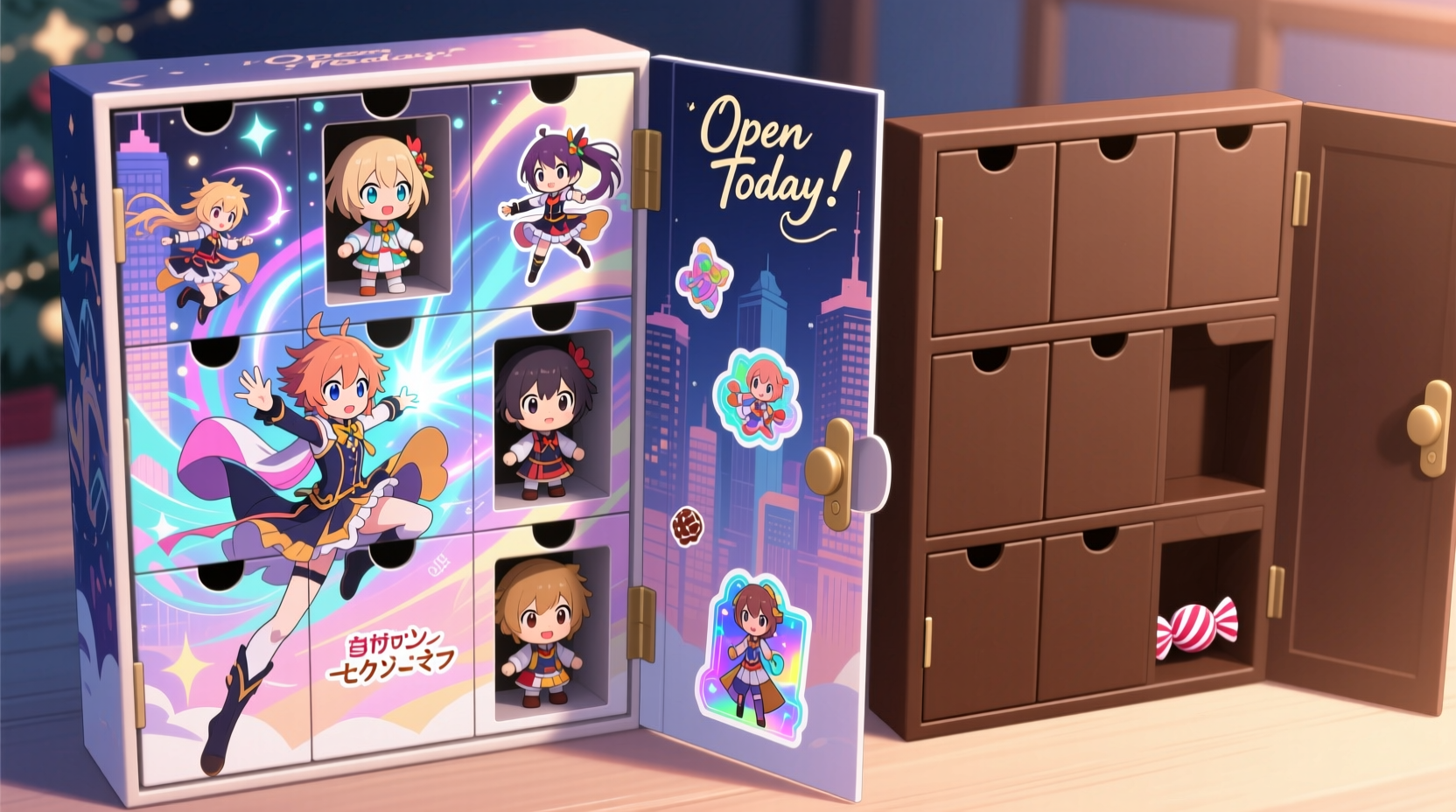
Anticipation is often more powerful than fulfillment. Behavioral economists call this “the pleasure of delayed gratification.” The 24-day structure of an advent calendar turns waiting into a game—one that rewards consistency with small bursts of joy. Each door opened represents progress, a tiny victory against the monotony of winter.
Dr. Laura Mitchell, a consumer behavior researcher at the University of Edinburgh, explains:
“The act of opening one door per day creates a rhythm. It anchors us in time, especially during chaotic seasons. What matters most isn't the gift itself—it's the ritual of discovery.”
Traditional chocolate calendars tap into immediate sensory reward: sight, smell, taste. They’re simple, predictable, and comforting. But anime advent calendars operate differently. Their value lies less in daily consumption and more in cumulative payoff—the growing collection, the narrative arc, the social sharing potential.
For fans, each item can represent a character milestone or plot twist. Some anime calendars even follow a story across the 24 days, revealing scenes or dialogue snippets as the month progresses. This transforms passive consumption into active engagement.
Structure & Experience: How Each Calendar Builds Momentum
To compare excitement-building capacity, consider three factors: variety, emotional resonance, and interactivity.
| Factor | Chocolate Calendar | Anime Advent Calendar |
|---|---|---|
| Variety | Low – same type of chocolate daily, minor flavor differences | High – mix of figures, accessories, rare variants, themed packaging |
| Emotional Resonance | Moderate – nostalgic, comforting, family-oriented | High – tied to beloved characters, personal identity, fan community |
| Interactivity | Low – eat and discard | High – display, trade, photograph, discuss online |
The data shows a clear divergence. Chocolate calendars deliver consistent but diminishing returns. By mid-December, the novelty wears off. Many adults admit to eating multiple chocolates at once after the first week. In contrast, anime calendars gain momentum. As collectors near Day 24, speculation peaks: What will the final item be? Is there a hidden chase figure?
A Case Study: Two Families, Two Approaches
Consider two households preparing for December.
The Thompsons use a classic Lindt chocolate advent calendar every year. Their children, ages 7 and 9, enjoy the treat but show little enthusiasm by Day 10. One child opens two doors early “by accident.” The parents note that while it’s a nice tradition, it doesn’t spark conversation or lasting memories.
Meanwhile, the Nakamura family—a bilingual household blending Japanese and American customs—opts for a *Demon Slayer* anime advent calendar. Their 13-year-old daughter follows the unboxing on YouTube, comparing her items with others online. She arranges the mini-figures each night on a display shelf. On Day 18, she discovers a translucent Nezuko variant, sparking excitement so intense she video-calls her cousin in Osaka.
Both families celebrate the season, but the depth of engagement differs significantly. The chocolate calendar offers momentary delight; the anime version fosters sustained interaction, pride in curation, and digital connectivity.
Step-by-Step: How to Maximize Excitement with Either Calendar
Regardless of format, the way you engage with your advent calendar shapes the experience. Here’s a five-step timeline to build momentum from December 1 to 24:
- Day 1–5: Establish Ritual – Open doors at the same time daily. Pair it with coffee, music, or journaling. Make it a sensory anchor.
- Day 6–10: Introduce Sharing – Post photos online (if using anime version), or let someone else open the door. Break predictability.
- Day 11–15: Add Mystery – Cover item descriptions beforehand. Guess what’s inside based on weight or shape. Turn it into a game.
- Day 16–20: Deepen Connection – Research the character or chocolate origin. Learn something new each day.
- Day 21–24: Build Final Anticipation – Save packaging, arrange all items, speculate on the last few reveals. Host a mini “reveal party” on Christmas Eve.
This framework works for both types—but anime calendars naturally support more complex interactions due to their collectible nature.
Fan Culture and the Rise of the Collectible Calendar
Anime advent calendars aren’t new, but their popularity surged post-2020. With lockdowns limiting physical gatherings, fans turned to tangible experiences they could share digitally. Unboxing videos exploded on TikTok and YouTube, turning niche products into viral events.
Companies noticed. Crunchyroll, Aniplex, and even Amazon Japan began releasing premium-tier calendars priced between $80 and $200. These weren’t toys—they were curated collector’s editions featuring hand-painted statues, fabric patches, and glow-in-the-dark elements.
“It’s not just merch,” says Kenji Sato, product director at Animate USA.
“We design these calendars like seasonal story arcs. Day 1 might be Tanjiro training, Day 12 sees him mastering Flame Breathing, Day 24 is the final battle. You live the journey.”
This narrative approach elevates the calendar from novelty to immersive experience. Fans don’t just receive objects—they participate in a shared cultural moment.
Practical Considerations: Cost, Accessibility, and Longevity
While anime calendars may generate more excitement, they come with trade-offs:
- Cost: Chocolate calendars average $10–$20. Anime versions range from $50 to over $150.
- Availability: Many anime calendars sell out within hours. Pre-orders open as early as August.
- Longevity: Chocolate is consumed; collectibles remain. This can be a pro (keepsake value) or con (storage issues).
- Gifting: Chocolate calendars are universally appealing. Anime versions risk mismatched tastes unless recipient is a confirmed fan.
Still, for dedicated fans, the investment pays off emotionally. A well-chosen anime calendar becomes part of annual tradition—not just something to open, but something to preserve and revisit.
Checklist: Choosing the Right Calendar for Your Needs
Use this guide to decide which format suits your situation:
- Choose a Chocolate Calendar If:
- ✅ You want a low-cost, accessible tradition
- ✅ Sharing with young children under 8
- ✅ Prefer edible treats over clutter
- ✅ Value simplicity and nostalgia
- Choose an Anime Advent Calendar If:
- ✅ The recipient is an established anime fan
- ✅ You want a collectible keepsake
- ✅ Enjoy interactive, display-worthy items
- ✅ Are comfortable with higher price points
- ✅ Want to encourage creative play or digital engagement
Frequently Asked Questions
Are anime advent calendars worth the price?
For fans, yes—especially if the contents include limited-edition items. Many users report that resale values cover half or all of the original cost. Beyond financial return, the emotional payoff of daily engagement often outweighs the sticker shock.
Can kids enjoy anime advent calendars too?
Yes, but with caveats. Calendars based on kid-friendly series (*Pokémon*, *My Hero Academia*, *Studio Ghibli*) work well for ages 8+. However, small parts pose choking hazards, and some designs assume prior knowledge of the plot. Supervision and context-sharing are recommended.
Do chocolate calendars lose excitement faster?
Research suggests yes. A 2022 University of Cologne study found that participants reported peak excitement on Days 1–3 and a steady decline thereafter. By Day 14, only 38% said they looked forward to opening the next door. In contrast, anime calendar users maintained high anticipation through Day 20, peaking again on the final days.
Conclusion: Which Builds More Excitement?
The answer depends on what kind of excitement you seek.
If you want warmth, simplicity, and a touch of indulgence, the chocolate advent calendar remains unmatched. It’s democratic, familiar, and requires no prior knowledge. Its power lies in universal comfort.
But if you’re chasing sustained engagement, emotional investment, and interactive joy, the anime advent calendar wins decisively. It leverages fandom, storytelling, and collectibility to create a richer, more dynamic experience. The items last longer, the conversations go deeper, and the sense of progression feels earned.
In an age where attention is scarce and rituals matter more than ever, the anime advent calendar doesn’t just count down to Christmas—it transforms the wait into something meaningful. It turns passive viewers into active participants, consumers into curators.




 浙公网安备
33010002000092号
浙公网安备
33010002000092号 浙B2-20120091-4
Comments
No comments yet. Why don't you start the discussion?