
In the world of anime, danger is a constant companion. Battles rage across dimensions, villains unleash devastating attacks, and protagonists face seemingly insurmountable odds. Yet, despite near-fatal blows, impossible escapes, and repeated brushes with death, certain characters never fall. They rise again, unscathed or quickly healed, always advancing toward their destiny. This phenomenon—commonly known as \"plot armor\"—is both a narrative tool and a point of contention among fans. While it can protect key characters essential to the story’s progression, it can also undermine tension and realism if overused.
Plot armor isn’t exclusive to anime, but its prevalence in long-running series with high-stakes battles makes it particularly noticeable. Understanding why it exists, how it functions, and when it serves—or sabotages—a story offers deeper insight into anime’s storytelling mechanics.
What Is Plot Armor?
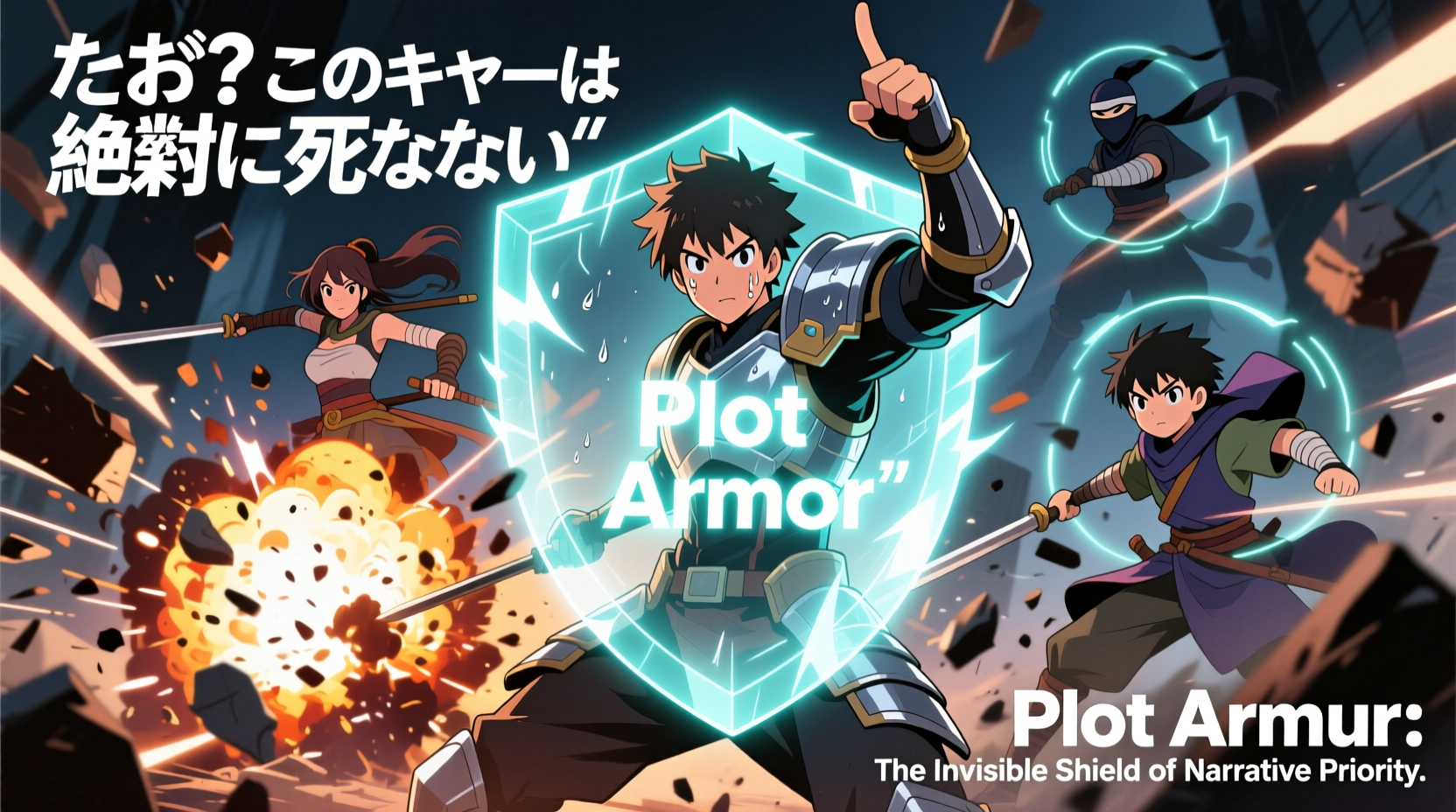
Plot armor refers to the implicit protection a character enjoys simply because the story depends on them. No matter how dire the situation, these characters survive critical injuries, dodge fatal attacks, or recover miraculously—not due to skill or luck, but because their continued presence is necessary for the plot to unfold.
In anime, where serialized storytelling often spans hundreds of episodes, maintaining central figures like the protagonist or pivotal allies is crucial. If Naruto died in episode 50, there would be no ninja revolution. If Luffy perished during his first major battle, the entire journey to become Pirate King would end before it began. Thus, plot armor acts as a narrative safeguard.
“Plot armor isn’t laziness—it’s structural necessity. You don’t kill the engine of your story halfway through.” — Akira Sato, Narrative Consultant for Japanese Animation Studios
However, the line between necessary protection and narrative inconsistency is thin. When audiences perceive that a character survives not because of clever writing or earned resilience, but simply because “they’re supposed to,” immersion breaks down.
The Mechanics Behind Anime Plot Armor
Plot armor operates through several subtle (and sometimes overt) techniques:
- Narrative Priority: The story centers on specific characters. Their survival is non-negotiable.
- Dramatic Timing: Characters are injured at climactic moments but never killed when it would derail the arc.
- Power Escalation: A sudden unlock of hidden abilities allows escape from otherwise unsurvivable situations.
- External Intervention: Allies arrive just in time, or fate intervenes (e.g., a deus ex machina).
These devices aren't inherently bad. In fact, they're staples of dramatic storytelling. The issue arises when they become predictable or contradict established rules within the anime’s universe.
When Plot Armor Enhances the Story
Used wisely, plot armor can amplify emotional stakes and thematic depth. Consider *Fullmetal Alchemist: Brotherhood*. Edward Elric faces mortal danger repeatedly, yet survives each encounter. However, his survival is consistently tied to consequences: he loses limbs, suffers trauma, and bears guilt over others’ sacrifices. His armor isn’t invincibility—it’s resilience shaped by cost.
Likewise, in *Attack on Titan*, Eren Yeager survives numerous deadly encounters. But rather than feeling arbitrary, his survival is framed as part of a larger, almost fated trajectory. The narrative foreshadows his role in a grand cycle, making his endurance feel inevitable rather than contrived.
In such cases, plot armor works because it’s integrated into character development and world logic. Survival comes with weight, not just convenience.
When It Undermines Tension
The opposite occurs when secondary characters die frequently while main figures emerge unscathed from identical threats. This imbalance erodes believability. If every side character dies from a single hit, but the hero tanks planet-level blasts and walks away, audiences begin to question the stakes.
A prime example is seen in many shonen battle animes, where the protagonist absorbs increasingly powerful attacks without lasting damage. While this showcases determination and growth, overuse desensitizes viewers to danger. When no outcome feels uncertain, suspense evaporates.
| Aspect | Healthy Use of Plot Armor | Problematic Use of Plot Armor |
|---|---|---|
| Consequences | Survival comes with physical, emotional, or moral cost | No lasting impact; character returns to baseline immediately |
| World Consistency | Rules of the universe still apply; survival is plausible | Ignores established power levels or physics |
| Character Role | Central to theme or narrative progression | Favored arbitrarily, even when expendable |
| Audience Perception | Feeling: “They made it through because they grew” | Feeling: “They didn’t die because the script said no” |
Why Some Characters Never Seem to Lose
Beyond mere survival, some anime protagonists rarely lose fights—at least decisively. Even when defeated, they gain something: knowledge, resolve, or a new power-up. This pattern reflects the genre’s emphasis on perseverance, self-improvement, and ultimate triumph.
In traditional shonen anime (*Dragon Ball Z*, *Naruto*, *My Hero Academia*), losing is temporary. Each defeat fuels the next victory. The hero may be beaten, bloodied, and broken—but never broken beyond recovery. This reinforces core themes: hard work beats talent, willpower transcends limits, and the underdog always has a chance.
Yet this formula risks predictability. When viewers know the main character will ultimately prevail, the drama shifts from “Will they win?” to “How will they win?” This can still be compelling—if the journey is well-crafted.
“In Japanese storytelling, especially in youth-oriented anime, the focus is on transformation, not tragedy. The hero must endure to evolve.” — Dr. Naomi Ito, Cultural Analyst at Kyoto University
Mini Case Study: Goku in Dragon Ball Z
Goku is perhaps the most iconic example of sustained plot armor. Across decades of battles, he faces enemies capable of destroying planets, yet he consistently survives, often returning stronger after near-death experiences.
Consider the Frieza Saga. After being impaled and left for dead, Goku recovers thanks to a healing device. He then unlocks Super Saiyan—a transformation foreshadowed earlier in the series. While convenient, this moment fits established lore: Saiyans grow stronger after recovering from severe injury, and the Super Saiyan legend had been seeded throughout the arc.
Had Goku died permanently, the series would have ended. But the writers ensured his survival felt earned through buildup, emotional investment, and mythic resonance. Later instances, however, became less convincing—such as surviving universal destruction via tournament loopholes—where plot armor overshadowed internal logic.
Recognizing and Evaluating Plot Armor
Not all plot armor is bad. What matters is execution. Below is a checklist to help identify whether a character’s survival strengthens or weakens a story.
Plot Armor Evaluation Checklist
- Was the threat consistent with the show’s established rules?
- Did other characters face similar risks and suffer accordingly?
- Did the protagonist experience meaningful consequences (injury, loss, trauma)?
- Was survival foreshadowed or grounded in prior character development?
- Did the outcome serve the story’s themes or emotional arc?
- Was the resolution predictable solely because of the character’s status?
If the answer to questions 1–5 is “yes,” the use of plot armor is likely justified. If only question 6 applies, the narrative may be relying too heavily on artificial protection.
Step-by-Step Guide: How Writers Can Use Plot Armor Effectively
To maintain tension while protecting key characters, skilled writers follow a deliberate approach:
- Establish Stakes Early: Show that death is real by killing off important side characters.
- Impose Costs: Even if the hero survives, ensure they pay a price—loss of ability, relationship, or innocence.
- Seed Future Abilities: Introduce latent powers or external aids before they’re needed.
- Use Time Pressure: Let the character survive but fail in their immediate objective, preserving urgency.
- Subvert Expectations: Allow temporary defeats or moral losses to keep outcomes uncertain.
- Gradually Remove Armor: In later arcs, let the character face true mortality to raise stakes.
This method keeps audiences engaged. They may know the protagonist won’t die, but they won’t know what they’ll lose along the way.
Frequently Asked Questions
Is plot armor the same as a Mary Sue?
No. A Mary Sue is a character who is unrealistically perfect, lacking flaws or meaningful challenges. Plot armor refers specifically to narrative protection from death or defeat. A well-written protagonist can have plot armor without being a Mary Sue—provided they face personal struggles, make mistakes, and grow.
Can plot armor be removed?
Yes—and doing so can be powerful. In *Fate/Zero*, Kiritsugu Emiya survives early battles but ultimately succumbs to physical and emotional decay. His eventual death carries weight because the armor was gradually stripped away, revealing the cost of survival. Similarly, in *Code Geass*, Lelouch appears protected until the final act, when his death becomes the climax of the story’s philosophy.
Do all anime protagonists have plot armor?
Virtually all do—to some extent. Even in dark, tragic series, the main character typically survives long enough to fulfill their arc. The difference lies in degree and transparency. In *Monster* or *Psycho-Pass*, the protagonist faces existential threats, but their survival stems from intelligence and strategy, not invulnerability. The armor is thinner, more believable.
Conclusion: Embracing Plot Armor Without Losing Authenticity
Plot armor is not a flaw—it’s a feature of serialized storytelling. Characters drive narratives, and removing central figures prematurely can collapse entire arcs. The challenge lies in balancing necessity with authenticity. When survival is earned, when consequences linger, and when the audience believes in the character’s journey, plot armor becomes invisible. It fades into the background, supporting the story rather than distorting it.
The best anime don’t eliminate plot armor—they refine it. They let characters bleed, break, and mourn. They raise the cost of survival so high that living feels like its own kind of sacrifice. In doing so, they preserve both narrative integrity and emotional truth.




 浙公网安备
33010002000092号
浙公网安备
33010002000092号 浙B2-20120091-4
Comments
No comments yet. Why don't you start the discussion?