
Anime has long been a medium of innovation, where boundaries are not just pushed—they’re obliterated. Among its most potent tools is the plot twist: a narrative detonation capable of upending expectations, redefining characters, and altering the trajectory of entire genres. Some twists don’t just shock audiences—they redefine what anime can be, influencing how stories are told across science fiction, mecha, psychological thrillers, and beyond. These aren’t just surprises; they’re seismic shifts in storytelling philosophy.
From deconstructing heroism to dismantling the concept of reality itself, certain anime have used twists not for cheap thrills but as catalysts for genre evolution. The following moments didn’t merely surprise fans—they forced creators, critics, and viewers to reconsider what anime could achieve narratively and thematically.
The Death of the Hero: Neon Genesis Evangelion’s Psychological Reckoning
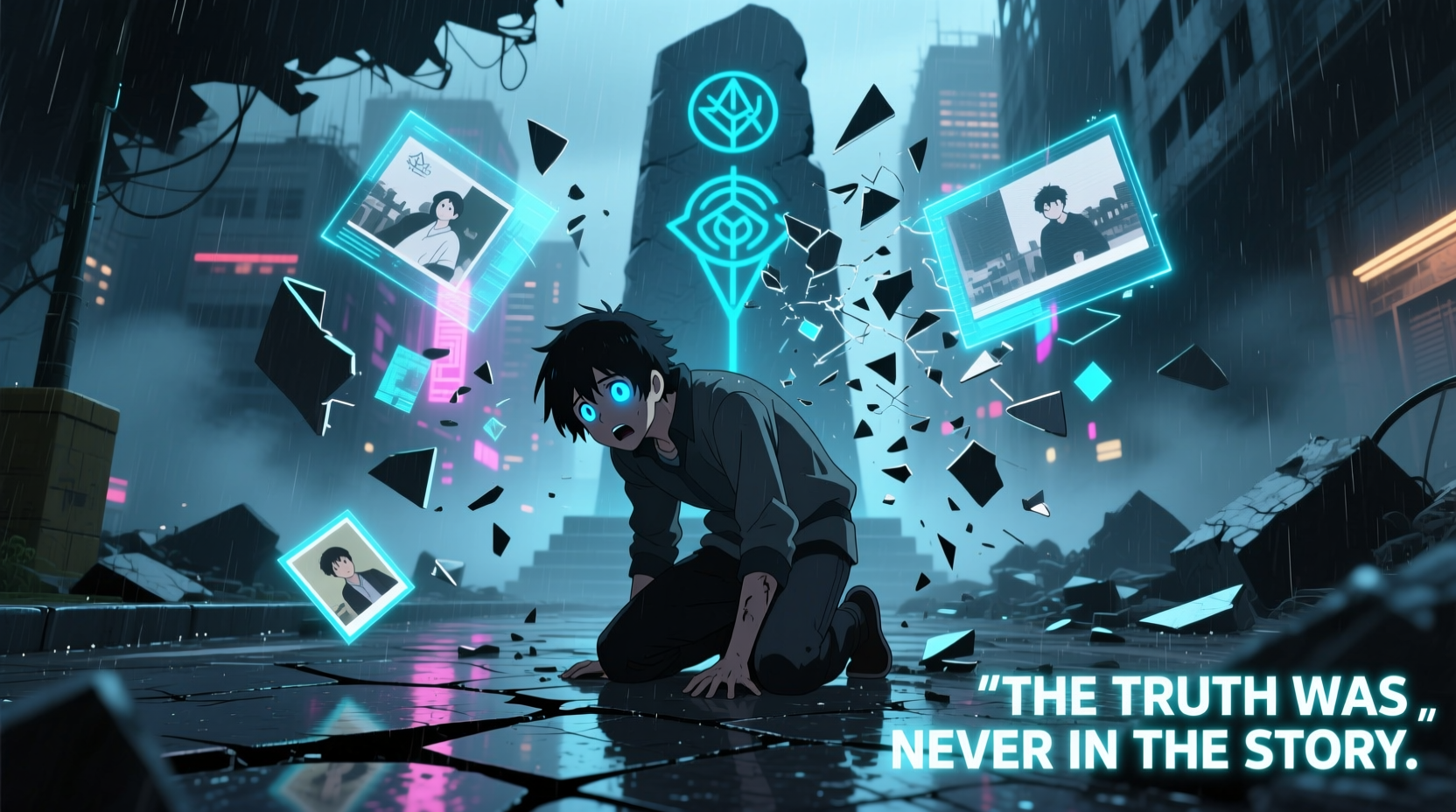
No series altered the mecha genre more profoundly than Neon Genesis Evangelion. At first glance, it followed a familiar blueprint: a young boy pilots a giant robot to save humanity from monstrous beings known as Angels. But by the final episodes, any resemblance to traditional mecha tropes had evaporated.
The twist wasn’t a single event—it was a slow unraveling of the protagonist Shinji Ikari’s psyche, culminating in an abstract, introspective finale that abandoned action entirely. Instead of a climactic battle, viewers were thrust into a surreal exploration of identity, trauma, and human connection. This departure stunned audiences upon release but ultimately redefined the genre.
Where earlier mecha series celebrated heroism and technological triumph, Evangelion exposed the psychological toll of such responsibilities. It revealed that the pilot wasn’t a chosen savior but a traumatized child manipulated by shadowy institutions. The real enemy wasn’t the Angels—it was the emotional isolation and systemic abuse perpetuated by adult authority figures.
“Evangelion didn’t just subvert the mecha genre—it performed an autopsy on it.” — Dr. Akira Tanaka, Media Studies Professor at Kyoto University
In the years since, countless series—from Gurren Lagann to Code Geass—have grappled with Evangelion’s legacy. Its influence extends beyond anime into Western sci-fi television and film, where flawed protagonists and morally ambiguous organizations have become standard.
Reality Is a Construct: The Matrix Before The Matrix – Serial Experiments Lain
Debuting in 1998, Serial Experiments Lain introduced a generation to questions about digital consciousness, online identity, and the erosion of physical reality—years before *The Matrix* popularized similar themes. Its central twist isn’t dramatic in the conventional sense; rather, it unfolds gradually, revealing that Lain herself may not be human at all, but a distributed consciousness emerging within the global network known as “The Wired.”
The revelation that Lain has rewritten her own existence—erasing her past, altering memories, and ascending beyond the physical world—was revolutionary. Unlike typical coming-of-age arcs, hers ends not with self-acceptance but with transcendence. She becomes both god and ghost of the internet, omnipresent yet intangible.
This conceptual leap transformed the cyberpunk and psychological thriller genres. Where previous works treated technology as a tool or threat, Lain portrayed it as a new plane of existence—one capable of dissolving the boundary between mind and machine, life and data.
Modern series like Dennou Coil, Psycho-Pass, and even aspects of Westworld owe a debt to Lain’s pioneering vision. It proved that anime could explore metaphysical questions with poetic ambiguity, rejecting clear answers in favor of existential unease.
Key Elements That Made Lain’s Twist Genre-Defining
- Non-linear narrative: Time and memory are fluid, challenging viewers to question causality.
- Ambiguous ending: No definitive resolution—only implication and interpretation.
- Blurred reality: Characters exist simultaneously in physical and digital spaces.
- Thematic depth: Explores loneliness, identity, and the search for meaning in a hyperconnected world.
The Villain Was Right: Code Geass and the Deconstruction of Revolution
Code Geass: Lelouch of the Rebellion masterfully manipulates viewer allegiance through one of anime’s most audacious ideological reversals. For much of the series, Lelouch Lamperouge is framed as a brilliant anti-imperialist leader, orchestrating a rebellion against the tyrannical Holy Britannian Empire. His use of the Geass power—forcing obedience with a glance—seems justified by his noble goal: freedom for the oppressed.
The twist arrives not with a betrayal, but with a confession: Lelouch never intended to create a better world through liberation. His ultimate plan, revealed in the second season, is far more radical—he will become the embodiment of evil, uniting the world through hatred, so that peace can only be achieved by killing him.
This moment reframed the entire narrative. What appeared to be a classic tale of resistance was actually a meditation on the cost of peace, the manipulation of truth, and the moral corruption of absolute power. Lelouch wasn’t just a tragic hero—he was a calculated architect of global suffering, believing the ends justified the means.
By having the protagonist execute this plan successfully—and die as a martyr vilified by history—Code Geass challenged the very notion of heroism. It asked whether peace built on lies and sacrifice could ever be legitimate, and whether a villain could be more righteous than a hero.
| Traditional Shonen Protagonist | Lelouch (Code Geass) |
|---|---|
| Motivated by justice | Motivated by revenge and control |
| Gains power to protect others | Uses power to manipulate everyone |
| Wins through strength and friendship | Wins through deception and sacrifice |
| Ends with celebration | Ends with assassination and silence |
The impact on political anime and dystopian narratives was immediate. Series like Psycho-Pass and Attack on Titan would later echo this theme: that systems of order often require moral compromise, and that truth is shaped by those who survive to tell the story.
Time Loops and Tragedy: Steins;Gate’s Emotional Precision Bomb
While time travel is a staple of science fiction, Steins;Gate elevated it into an emotionally devastating engine of narrative tension. The series begins as a quirky sci-fi comedy about a self-proclaimed mad scientist sending texts to the past. But after a pivotal incident—the failed rescue of Mayuri—viewers realize the true stakes: every attempt to change fate results in her death, no matter the timeline.
The twist isn’t that time travel exists, but that free will might not. Despite Okabe’s intelligence and determination, he is trapped in a loop where certain events are fixed points. The realization that he must endure endless repetitions of Mayuri’s death before finding a path to salvation transforms the series from adventure to psychological endurance test.
More importantly, Steins;Gate shifted the tone of sci-fi anime. It proved that hard science concepts could coexist with deep emotional arcs. The cold logic of physics clashed with the irrational force of love and grief, creating a narrative that felt both intellectually rigorous and profoundly human.
“Steins;Gate showed us that the heart of science fiction isn’t the machine—it’s the person standing beside it, begging the universe for a second chance.” — Naomi Sato, Sci-Fi Critic & Author of *Beyond the Screen*
Its success paved the way for narrative-driven sci-fi titles like Re:Zero and Erased, where personal trauma and temporal mechanics intersect. It also demonstrated that anime could balance complex plotting with character depth without sacrificing either.
Step-by-Step: How Steins;Gate Built Its Most Devastating Twist
- Establish normalcy: Introduce characters in a lighthearted lab setting.
- Introduce minor anomalies: Small changes in the past yield humorous results.
- First major consequence: Mayuri dies under mysterious circumstances.
- Reveal the loop: Okabe realizes he’s relived the same week repeatedly.
- Emotional escalation: Each failure intensifies his despair and isolation.
- Breakthrough: He discovers the concept of “World Lines” and the need to reach Steins;Gate.
- Final sacrifice: To save Kurisu, he must let go of his current timeline—and her memory of him.
The Monster You Sympathize With: Attack on Titan’s Moral Inversion
No twist in recent anime history has been as polarizing or transformative as the revelation in Attack on Titan that the Titans are not mindless monsters, but humans transformed through a cursed system of power. Even more shocking: the true antagonists are not the Titans themselves, but the nation of Marley, which weaponizes Eldians—including children—as living bombs.
Eren Yeager’s transformation from victim to perpetrator is the series’ defining arc. By the final seasons, he unleashes the Rumbling—a genocidal march of colossal Titans meant to destroy the outside world. The twist? The audience has spent years rooting for Eren, only to witness him become the very horror he once fought.
This inversion shattered the black-and-white morality common in shonen anime. It forced viewers to confront uncomfortable truths: oppression breeds retaliation, heroes can become fascists, and freedom for one group may mean annihilation for another.
Attack on Titan didn’t just challenge genre norms—it questioned the ethics of storytelling itself. Can we empathize with a mass murderer if his pain is real? Should we?
Checklist: Identifying Genre-Shifting Twists in Anime
- ✅ Does the twist fundamentally alter your understanding of the protagonist?
- ✅ Does it reject established genre conventions rather than follow them?
- ✅ Is the aftermath more important than the reveal itself?
- ✅ Does it inspire imitation or thematic debate in later works?
- ✅ Does it linger emotionally or philosophically after the series ends?
Frequently Asked Questions
What makes a plot twist truly genre-changing?
A genre-defining twist doesn’t just surprise—it recontextualizes the entire narrative framework. It challenges assumptions about heroism, morality, or reality, and influences how future stories in that genre are constructed. Examples include shifting from external conflict to internal psychology or replacing clear moral binaries with ethical ambiguity.
Are these twists predictable?
Many were not predictable upon first viewing. However, rewatching often reveals meticulous foreshadowing. Series like Evangelion and Steins;Gate plant clues early, rewarding attentive viewers. The best twists feel inevitable in hindsight, not random.
Do these twists alienate audiences?
Sometimes. Evangelion’s original ending was so controversial it led to a theatrical rewrite. Similarly, Attack on Titan’s final arc divided fans. But artistic risk often comes with backlash—and lasting influence. The most impactful stories rarely please everyone.
Conclusion: The Ripple Effect of Narrative Courage
The most powerful anime plot twists do more than shock—they shift paradigms. They transform genres from formulaic entertainment into vehicles for philosophical inquiry, emotional depth, and cultural critique. From Evangelion’s dissection of trauma to Lain’s prophecy of digital immortality, these moments prove that anime is not just a medium for escapism, but a frontier for bold storytelling.
These twists endure because they refuse simplicity. They ask difficult questions, embrace ambiguity, and trust the audience to wrestle with uncertainty. As new generations of creators emerge, they inherit not just animation techniques, but a legacy of narrative fearlessness—one twist at a time.




 浙公网安备
33010002000092号
浙公网安备
33010002000092号 浙B2-20120091-4
Comments
No comments yet. Why don't you start the discussion?