
For many, anime is more than just storytelling—it’s a sensory experience. The music often plays as vital a role as the animation or dialogue, shaping emotional arcs and enhancing immersion. But beyond entertainment, anime soundtracks have quietly emerged as powerful tools for mental clarity, deep focus, and stress reduction. Composers like Yoko Kanno, Joe Hisaishi, and Hiroyuki Sawano craft scores that balance emotional depth with ambient minimalism, making them ideal for background listening during work, study, or meditation.
Yet knowing where to begin can be overwhelming. With thousands of series spanning decades and genres, the volume of available music is vast. Not all anime soundtracks are created equal when it comes to concentration or calm. Some are too dramatic; others too lyric-heavy. The key lies in identifying the right composers, series, and moods that align with cognitive flow and relaxation states.
This guide cuts through the noise, offering a structured approach to building effective anime-based audio environments tailored for productivity and peace.
Why Anime Soundtracks Work for Focus and Relaxation
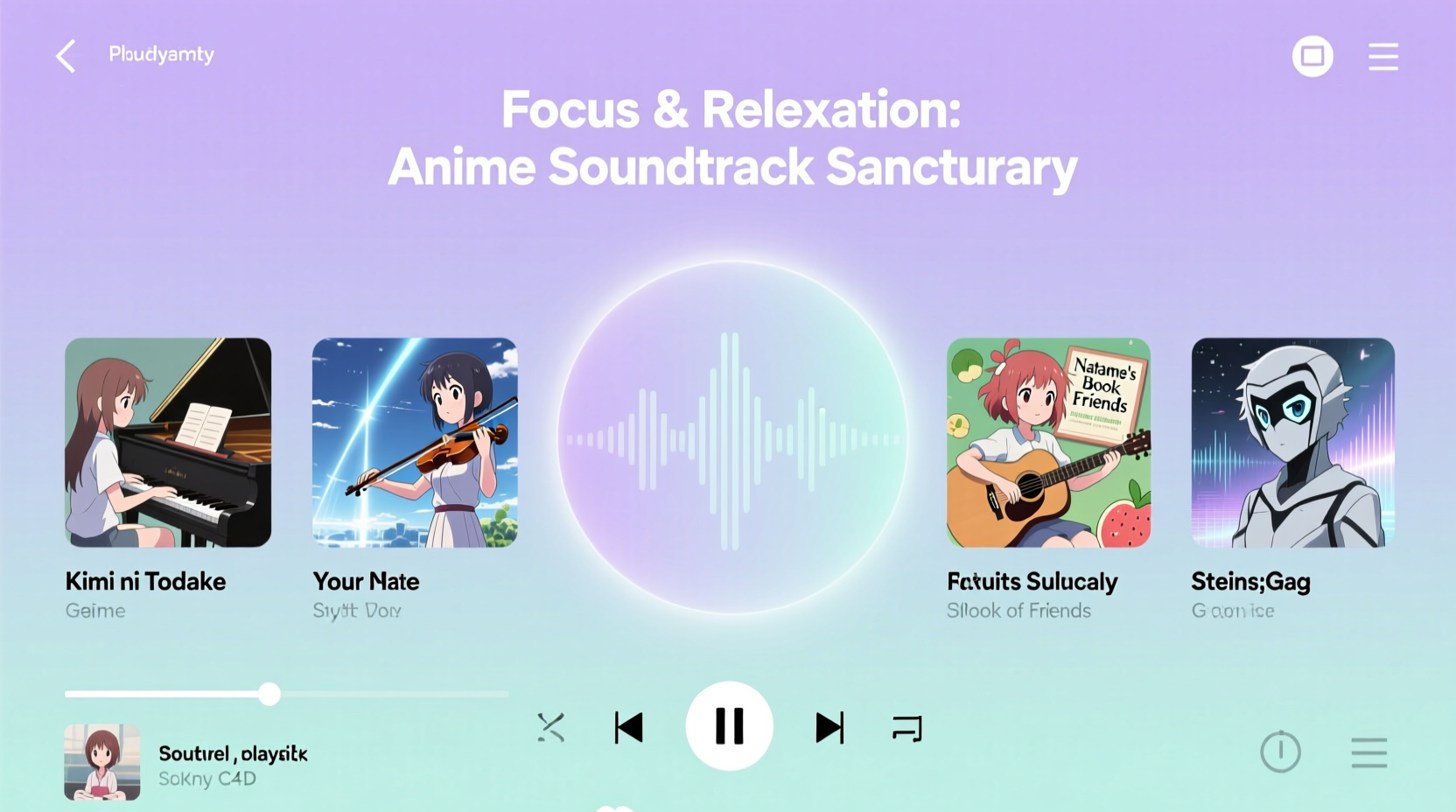
Anime scores are uniquely suited to non-intrusive listening. Unlike Western pop or electronic music, which often prioritize rhythm and vocals, many anime soundtracks emphasize melody, atmosphere, and instrumental layering without abrupt transitions. This makes them less distracting and more conducive to sustained attention.
Studies in cognitive psychology suggest that moderate environmental sound—especially instrumental music with predictable structure—can enhance concentration by reducing external auditory distractions and inducing a mild state of arousal that supports alertness without overstimulation.
Anime soundtracks frequently employ:
- Minimalist piano and strings – Found in Studio Ghibli films, these pieces support calm without inducing drowsiness.
- Ambient textures and reverb-heavy synths – Common in sci-fi series like *Cowboy Bebop* or *Ghost in the Shell*, they create immersive sonic backdrops.
- Repetitive melodic motifs – Used in long-running series such as *Fullmetal Alchemist*, they provide consistency without monotony.
“Music with emotional resonance but low lyrical interference allows the brain to stay engaged without being hijacked by language processing.” — Dr. Lena Torres, Cognitive Neuroscientist, University of Kyoto
Top Anime Series with Focus-Friendly Soundtracks
Not every anime delivers usable background music. The following series stand out for their consistent tonal quality, emotional neutrality, and compositional restraint—ideal traits for focus and relaxation.
| Anime Series | Composer(s) | Mood & Use Case | Key Tracks |
|---|---|---|---|
| Studio Ghibli Films (e.g., My Neighbor Totoro, Spirited Away) | Joe Hisaishi | Gentle, pastoral, calming – perfect for reading, light work, or mindfulness | \"Path of the Wind\", \"The Name of Life\", \"Mermaid’s Hill\" |
| Cowboy Bebop | Yoko Kanno | Jazz-infused, cool, dynamic yet smooth – excellent for creative tasks | \"The Real Folk Blues\", \"Blue\", \"Green Bird\" |
| Clannad / Clannad: After Story | Shinji Orito | Piano-driven, melancholic warmth – best for reflective writing or emotional regulation | \"Mag Mell\", \"Town, Where We Live\", \"Light Colored Song\" |
| Attack on Titan | Hiroyuki Sawano | Epic, intense, rhythmic – use sparingly for high-energy sprints or motivation | \"You See Big Girl\", \"Barricades\", \"Vogel im Käfig\" |
| March Comes In Like a Lion | Yuki Kajiura | Quiet, introspective, emotionally balanced – ideal for deep work sessions | \"Half Awakening\", \"Scattered Cherry Blossoms\", \"Rainy Days, Rainy Ways\" |
While series like *Naruto* or *Demon Slayer* offer memorable themes, their music tends to be action-oriented and emotionally charged, making them less suitable for prolonged focus. Instead, prioritize shows centered on character development, daily life, or philosophical themes—genres where music supports mood rather than punctuates action.
How to Build Your Own Anime Focus Playlist: A Step-by-Step Guide
Creating an effective playlist isn’t just about collecting favorite songs. It requires intentionality in pacing, instrumentation, and emotional arc. Follow this sequence to build a personalized, function-first soundtrack.
- Define your purpose: Are you aiming for relaxation, concentration, or gentle energy? Choose music accordingly. Calm piano works for meditation; subtle jazz fusion suits coding or design.
- Select 3–5 source series: Start with the recommendations above. Stick to one composer per session to maintain sonic consistency.
- Filter by instrument type: Exclude vocal tracks unless they’re in an unfamiliar language and minimally intrusive. Prioritize solo piano, acoustic guitar, strings, or ambient synth.
- Sequence for flow: Begin with slightly brighter tones, transition into mid-tempo pieces, and end with softer, fading melodies. Avoid sudden shifts in dynamics.
- Test in real conditions: Play the list during a 45-minute work block. Note any moments that pull attention away. Remove or replace disruptive tracks.
- Limits matter: Keep playlists between 60–90 minutes. Longer lists risk fatigue. Rotate different playlists to prevent habituation.
Where to Find Curated Anime Soundtrack Playlists
You don’t need to build everything from scratch. Several platforms host expertly curated collections designed specifically for focus and wellness.
- Spotify: Search for “Anime Study,” “Relaxing Anime Piano,” or “Studio Ghibli Loops.” Verified playlists like *Anime Vibes* and *Calm Anime* are updated regularly and vetted for coherence.
- YouTube: Channels such as *Lofi Bear*, *Anime Music Box*, and *Piano Collections* offer extended streams (2–4 hours) with seamless loops. Ideal for all-day background play.
- Apple Music: Explore editorial playlists under “Focus” or “Ambient.” Look for compilations featuring Hisaishi or Kanno.
- SoundCloud: Independent creators often remix anime themes into lo-fi or ambient formats, stripping vocals and slowing tempos for maximum calm.
When using public playlists, verify track sources. Some fan-made lists mix anime music with non-anime lo-fi beats, diluting the aesthetic. Stick to those labeled “pure anime” or “original score only” for authenticity.
Mini Case Study: A Student’s Focus Transformation
Maya, a third-year university student majoring in architecture, struggled with distraction during late-night design sessions. She experimented with classical music, white noise, and pop playlists but found herself either zoning out or getting pulled into lyrics.
On a friend’s suggestion, she tried a Studio Ghibli piano compilation during a model-building marathon. The absence of words and the gentle progression of melodies allowed her to stay immersed in spatial thinking without mental clutter. Over two weeks, she refined her playlist to include select tracks from *March Comes In Like a Lion* and *Your Name*, both known for their emotional subtlety.
Her self-reported focus duration increased from 25 to 60 minutes per uninterrupted stretch. “It’s not just background noise,” she said. “It feels like the music understands the pace my brain needs.”
Essential Checklist: Building Your Anime Focus Toolkit
Before launching your listening routine, run through this checklist to ensure effectiveness and sustainability.
- ✅ Choose instrumental-only tracks to minimize cognitive load
- ✅ Limit playlist length to 60–90 minutes to avoid fatigue
- ✅ Test each playlist during actual work before relying on it
- ✅ Rotate 3–4 different playlists weekly to maintain freshness
- ✅ Use headphones for consistent audio quality and noise isolation
- ✅ Avoid looping single tracks endlessly—variety supports sustained attention
- ✅ Pair music with timed work blocks (e.g., Pomodoro technique)
Frequently Asked Questions
Can anime music really help with anxiety and relaxation?
Yes, particularly when it features slow tempos, natural instrumentation, and harmonic predictability. Tracks from *Spirited Away* or *Only Yesterday* have been used in therapeutic settings to reduce cortisol levels and support mindful breathing. However, individual responses vary—always choose music that personally resonates with calm.
Is it better to listen to full OSTs or curated playlists?
Curated playlists are generally more effective. Full original soundtracks (OSTs) often include dramatic cues, battle themes, or vocal tracks unsuitable for focus. Curated lists filter for continuity and mood alignment, making them more functional for daily use.
What if I love a series but its music is too intense?
Look for fan-made arrangements. Many artists on YouTube and SoundCloud reinterpret intense themes—like those from *Attack on Titan*—into soft piano or ambient versions. Search terms like “[anime name] + lofi” or “piano cover” to find gentler alternatives.
Conclusion: Tune In, Zone Out, Get Things Done
Anime soundtrack playlists offer a rich, underutilized resource for anyone seeking deeper focus or genuine relaxation. By moving beyond nostalgia and selecting music with intention, you can transform your auditory environment into a catalyst for clarity and calm. The best part? These scores are widely accessible, free from lyrical distraction, and steeped in artistic craftsmanship that honors silence as much as sound.
Start small. Pick one series, extract three instrumental tracks, and test them during your next focused task. Notice how your mind responds. Over time, refine your collection into a personal sanctuary of sound—one that supports your goals without demanding your attention.




 浙公网安备
33010002000092号
浙公网安备
33010002000092号 浙B2-20120091-4
Comments
No comments yet. Why don't you start the discussion?