
For anime enthusiasts, collecting merchandise is more than a hobby—it's a way to connect with beloved characters, shows, and memories. Whether it’s a limited-edition figure, a themed hoodie, or an exclusive art print, each item adds meaning to a fan’s space. But how you acquire these collectibles—through curated subscription boxes or direct single-item purchases—can significantly impact your budget, satisfaction, and overall experience.
The rise of anime subscription boxes has made collecting more accessible, offering surprise items delivered monthly. At the same time, individual shopping allows for precise control over what you buy. The real question isn’t just about cost—it’s about value: What do you gain beyond the price tag? This article breaks down both models, comparing cost, customization, exclusivity, risk, and emotional payoff to help you make smarter decisions as a collector.
Cost Analysis: Upfront Price vs Long-Term Spending
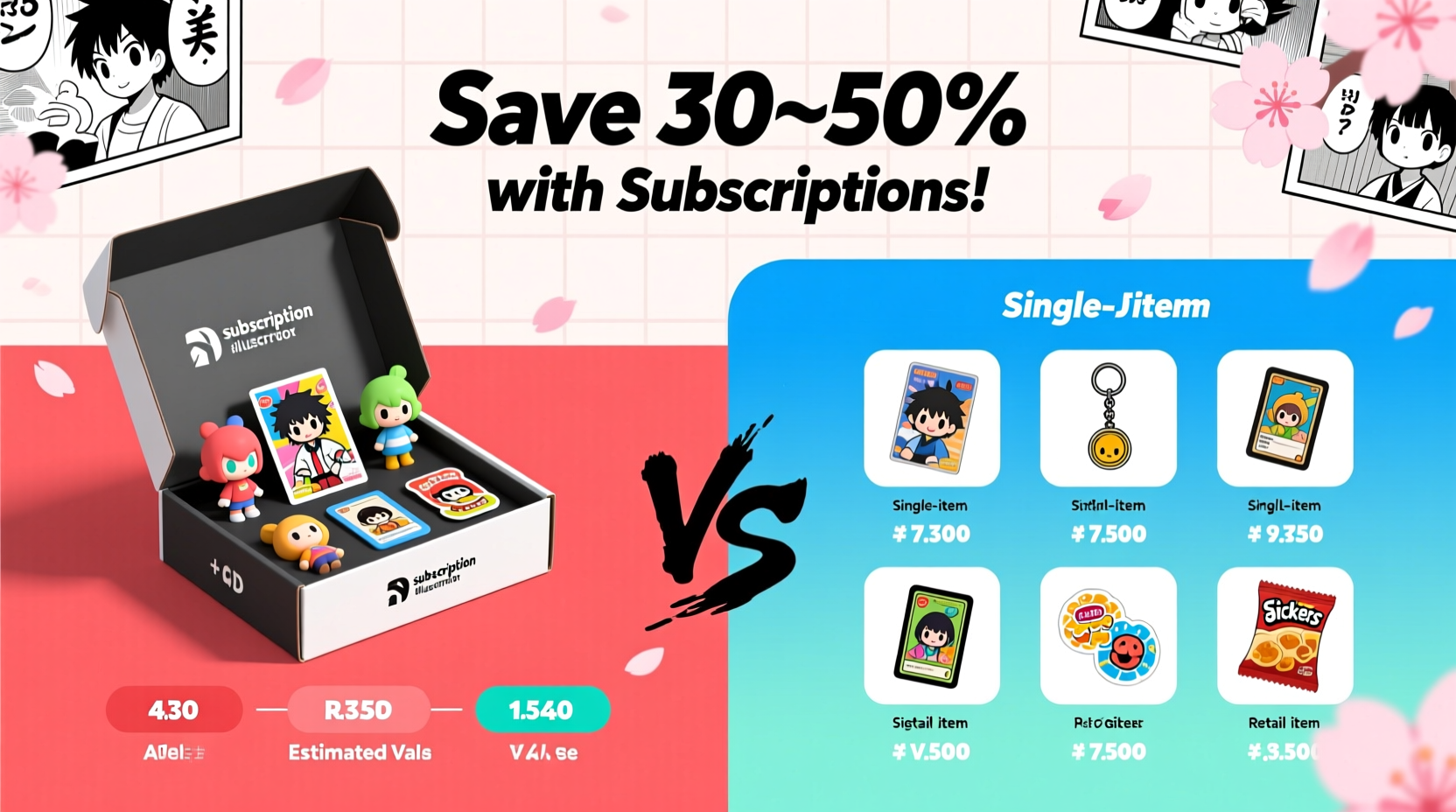
At first glance, single-item purchases seem straightforward: pay for exactly what you want, when you want it. A $40 Nendoroid or a $25 enamel pin costs only that amount. Subscription boxes, however, typically charge between $30 and $60 per month, sometimes requiring 3- to 6-month commitments. While some appear cheaper upfront, recurring payments can add up quickly.
Consider this: a 6-month anime box at $45/month totals $270. If one box includes a $70 figure, two apparel items worth $40 total, three accessories averaging $15 each, and miscellaneous stickers and cards ($20), the estimated retail value reaches $175. In this case, you're paying $95 more than the sum of the parts. That premium covers curation, packaging, licensing, and surprise factor—but not everyone sees that as worthwhile.
In contrast, buying those same items individually lets you avoid overpaying. You could spend $175 on verified goods from trusted retailers and skip anything you don’t love. However, impulse buys during sales or limited drops can blur this advantage. Without discipline, single-item shopping may lead to overspending on non-essentials.
Customization and Personal Taste: Control vs Surprise
One of the biggest differences lies in control. When purchasing single items, you choose based on character preference, design quality, size, and relevance to your collection. You’re unlikely to end up with a Goku mug if you’re deeply invested in *Spirited Away*. With subscription boxes, variety is built-in—and so is unpredictability.
Some boxes let you select themes (e.g., shonen, shojo, retro anime), but few allow full customization. You might receive five My Hero Academia items in a row while waiting months for that rare *Princess Tutu* keychain. For completists or fans of niche series, this lack of precision becomes frustrating.
Yet, surprise has its appeal. Many subscribers enjoy the “unboxing ritual,” treating each delivery like a gift. There’s psychological satisfaction in discovering something unexpected—a sentiment backed by behavioral research on reward anticipation. Dr. Lena Park, consumer behavior analyst at Kyoto University, notes:
“The dopamine hit from surprise rewards strengthens emotional attachment to products. That’s why curated experiences often feel more memorable than planned purchases.” — Dr. Lena Park, Consumer Behavior Analyst
Still, emotional highs fade. Lasting value comes from usefulness and personal resonance. If most items don’t match your taste, even high-quality pieces become clutter.
Value Comparison Table: Key Factors Side-by-Side
| Factor | Subscription Boxes | Single Item Purchases |
|---|---|---|
| Average Monthly Cost | $30–$60 (often with minimum commitments) | Variable; $5–$150+ per item |
| Customization Level | Low to moderate (theme selection only) | Full control over choices |
| Exclusivity | High—many boxes include members-only items | Mixed—limited editions available via drops or pre-orders |
| Risk of Unused Items | Higher—depends on curation accuracy | Lower—you choose what you want |
| Emotional Engagement | High—anticipation and unboxing excitement | Moderate—satisfaction from intentional acquisition |
| Long-Term Flexibility | Low—contracts, renewal pressure | High—buy only when desired |
| Resale Potential | Limited—exclusive items may have niche markets | Better—popular figures maintain resale value |
Real Collector Scenario: Two Approaches, One Goal
Meet Aisha, a longtime anime fan who collects Studio Ghibli memorabilia. Over two years, she tested both methods to expand her display shelves.
First, she subscribed to a popular seasonal anime box for six months at $48/month. Her shipments included a Totoro plush, a Howl’s Moving Castle candle, a Laputa-themed notebook, and several smaller trinkets. One box had a Miyazaki art card labeled “exclusive to members”—a highlight. But two deliveries contained mostly Naruto and Demon Slayer items, which she resold at a loss.
Total spent: $288. Estimated resale recovery: $60. Net cost: $228. Number of kept items: 7.
Then, Aisha switched strategies. She paused subscriptions and began saving $50/month toward specific purchases. Within eight months, she bought a high-end Kiki’s Delivery Service statue ($120), a vintage poster ($60), and a hand-painted wall scroll ($100). Every piece matched her aesthetic. No items were unwanted.
Total spent: $400. All items retained or increased in value. Emotional satisfaction was higher due to intentionality.
Was the second method more expensive? Yes. But Aisha felt greater pride in her collection. “I didn’t just accumulate things,” she said. “I built something meaningful.”
Step-by-Step Guide: Choosing Your Best Strategy
Deciding between subscription boxes and single-item purchases doesn’t have to be permanent. Use this flexible framework to assess your current needs:
- Evaluate your current collection goals. Are you building a display, seeking rare items, or just enjoying casual fandom?
- Set a monthly budget. Decide how much you’re comfortable spending without strain.
- Research 2–3 top subscription services. Read reviews, check past box contents, and look for resale data on their exclusives.
- Compare average value per dollar. Divide the listed retail value of past boxes by the subscription cost. Anything below 1.0 means you’re paying more than item worth.
- Test one box cycle. Commit to a single month (avoid auto-renewals) and document every item received, including emotional response and practical use.
- Assess fit. Did at least 70% of items excite you? Could you have bought them cheaper elsewhere?
- Switch or stay. If satisfied, continue. If not, redirect funds to targeted purchases using wishlists and sale alerts.
When Subscriptions Make Sense (And When They Don’t)
Subscription boxes aren’t inherently wasteful. They offer real benefits under certain conditions:
- You enjoy discovery and don’t mind occasional mismatches.
- The box consistently includes high-value exclusives (e.g., artist collabs, numbered prints).
- You lack time to research or monitor drops across multiple stores.
- You appreciate community perks—like access to Discord groups or early convention tickets.
But red flags should prompt caution:
- Items are clearly sourced from generic wholesalers (low uniqueness).
- Customer reviews frequently mention damaged goods or late shipping.
- Renewal policies are aggressive (e.g., hard-to-cancel auto-billing).
- Themed boxes drift far from your interests (e.g., heavy battle anime in a “general” box).
Ultimately, value isn’t just monetary—it’s experiential. If opening a box brings consistent joy, that’s valid. But if guilt or clutter follows each delivery, it’s time to reevaluate.
FAQ: Common Questions Answered
Are anime subscription boxes worth it for casual fans?
Often, no. Casual fans usually prefer selective purchases. Subscriptions work best for engaged collectors willing to absorb mismatched items. For lighter interest, occasional single buys during sales provide better alignment with enthusiasm levels.
Can I cancel a subscription anytime?
It depends on the provider. Some offer month-to-month plans with easy cancellation. Others require 3- to 6-month commitments or bury cancellation links in support portals. Always read the terms before signing up. Look for phrases like “no long-term contract” or “cancel anytime” in bold.
Do single-item purchases lose the fun of surprise?
They change the type of fun. Instead of random discovery, you gain the satisfaction of hunting down a grail item or scoring a rare pre-order. Many collectors find equal—or greater—joy in achieving a goal than in passive receiving. Consider combining both: buy most items directly, then treat yourself to a box once a year as a special event.
Checklist: Make the Right Choice for Your Collection
Before committing to either model, go through this checklist:
- ✅ Defined my collecting goals (display, investment, casual enjoyment)
- ✅ Set a realistic monthly budget
- ✅ Researched at least three subscription boxes with recent unboxings
- ✅ Compared retail value vs. subscription cost
- ✅ Checked cancellation policy and customer service reputation
- ✅ Created a wishlist of desired single items with target prices
- ✅ Decided whether I value surprise or precision more
- ✅ Committed to tracking spending for the next 90 days
Conclusion: Value Is Personal—Choose With Purpose
There’s no universal answer to whether anime subscription boxes or single-item purchases offer better value. The truth depends on your personality, priorities, and habits. For disciplined collectors who cherish intentionality, direct buying wins. For explorers who love surprises and community, a well-chosen box can be a rewarding ritual.
The key is awareness. Blindly subscribing “just because” leads to wasted money. Equally, avoiding all subscriptions out of principle means missing unique opportunities. Test both approaches on a small scale. Reflect on what truly enhances your fandom—not just financially, but emotionally.




 浙公网安备
33010002000092号
浙公网安备
33010002000092号 浙B2-20120091-4
Comments
No comments yet. Why don't you start the discussion?