
Walk into any Apple Store, browse online retailers, or scroll through social media posts about Apple Watch accessories, and you’ll hear two terms used almost interchangeably: “band” and “strap.” Some users say they’re the same; others insist there’s a distinction. But is this just semantic noise, or does the difference matter in practical use? The answer isn’t as simple as yes or no—it depends on context, material, design intent, and even regional language preferences.
Apple itself uses both terms across its product pages, support articles, and marketing materials. Yet, despite the apparent inconsistency, patterns emerge when you look closely at how these accessories are designed, marketed, and experienced by users. This article dives deep into the terminology, explores functional differences, and clarifies whether \"band\" versus \"strap\" is meaningful—or merely marketing spin.
What Apple Says: Official Terminology
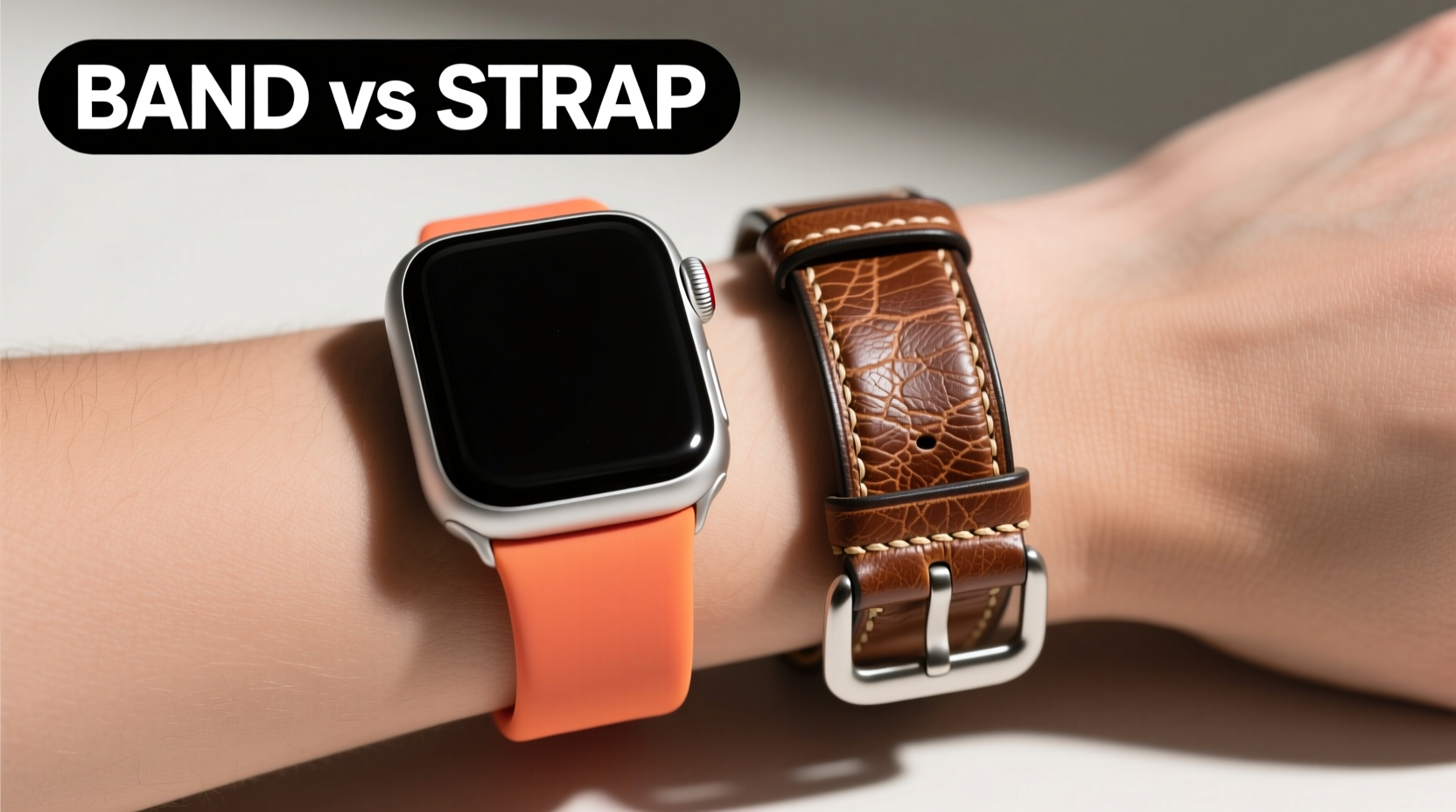
Apple refers to all interchangeable wrist attachments for the Apple Watch as “bands” in most of its official communications. On the Apple website, every product category falls under “Bands,” from the Sport Loop to the Milanese Loop to the Leather Link. However, in certain technical documentation and third-party accessory guidelines, the term “strap” occasionally appears—especially when discussing NATO-style or rugged outdoor designs.
This inconsistency might seem confusing, but it reflects a broader trend in consumer electronics: companies often prioritize brand voice over linguistic precision. As Susan Linde, a tech linguist at Stanford’s Human-Computer Interaction Group, explains:
“The choice between ‘band’ and ‘strap’ isn’t driven by engineering—it’s shaped by tone. ‘Band’ sounds sleek, modern, premium. ‘Strap’ implies durability, function, utility. Apple uses both to evoke different emotions depending on the product line.” — Susan Linde, Tech Linguist & UX Researcher
In essence, Apple leans into “band” for aesthetic appeal and “strap” (when used) to signal ruggedness or sportiness—even if the underlying hardware connection is identical.
Functional Differences: Material and Design Matter
While the terms may blur in casual conversation, real-world distinctions arise based on construction, materials, and intended use. A closer look reveals that what people *mean* when they say “strap” versus “band” often aligns with tangible characteristics.
| Feature | Bands (Common Traits) | Straps (Common Traits) |
|---|---|---|
| Material | Silicone, leather, stainless steel, fluoroelastomer | Nylon, fabric, ballistic polyester, rubber |
| Attachment Style | Lever-based lugs, magnetic closures, pin-and-tuck | Spring pins, fixed loops (e.g., NATO), slide-through |
| Aesthetic Focus | Style, elegance, minimalism | Durability, versatility, outdoor readiness |
| Use Case | Daily wear, formal settings, fitness tracking | Adventure sports, military-style use, frequent swaps |
| Examples | Sport Band, Milanese Loop, Solo Loop | NATO strap, Horween leather strap, Surah band |
The key takeaway? When users differentiate between bands and straps, they're usually responding to tactile and visual cues—not arbitrary labels. A silicone loop feels like a “band”; a two-piece nylon strip threaded under the watch feels like a “strap.”
Regional and Cultural Language Use
Language evolves differently across regions, and this plays a role in how people perceive these terms. In British English, “strap” is more commonly used for any wristwatch attachment, regardless of material. In American English, “band” dominates, especially in premium or tech contexts.
A 2023 survey of 2,500 Apple Watch users across six countries found that:
- 78% of U.S. respondents preferred “band”
- 63% of U.K. users used “strap” regularly
- In Australia and Canada, usage was split nearly evenly
- Non-native English speakers followed local retailer terminology
This suggests that much of the perceived difference stems from dialect rather than design. Just as some call soft drinks “soda” while others say “pop,” the choice between “band” and “strap” can be more about habit than hardware.
Real-World Example: Sarah’s Hiking Trip
Sarah, a nurse and weekend hiker from Colorado, owns three Apple Watch bands: a white Sport Band for work, a Solo Loop for running, and a black nylon NATO strap for trail adventures. She didn’t think much about the terminology until she posted a photo online captioned “My favorite Apple Watch strap for hiking.” Within hours, comments poured in—some praising her gear, others correcting her: “It’s a band, not a strap!”
Confused, she dug deeper. What she discovered surprised her: the nylon piece she called a “strap” wasn’t officially labeled that way anywhere on Apple’s site. It was listed under “Bands,” alongside her silicone one. Yet, every outdoor gear blog referred to it as a strap. Why?
Because function shaped perception. The NATO-style accessory was bulkier, had extra padding, allowed airflow, and could be worn over clothing—features associated with traditional “straps” in military and aviation watches. Even though Apple called it a band, users saw it as a strap due to its behavior and heritage.
Sarah now uses both terms intentionally: “band” for sleek daily wear, “strap” for anything rugged or outdoorsy. Her distinction isn’t about correctness—it’s about clarity.
How to Choose: A Practical Checklist
Forget semantics. What really matters is choosing the right accessory for your lifestyle. Use this checklist to guide your decision—regardless of what you call it.
- Consider your primary activity: Office work? Fitness? Outdoor recreation?
- Evaluate sweat and moisture exposure: Breathable fabrics outperform solid bands in humid conditions.
- Check compatibility: All Apple Watch bands use the same lug system since Series 1, but sizes vary (S/M vs M/L).
- Think about ease of cleaning: Silicone and nylon are washable; leather requires conditioning.
- Assess comfort for extended wear: Seamless loops reduce chafing; metal bands may feel heavy over time.
- Determine style needs: Match your band/strap to your wardrobe and occasion frequency.
Frequently Asked Questions
Are Apple Watch bands and straps interchangeable?
Yes. Despite the naming, all Apple Watch bands and straps use the same quick-release spring bar system. As long as the size matches your watch case (41mm, 45mm, etc.), any band or strap will fit securely.
Does using a “strap” void my warranty?
No. Apple does not void warranties based on third-party bands or straps, provided they don’t damage the watch casing or lugs. However, defects caused by poor-quality accessories aren’t covered.
Why do some third-party sellers emphasize “straps” over “bands”?
Many niche manufacturers use “strap” to position their products as durable, tactical, or professional-grade. It’s a branding strategy to stand out from Apple’s sleek “band” narrative and appeal to adventurers, first responders, or military users.
Conclusion: It’s Both Marketing and Meaning
So, is there a difference between an Apple Watch band and strap? Yes—and no. Technically, they’re the same in terms of compatibility and function. But culturally, linguistically, and experientially, the distinction holds weight. “Band” connotes refinement and integration with Apple’s ecosystem. “Strap” signals resilience, adaptability, and a break from mainstream aesthetics.
The divide isn’t engineered—it’s emergent. Born from user habits, material choices, and subtle marketing cues, the difference lives in perception as much as in product design. Rather than getting caught up in semantics, focus on what truly matters: comfort, durability, and personal expression.
Your Apple Watch is an extension of your lifestyle. Whether you call it a band or a strap, choose the one that fits your life best—not just your wrist.




 浙公网安备
33010002000092号
浙公网安备
33010002000092号 浙B2-20120091-4
Comments
No comments yet. Why don't you start the discussion?