
The Apple Watch SE has carved a strong niche in the smartwatch market by offering core Apple Watch functionality at a more accessible price point. With the release of the 2023 model, Apple introduced subtle but meaningful updates. For owners of the 2022 version, the question arises: does this refresh deliver enough new value to justify an upgrade? The answer depends on your priorities—whether you're chasing cutting-edge tech or simply want reliable daily performance.
This analysis dives into hardware changes, software capabilities, battery life, user experience, and long-term value to help you determine if moving from the 2022 to the 2023 Apple Watch SE makes practical sense.
Key Differences Between the 2022 and 2023 Models
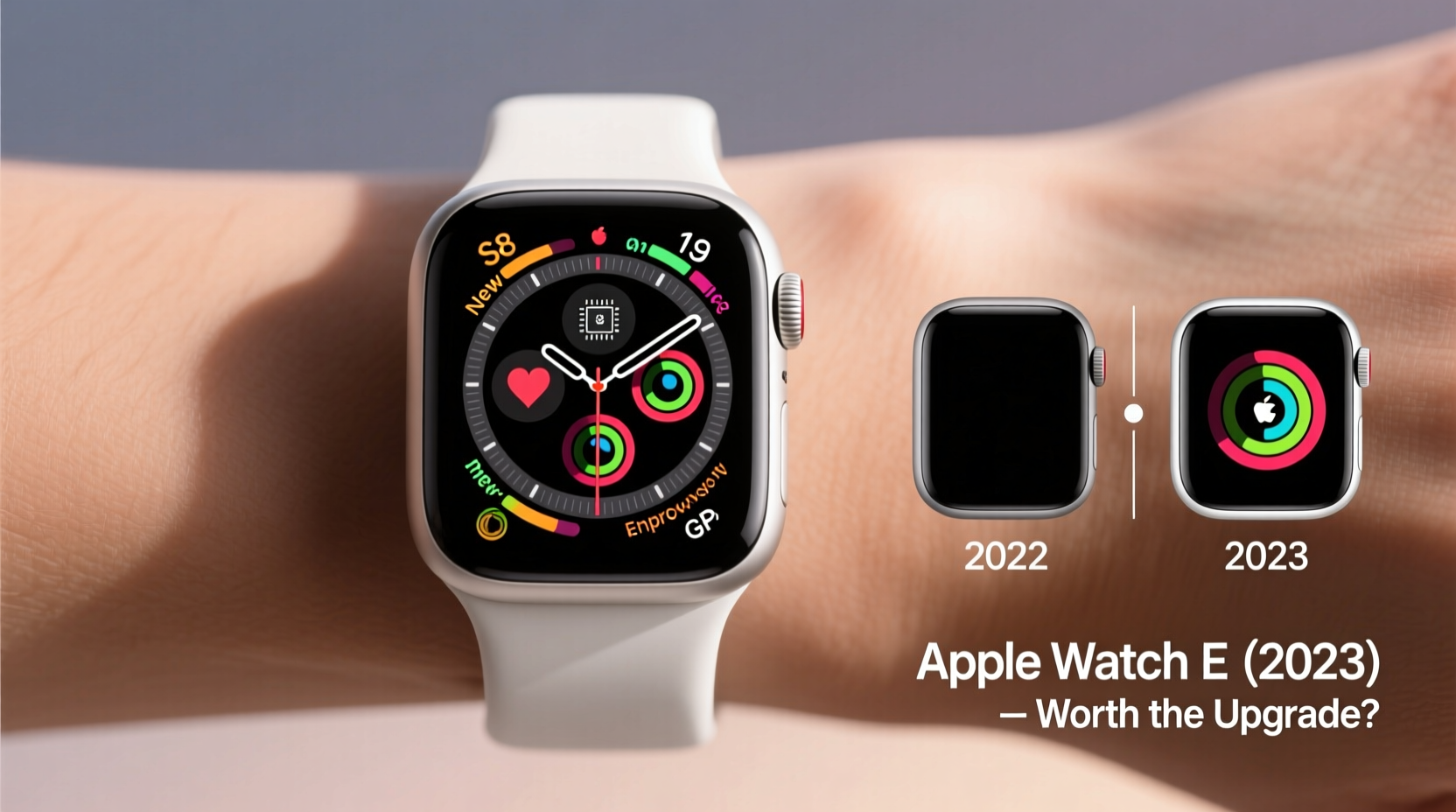
At first glance, the 2023 Apple Watch SE appears nearly identical to its predecessor. Both models share the same design language, aluminum case options, display size (40mm and 44mm), and water resistance rating. However, under the hood, Apple made a critical upgrade that defines the newer model’s identity: the shift to the S8 chip.
The original 2022 SE used the S6 chip (the same as the Series 6), while the 2023 model inherits the S8 processor from the Apple Watch Series 8. This change brings modest improvements in processing speed, graphics performance, and power efficiency. While not revolutionary, the S8 enables smoother animations, faster app launches, and better responsiveness during intensive tasks like GPS tracking or voice dictation.
In addition, the 2023 model includes enhanced motion sensors and supports crash detection—a safety feature that automatically calls emergency services if it detects a severe car crash. This function relies on improved accelerometer and gyroscope technology, which was absent in the 2022 SE.
Performance and User Experience Comparison
Real-world usage reveals that the S8 chip provides a perceptible—but not dramatic—improvement over the S6. Everyday tasks such as checking notifications, using fitness apps, or controlling music remain snappy on both devices. However, users who multitask heavily or rely on third-party apps may notice quicker load times and reduced lag on the 2023 version.
Battery life remains consistent across both models: Apple still estimates up to 18 hours of typical use, with full charge lasting about one day under normal conditions. Neither model supports fast charging, so the experience of powering up is unchanged.
One area where the 2023 model shines is future-proofing. Devices with newer chips tend to receive longer software support. Given that watchOS updates often demand higher processing power, the S8-equipped 2023 SE is likely to stay compatible with upcoming OS versions for a year or two longer than the 2022 model.
“While the Apple Watch SE isn’t positioned as a premium device, its silicon foundation determines longevity. The S8 gives the 2023 model a clear edge in long-term usability.” — David Lin, Wearable Technology Analyst at TechPulse Insights
Feature Comparison Table
| Feature | Apple Watch SE (2022) | Apple Watch SE (2023) |
|---|---|---|
| Processor | S6 chip | S8 chip |
| Crash Detection | No | Yes |
| Fall Detection | Yes | Yes |
| ECG App | No | No |
| Blood Oxygen Monitoring | No | No |
| Always-On Retina Display | No | No |
| Water Resistance | 50m (WR50) | 50m (WR50) |
| Battery Life | Up to 18 hours | Up to 18 hours |
| watchOS Support Timeline (Estimated) | 2022–2027 | 2023–2028+ |
Real-World Example: A Commuter’s Perspective
Consider Sarah, a 34-year-old urban commuter who bought the 2022 Apple Watch SE primarily for fitness tracking, transit navigation, and call management. Over the past year, she’s found the device reliable but occasionally sluggish when switching between Maps and her workout app during morning runs.
After testing the 2023 model, she noticed faster route recalculations and smoother transitions between apps. More importantly, during a minor fender-bender on her way home, the watch prompted her with a crash detection alert—something her old model couldn’t do. Though no emergency call was needed, the peace of mind influenced her decision to upgrade.
For users like Sarah, whose lifestyles involve dynamic movement and variable environments, the incremental upgrades in sensor accuracy and responsiveness translate into tangible benefits—even if they’re not headline-grabbing innovations.
Upgrade Checklist: Is the 2023 Model Right for You?
Before making a decision, consider the following factors. Check off each item that applies to your situation:
- ✅ I frequently engage in driving or high-risk activities where crash detection could be lifesaving
- ✅ I want my device to remain supported by the latest watchOS updates through 2028 or beyond
- ✅ I’ve experienced performance lags on my 2022 model when using multiple apps
- ✅ I plan to keep my Apple Watch for 3+ years without another upgrade
- ✅ I value having the most up-to-date safety and sensor technology available in the SE line
If three or more of these apply, the 2023 Apple Watch SE represents a worthwhile investment. If not, your 2022 model likely continues to serve you well.
Frequently Asked Questions
Can the 2022 Apple Watch SE receive crash detection via a software update?
No. Crash detection requires advanced motion sensors and algorithms that are hardware-dependent. Since the 2022 SE lacks the necessary gyroscopic range and accelerometer sensitivity, this feature cannot be added through software alone.
Does the 2023 model have better battery life than the 2022?
Apple states the battery life is equivalent—up to 18 hours under typical use. Real-world tests show negligible differences. Any perceived improvement comes from more efficient background task handling due to the S8 chip, not increased capacity.
Is the design different between the two models?
No. Both watches share the same casing, display type (Retina LTPO OLED), button layout, and available finishes. The only visual difference is the engraved text on the back: “(PRODUCT)RED,” “Aluminum,” and “S8” on the 2023 model.
Final Verdict: To Upgrade or Not?
The 2023 Apple Watch SE isn’t a reinvention—it’s a refinement. For someone still using an older Apple Watch (Series 3 or earlier), this model delivers a massive leap in performance and safety. But for existing 2022 SE owners, the upgrade calculus shifts toward marginal gains rather than transformative change.
The inclusion of crash detection and the S8 chip enhances reliability and extends the device’s usable lifespan, particularly for users who depend on their watch for health monitoring or travel safety. However, if your current watch functions smoothly and you don’t prioritize emergency features, holding onto your 2022 model remains a perfectly rational choice.
Ultimately, the decision hinges on how much you value forward compatibility and passive safety systems. The 2023 SE doesn’t dazzle with flashy upgrades, but it quietly improves upon what matters: responsiveness, resilience, and readiness when you need it most.




 浙公网安备
33010002000092号
浙公网安备
33010002000092号 浙B2-20120091-4
Comments
No comments yet. Why don't you start the discussion?