
The Apple Watch lineup offers a range of options for different budgets and needs. At the heart of the current selection sits the Apple Watch SE and the Apple Watch Series 9—two models that look similar at first glance but diverge significantly in functionality, performance, and long-term utility. For consumers weighing cost against capability, the question arises: is the more affordable SE truly holding back on essential features, or does it still deliver enough to justify its lower price?
This comparison dives deep into hardware, software, health tracking, user experience, and real-world usability to determine whether the gap between the SE and Series 9 is meaningful—or merely marketing.
Design and Build: Nearly Identical, But Not Equal
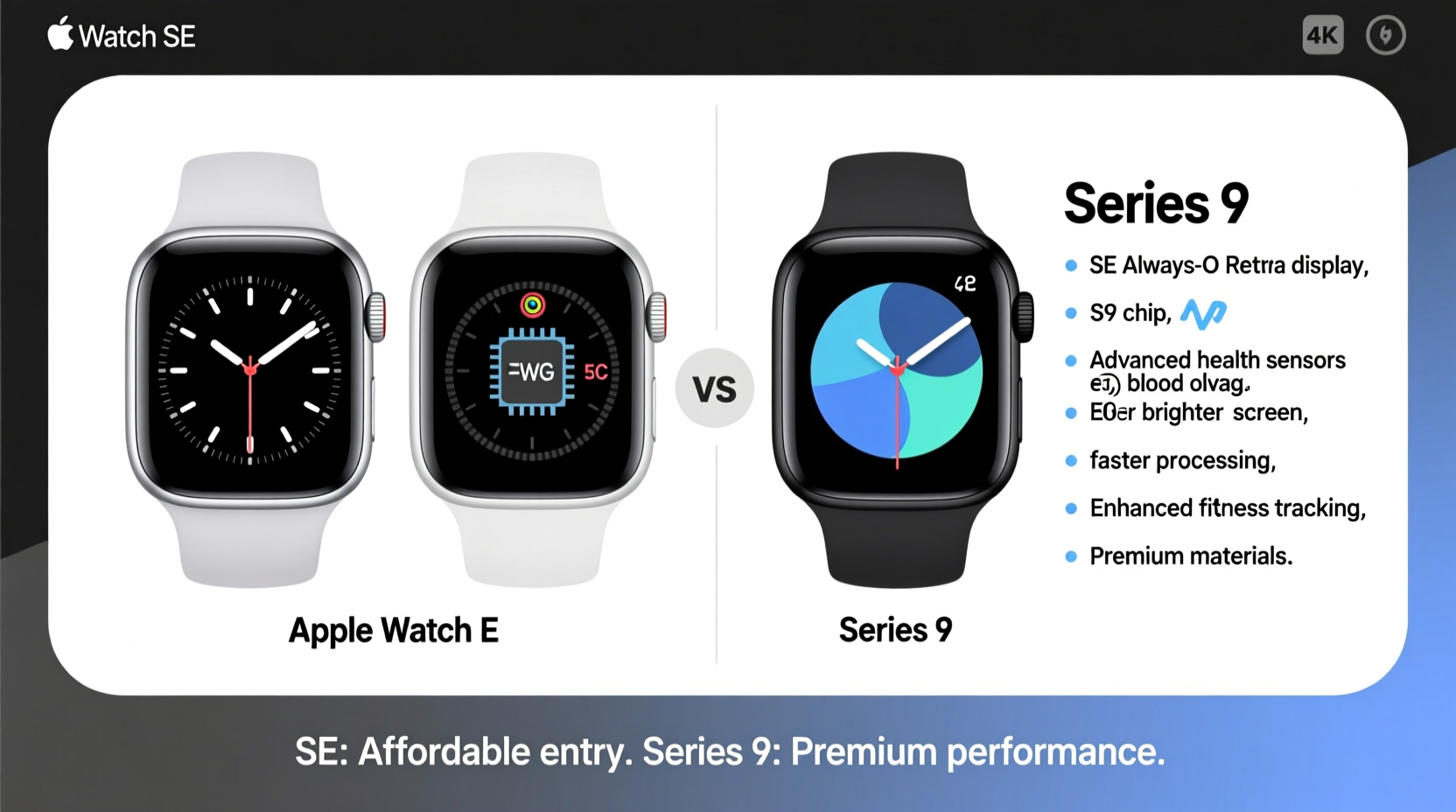
Visually, the Apple Watch SE (2nd generation) and Series 9 are nearly indistinguishable. Both feature a sleek aluminum case, an Always-On Retina display, and compatibility with the full range of Apple bands. They share the same form factor, thickness, and water resistance rating (up to 50 meters), making them equally suitable for swimming and daily wear.
However, subtle differences exist beneath the surface. The Series 9 uses a slightly brighter OLED display—up to 2,000 nits peak brightness compared to the SE’s 1,000 nits—making it far more readable in direct sunlight. This becomes noticeable during outdoor workouts or when checking notifications on a sunny sidewalk.
Another distinction lies in the materials. While both come in silver, space gray, and starlight finishes, only the Series 9 offers additional color options like pink and blue, reflecting Apple’s trend of reserving aesthetic variety for flagship models.
Performance: Chipset Differences That Matter
The core difference between the two models lies in their processors. The Apple Watch SE runs on the S8 chip (same as Series 8), while the Series 9 introduces the new S9 SiP (System in Package). Though both are capable, the S9 delivers measurable improvements in speed, efficiency, and AI-driven features.
Independent benchmarks show the S9 offers up to 30% faster CPU performance and enhanced graphics processing. In practice, this translates to quicker app launches, smoother animations, and better responsiveness when multitasking—especially important as watchOS continues to evolve with more complex apps and interfaces.
More importantly, the S9 includes a dedicated Neural Engine optimized for on-device machine learning. This enables advanced features like improved Siri response, voice recognition without internet, and future-proofing for upcoming AI integrations in health and personalization.
“Processing power on wearables isn’t just about speed—it’s about enabling smarter interactions and longer relevance.” — Dr. Lena Patel, Wearable Technology Researcher at MIT Media Lab
Health and Fitness Tracking: Where the Gap Widens
Both watches support core fitness features: step counting, heart rate monitoring, sleep tracking, ECG, fall detection, and emergency SOS. However, the Series 9 includes several upgrades that enhance accuracy and insight.
- Blood Oxygen Sensing: Available on Series 9, absent on SE.
- Advanced Sleep Stages: Series 9 provides REM, Core, and Deep sleep analysis; SE only estimates total sleep duration.
- Temperature Sensing: Exclusive to Series 9 and Ultra models, enabling retrospective ovulation estimates and cycle predictions.
- Crash Detection: Present on both, but Series 9 uses dual-frequency GPS and improved motion sensors for higher accuracy.
The absence of blood oxygen monitoring on the SE is particularly notable. While not critical for everyone, SpO2 tracking can help detect early signs of respiratory issues, sleep apnea, or altitude-related stress—valuable for active users or those managing chronic conditions.
Real-World Example: Managing Health Proactively
Consider Sarah, a 38-year-old teacher with mild asthma. She opted for the SE to save money but found herself frustrated when her nighttime coughing episodes weren’t flagged by her watch. After upgrading to the Series 9, she began receiving low SpO2 alerts during sleep, prompting her to adjust her medication and bedroom environment. Over three months, her sleep quality improved significantly—something the SE couldn’t have supported due to missing sensor hardware.
This illustrates how feature gaps can impact real health outcomes, especially for users relying on their wearable as a wellness companion rather than just a notification hub.
Smart Features and User Experience
The Series 9 introduces several intelligent enhancements that redefine convenience:
- Double Tap Gesture: Control your watch by tapping your thumb and index finger twice—answer calls, dismiss alarms, start workouts—without touching the screen. This requires the S9’s ultra-low-power neural engine and is unavailable on the SE.
- On-Device Siri: Series 9 processes many Siri requests locally, meaning commands work even without Wi-Fi or iPhone connectivity. The SE routes most queries through the cloud, requiring network access.
- Improved Keyboard & Scribble: Faster text input via handwriting recognition, powered by on-device AI.
These may seem minor individually, but collectively they create a more seamless, responsive experience—particularly useful during workouts, commutes, or emergencies where every second counts.
Comparison Table: Apple Watch SE vs Series 9
| Feature | Apple Watch SE | Apple Watch Series 9 |
|---|---|---|
| Display Brightness | Up to 1,000 nits | Up to 2,000 nits |
| Processor | S8 chip | S9 SiP with Neural Engine |
| Blood Oxygen Monitoring | No | Yes |
| Temperature Sensing | No | Yes (for sleep/cycle tracking) |
| ECG App | Yes | Yes |
| Fall Detection | Yes | Yes (with improved algorithms) |
| Crash Detection | Yes | Yes (with dual-frequency GPS) |
| Always-On Display | Yes | Yes (brighter, more efficient) |
| Double Tap Gesture | No | Yes |
| On-Device Siri | Limited | Full support |
| Water Resistance | 50m (WR50) | 50m (WR50) |
| Battery Life | Up to 18 hours | Up to 18 hours (slightly more efficient) |
| Price (Starting) | $249 | $399 |
Who Should Choose the Apple Watch SE?
The SE remains a compelling option for users who prioritize basics over bells and whistles. It’s ideal for:
- First-time smartwatch buyers testing the waters.
- Teens or parents wanting safety features like fall detection and emergency calling.
- Budget-conscious users focused on activity tracking and notifications.
- iPhone users seeking seamless integration without premium extras.
For these audiences, the SE delivers excellent value. You still get access to watchOS updates, Apple Fitness+, and core health metrics. It supports all major third-party apps and integrates flawlessly with the Apple ecosystem.
Checklist: Is the Apple Watch SE Right for You?
- Do you primarily want step counting, heart rate, and sleep duration?
- Are you okay without blood oxygen or temperature insights?
- Will you mostly use the watch near your iPhone?
- Is your budget under $279?
- Do you prefer simplicity over cutting-edge tech?
If you answered “yes” to most of these, the SE likely meets your needs.
When the Series 9 Is Worth the Extra Cost
The $150 price jump from SE to Series 9 is justified if you value long-term usability, advanced health monitoring, or independent functionality. The Series 9 shines for:
- Athletes needing precise recovery data via blood oxygen and sleep staging.
- Users managing health conditions that benefit from continuous SpO2 tracking.
- People who rely on their watch during travel, hiking, or flights without constant phone access.
- Early adopters who appreciate gesture controls and future-ready AI features.
Moreover, the Series 9’s superior processor ensures it will handle future watchOS updates more smoothly. Given that many users keep their Apple Watches for 3–5 years, investing in stronger hardware today can delay obsolescence.
Step-by-Step: Choosing Between SE and Series 9
- Assess Your Primary Use Case: Are you tracking fitness, managing health, or just staying connected?
- Evaluate Sensor Needs: Do you need SpO2, temperature sensing, or advanced sleep analysis?
- Test Independence Level: Will you use the watch away from your iPhone often?
- Consider Longevity: Plan to keep the device for 4+ years? Prioritize the S9 chip.
- Compare Budget vs. Benefit: Can you absorb the $150 difference for incremental gains?
By following this sequence, you avoid overbuying or under-equipping based on emotional appeal alone.
Frequently Asked Questions
Can the Apple Watch SE get all the same watchOS updates as the Series 9?
Yes, both models receive the same major watchOS updates. However, some new features may be limited to newer hardware. For example, Double Tap and on-device Siri are exclusive to Series 9 due to required neural engine support.
Does the Apple Watch SE have GPS?
Yes, the SE includes GPS for tracking walks, runs, and bike rides without your iPhone nearby. However, it lacks the dual-frequency GPS found in the Series 9, which improves location accuracy in urban environments and dense forests.
Is the battery life different between the two models?
Apple rates both at \"up to 18 hours.\" Real-world usage shows minimal difference, though the Series 9’s more efficient architecture may extend standby time slightly. Neither supports multi-day battery life like the Ultra line.
Final Verdict: Missing Features or Smart Savings?
The Apple Watch SE doesn’t merely cut corners—it makes deliberate trade-offs. It omits advanced sensors and next-gen processing not because they’re unnecessary, but because Apple segments its market to serve diverse needs.
For casual users, the missing features rarely impact day-to-day experience. But for health-focused individuals, outdoor enthusiasts, or those valuing autonomy, the Series 9 offers tangible benefits that accumulate over time.
The SE excels as an entry point. The Series 9 stands as the complete package. Neither is objectively better—the right choice depends on what you expect from a smartwatch beyond telling time.




 浙公网安备
33010002000092号
浙公网安备
33010002000092号 浙B2-20120091-4
Comments
No comments yet. Why don't you start the discussion?