
For trail runners, the right smartwatch isn’t just a fitness tracker—it’s a navigation tool, a safety device, and a performance coach wrapped into one rugged package. As trail running grows in popularity, so does the demand for durable, precise, and long-lasting wearables. Two top contenders dominate this space: the Apple Watch Ultra and the Garmin Fenix series. Both promise elite outdoor performance, but they serve different philosophies. Choosing between them isn't about which is \"better\" overall, but which aligns with your priorities as a trail runner.
Durability and Design: Built to Survive the Trail
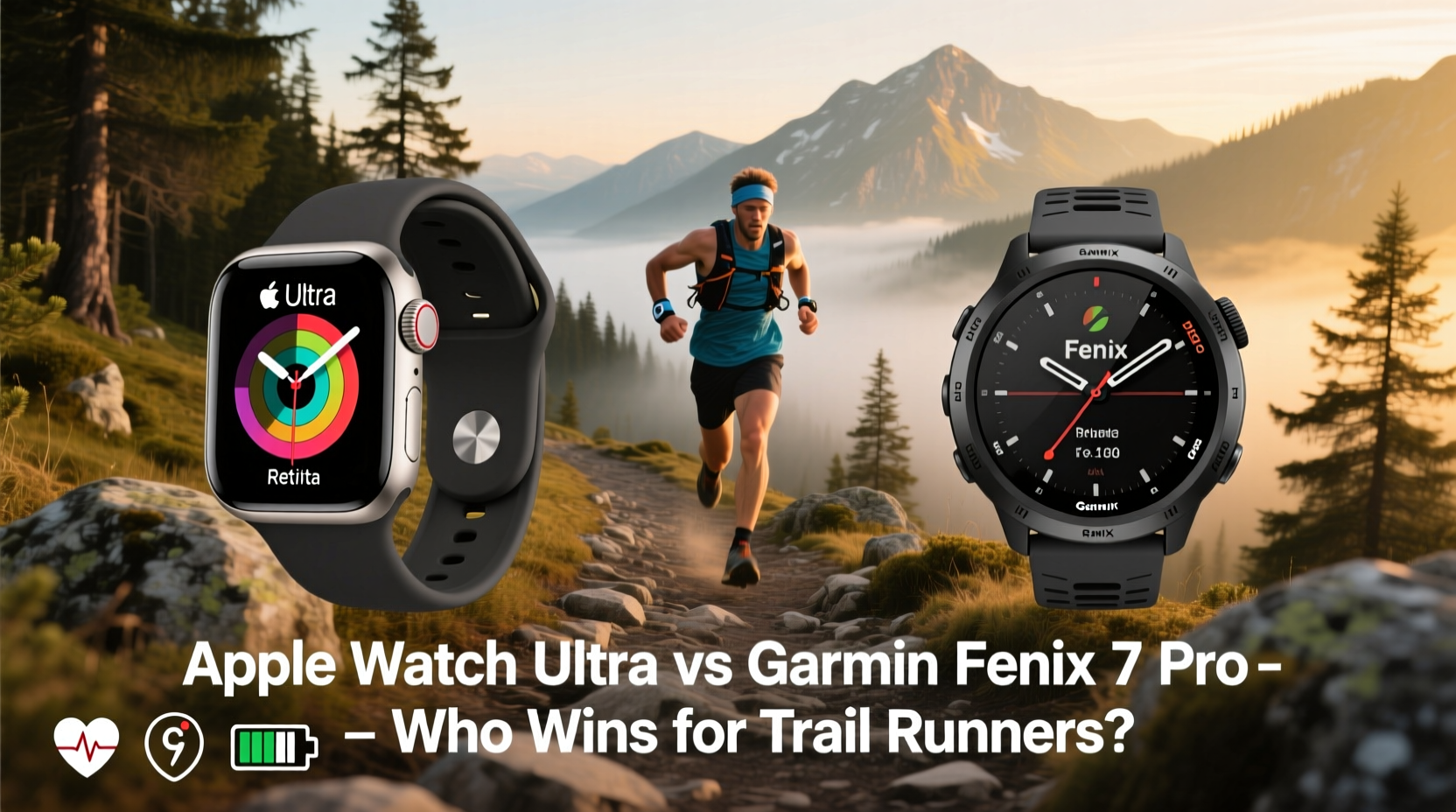
The first thing trail runners notice when holding either device is how solid it feels. The Apple Watch Ultra features a titanium case, a sapphire crystal front, and a crack-resistant lens. It’s rated IP6X dust resistant and WR100 water resistant (up to 100 meters), making it suitable for river crossings and heavy rain. Its flat, angular design maximizes screen real estate and integrates a unique Action Button—customizable for starting a workout, triggering a flashlight, or activating a dive mode.
Garmin Fenix watches, particularly the Fenix 7 series, take a more traditional multisport approach. Built with fiber-reinforced polymer and available in titanium or stainless steel variants, they’re engineered for extreme environments. Most models meet or exceed MIL-STD-810 standards for thermal, shock, and water resistance. While not always sleeker, their button-based interface ensures reliability with gloves or wet fingers—a critical advantage in alpine conditions.
Battery Life: Endurance That Matches Your Long Runs
No trail runner wants their watch dying mid-race. Battery life is where the Garmin Fenix consistently outshines its competition. In typical GPS mode, the Fenix 7 lasts 36–57 hours, depending on model and settings. With solar charging enabled, that can stretch to over 100 hours. For ultrarunners covering 50- or 100-mile races, this means no mid-event charging anxiety.
The Apple Watch Ultra, while impressive for an Apple product, maxes out at around 36 hours in GPS-only mode. Real-world use—especially with LTE, notifications, and third-party apps—can reduce that to 24 hours or less. This may suffice for weekend warriors doing half-day adventures, but it falls short for multi-day backcountry treks or unsupported ultras.
Charging logistics matter too. The Fenix uses a standard clip-on charger, compact and field-friendly. The Watch Ultra requires a proprietary magnetic puck, which is less convenient in remote areas without power access.
“Battery endurance is non-negotiable in trail racing. I’ve seen runners lose navigation capability halfway through a mountain loop because their smartwatch couldn’t keep up.” — Sarah Lin, Professional Trail Coach and UTMB Competitor
GPS Accuracy and Navigation Features
Precise tracking is essential when trails fork unexpectedly or visibility drops. Both watches use multi-band GNSS systems (GPS, GLONASS, Galileo) for high accuracy. However, real-world testing shows subtle differences.
The Garmin Fenix excels in route navigation. It supports full-color TOPO maps, breadcrumb trails, and turn-by-turn directions. You can load GPX routes from platforms like Komoot or AllTrails and follow them reliably—even offline. The “Back to Start” and “Find Next” functions are lifesavers when you miss a trail junction.
The Apple Watch Ultra also offers detailed GPS tracking and works with the Compass app to display elevation and heading. When paired with an iPhone, it can show Maps along your route. But standalone navigation is limited. Without cellular connectivity, rerouting options are minimal, and custom map downloads aren’t as robust as Garmin’s ecosystem.
Additionally, the Fenix allows advanced metrics like TracBack (reverse route guidance), storm alerts based on barometric pressure changes, and sunrise/sunset times—all tailored to off-grid safety.
Performance Tracking and Training Insights
Both devices deliver comprehensive health and fitness data, but their focus differs. The Apple Watch Ultra integrates tightly with the Apple Fitness+ and Health ecosystem. It tracks heart rate, blood oxygen, sleep quality, and ECG—all useful for monitoring recovery. Its Workout app automatically detects movement types and provides real-time pace and elevation feedback.
Where Apple shines is in user experience: intuitive interface, seamless sync with iPhone, and rich third-party app support (Strava, Nike Run Club, etc.). Notifications, music control, and emergency SOS via satellite (on Ultra 2) add convenience and safety.
Garmin, meanwhile, focuses on actionable training analytics. The Fenix calculates metrics like Training Load Focus, Running Dynamics (when paired with a chest strap), Heat Acclimation, and Recovery Time. It offers race time predictions based on recent performance and includes sport-specific profiles for trail running, hiking, and even bouldering.
Its Morning Report gives a snapshot of readiness, stress levels, and suggested workouts—ideal for structured training blocks leading up to a race.
| Feature | Apple Watch Ultra | Garmin Fenix 7 |
|---|---|---|
| Battery (GPS Mode) | Up to 36 hours | 36–57 hours (up to 100+ with solar) |
| Navigation | Basic maps with iPhone; limited offline | Full TOPO maps, route planning, Back to Start |
| Trail-Specific Metrics | Pace, elevation, heart rate | Grade Adjusted Pace, Climb Duration, Readyness Score |
| Durability | WR100, sapphire, titanium | MIL-STD-810, fiber-reinforced, optional solar |
| Smart Features | iOS integration, apps, calls, music | Limited notifications, no calling |
| Price (Starting) | $799 | $799 (Fenix 7S); up to $1,199 (Solar) |
Real-World Use Case: A 50K Trail Race in the Rockies
Consider Alex, an experienced trail runner preparing for a rugged 50K in Colorado. The course includes steep ascents, unpredictable weather, and sections above tree line with poor cell service. Alex needs reliable GPS, accurate elevation tracking, and the ability to navigate if markers fade under snow.
Using the Garmin Fenix 7X Solar, Alex preloads the official race GPX file, checks elevation profiles, and sets alerts for aid stations. During the race, the watch accurately tracks ascent time and adjusts pace goals based on gradient. When a sudden thunderstorm rolls in, the Fenix detects a rapid drop in barometric pressure and displays a weather alert. Alex decides to descend early—a decision potentially influenced by the watch’s environmental awareness.
If Alex had used the Apple Watch Ultra instead, GPS tracking would still be accurate, and emergency SOS via satellite could provide peace of mind. However, navigating without phone connectivity would be harder. No downloadable topo maps mean reliance on memory or external cues. Battery anxiety might prompt conservative settings, disabling certain sensors.
In this scenario, the Fenix proves more self-sufficient. The Watch Ultra remains excellent for post-run analysis and sharing results instantly—but only if the device lasts the full distance.
Who Wins for Trail Runners?
The answer depends on what kind of trail runner you are.
Choose the Garmin Fenix if:
- You prioritize battery life over smart features.
- You run long distances (marathons, ultras) or multi-day events.
- You value offline navigation, topographic maps, and environmental alerts.
- You want deep training insights and structured recovery metrics.
- You often run without phone access.
Choose the Apple Watch Ultra if:
- You're deeply embedded in the Apple ecosystem.
- You run shorter trail races or weekend loops under 6 hours.
- You want seamless integration with music, messages, and health apps.
- Safety features like fall detection and satellite SOS are high priority.
- You prefer a touchscreen interface and modern design.
Checklist: How to Decide Between Apple Watch Ultra and Garmin Fenix
- Assess your typical run duration: Over 8 hours? Lean toward Fenix.
- Evaluate navigation needs: Do you rely on offline maps? Fenix wins.
- Check smartphone dependency: Can you carry your phone? If not, Fenix is more independent.
- Review training goals: Need recovery scores and load balancing? Fenix offers deeper analytics.
- Test interface preference: Buttons vs. touchscreen—try both if possible.
- Consider ecosystem fit: iPhone users gain more utility from Apple Watch.
- Budget for accessories: Chest straps, bike mounts, or solar panels may affect total cost.
Frequently Asked Questions
Can the Apple Watch Ultra replace a Garmin for serious trail running?
It can for shorter or well-supported runs, especially if you carry your phone. However, limitations in standalone navigation, battery life, and advanced trail metrics make it less ideal for self-supported ultras or remote expeditions.
Does the Garmin Fenix work well with iPhones?
Yes, but with reduced functionality compared to Android. You’ll still get full GPS, health tracking, and app sync via Garmin Connect. However, smart notifications and voice assistant features are more limited than on Apple devices.
Is the Apple Watch Ultra worth it for trail runners already using Garmin?
Only if you value iOS integration and daily smart features. Many dual-device users keep a Fenix for races and the Watch Ultra for everyday wear. Duplicating core running functions may not justify the cost unless lifestyle benefits are significant.
Final Verdict: Purpose Dictates Performance
The Garmin Fenix is purpose-built for endurance athletes and outdoor adventurers. It doesn’t try to be a smartphone companion—it aims to outlast storms, guide you home, and quantify every aspect of your training. For dedicated trail runners, especially those tackling ultras or technical terrain, it remains the gold standard.
The Apple Watch Ultra, while rugged and capable, is fundamentally a reimagined smartwatch. It brings unprecedented health monitoring, emergency features, and ecosystem cohesion to the outdoors. For runners who split time between city streets and weekend trails—and who rarely go beyond a day hike—it offers compelling versatility.
Ultimately, the winner isn’t determined by specs alone, but by how you run. If your trail runs demand autonomy, precision, and resilience, the Fenix earns its place on your wrist. If you seek a seamless blend of urban life and outdoor adventure—with cutting-edge safety tech—the Watch Ultra delivers a uniquely Apple experience.




 浙公网安备
33010002000092号
浙公网安备
33010002000092号 浙B2-20120091-4
Comments
No comments yet. Why don't you start the discussion?