
For outdoor adventurers, athletes, and tech-savvy users who rely on wearables to track performance and endure extreme conditions, the choice between the Apple Watch Ultra and the Garmin Fenix series is more than just a matter of brand loyalty. It’s a decision shaped by ecosystem integration, functionality, durability, and above all—battery life. While Apple has long dominated the smartwatch space with seamless iOS integration, Garmin has carved out a loyal following among endurance athletes with rugged design and exceptional power efficiency. But when faced with the reality of multi-day hikes, ultramarathons, or extended expeditions, is sacrificing the Apple ecosystem for Garmin’s battery superiority truly worth it?
Battery Life: The Core Differentiator
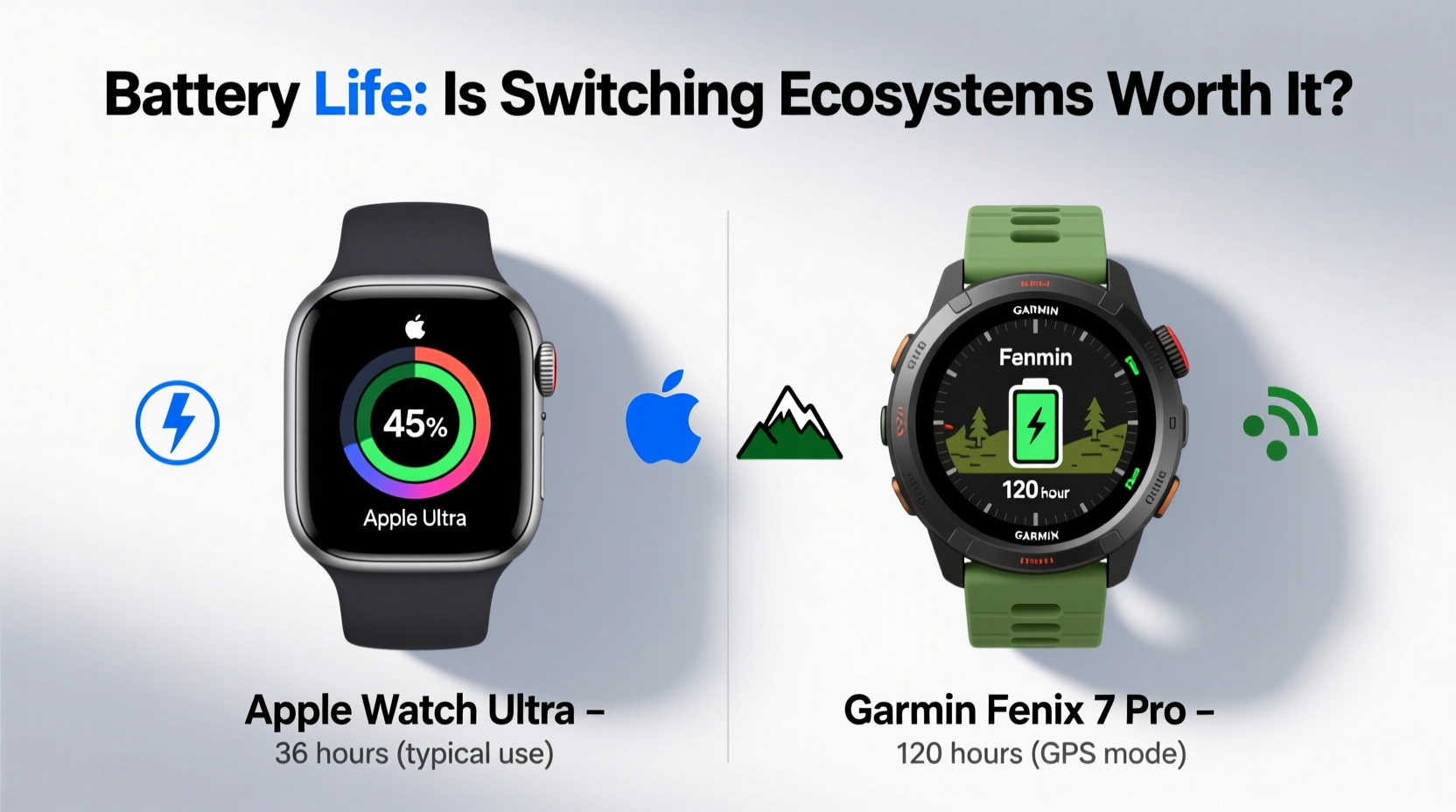
The most glaring distinction between the Apple Watch Ultra and the Garmin Fenix lies in their battery performance. Apple Watch Ultra offers up to 36 hours of typical usage, extendable to 60 hours in Power Reserve mode. In contrast, the Garmin Fenix 7X can last up to 57 hours in GPS mode—and over 24 days in smartwatch mode. For daily commuters or gym-goers, 36 hours may be sufficient. But for trail runners covering 100-mile races, backpackers without access to charging, or sailors on open-water voyages, this gap becomes a dealbreaker.
Garmin’s engineering prioritizes longevity through efficient processors, optimized software, and larger batteries—all without compromising ruggedness. Apple, meanwhile, balances battery capacity with sleek design and high-performance features like always-on display, LTE (on select models), and rich app integrations that drain power quickly.
Real-World Usage Scenarios
Consider an ultrarunner preparing for a 100K race across mountainous terrain. With frequent GPS tracking, heart rate monitoring, elevation logging, and music playback, the Apple Watch Ultra might struggle past day one. In contrast, the Garmin Fenix can easily sustain three full days under similar conditions. Similarly, a mountaineer ascending Denali needs reliable navigation and weather updates over several days. Relying on a device that requires nightly charging isn’t practical when shelter time is limited and temperatures drop below freezing.
“Battery life isn’t just about convenience—it’s a safety consideration in remote environments.” — Dr. Lena Patel, Outdoor Safety Researcher at Colorado Mountain Institute
Ecosystem Integration: Convenience vs Independence
Switching from Apple Watch to Garmin means stepping outside the tightly woven Apple ecosystem. This shift affects everything from notifications and message replies to health data syncing and third-party app support.
On iPhone, the Apple Watch Ultra delivers flawless integration. Messages, calls, emails, and calendar alerts arrive instantly. Health metrics sync directly to the Health app, which many users rely on for longitudinal wellness tracking. Third-party apps like Strava, MyFitnessPal, and Spotify are deeply integrated and easy to manage.
Garmin, while compatible with iOS, operates as a standalone platform. Notifications work, but interaction is limited. You can’t reply to iMessages directly from the watch unless using third-party hacks. Music control is functional but less intuitive. Most critically, Garmin Connect does not natively feed into Apple Health without manual export or third-party tools like Health Sync.
This lack of deep integration creates friction. Users accustomed to effortless handoffs between devices may find Garmin’s interface clunky. However, Garmin compensates with independence: its watches function equally well with Android and iOS, making them ideal for mixed-device households or future-proofing against potential platform changes.
Data Accuracy and Athletic Features
Both devices excel in core biometrics—heart rate, blood oxygen, sleep tracking—but differ in depth and specialization.
- Apple Watch Ultra: Uses advanced optical sensors and temperature sensing (via back crystal) for improved workout detection and menstrual cycle tracking. ECG and fall detection add medical-grade safety features.
- Garmin Fenix: Offers comprehensive training load analytics, recovery time recommendations, hydration logging, and advanced running dynamics (when paired with external sensors). Its wrist-based heart rate is slightly less accurate during interval training but shines in long-duration consistency.
Garmin also provides built-in topographic maps, ski resort maps, golf course views, and aviation data depending on model—features absent from Apple’s lineup. For multisport athletes who transition from trail running to cycling to swimming to climbing, this breadth of preloaded functionality reduces reliance on smartphones.
Design and Durability: Built for Extremes
Both watches meet military-grade durability standards (MIL-STD-810H), feature sapphire glass, titanium cases, and water resistance up to 100 meters. The Apple Watch Ultra uses a flat, convex lens to reduce glare and improve touch response with gloves. Its Action Button allows quick access to workouts or flashlight—a welcome addition for adventurers.
Garmin Fenix takes a more traditional approach with physical buttons, preferred by many in wet or cold conditions where touchscreens fail. The rotating bezel on newer models enhances menu navigation without swiping. While heavier than the Ultra, the Fenix feels more like field equipment than consumer electronics—a psychological advantage for serious outdoorspeople.
| Feature | Apple Watch Ultra | Garmin Fenix 7X |
|---|---|---|
| Battery (Smartwatch Mode) | 36 hours (up to 60 in Power Reserve) | Up to 24 days |
| Battery (GPS Mode) | ~24 hours | Up to 57 hours |
| Maps | Turn-by-turn directions (downloaded) | Full-color topographic, ski, golf maps |
| Connectivity | LTE, Wi-Fi, Bluetooth, U2 chip | Bluetooth, Wi-Fi, ANT+ |
| Health Sensors | ECG, SpO2, skin temp, accelerometer | SpO2, HRV, hydration, respiration |
| Third-Party Apps | Extensive App Store | Limited Connect IQ store |
| iOS Integration | Seamless | Basic notification sync |
When the Battery Wins: A Case Study
Jamie Rivera, a thru-hiker completing the Pacific Crest Trail, initially relied on the Apple Watch Ultra for its fitness tracking and emergency SOS via satellite (a shared feature in both brands). After 10 days on the trail, Jamie found herself carrying a portable charger solely to keep the watch alive. “I was spending more time managing battery than enjoying the hike,” she said. She switched to a Garmin Fenix 7 and completed the remaining 2,000 miles without needing to charge her watch more than once every five days.
“The peace of mind knowing my watch would outlast my food supply changed how I approached each leg,” Jamie explained. “I could focus on navigation, elevation gain, and pacing—not whether my device would die before sunset.”
Her experience underscores a critical point: for extended off-grid adventures, battery life isn't just a spec—it's a lifeline.
Making the Switch: A Step-by-Step Guide
If you're considering leaving the Apple ecosystem for Garmin’s endurance edge, follow this practical transition plan:
- Backup Your Data: Export health data from Apple Health to a CSV or use a service like SyncMyTracks to preserve historical records.
- Set Up Garmin Connect: Create an account and pair your Fenix watch. Enable auto-sync with your phone.
- Transfer Key Metrics: Manually input baseline stats (weight, resting HR, VO₂ max) if migrating from Apple Fitness history.
- Configure Notifications: Adjust message previews, call alerts, and app notifications within the Garmin Connect app.
- Integrate with Apple Health (Optional): Use third-party apps like Health Sync to push Garmin data back into Apple Health for unified viewing.
- Test Before Committing: Run a weekend trip using only the Fenix to evaluate real-world performance and comfort.
Checklist: Should You Switch from Apple Watch Ultra to Garmin Fenix?
Answer these questions honestly to determine if the trade-off makes sense for your lifestyle:
- Do your activities regularly exceed 24–48 hours without charging access? ✅
- Do you prioritize detailed training analytics over smart replies and app variety? ✅
- Are you willing to manually sync health data or use third-party tools for Apple Health integration? ✅
- Do you value physical buttons and glove-friendly operation in harsh weather? ✅
- Is offline mapping with contour lines and route planning essential for your sport? ✅
- Can you live without native ECG, irregular rhythm notifications, or seamless Siri interaction? ✅
If you answered “yes” to most of these, the switch likely aligns with your priorities.
Frequently Asked Questions
Can I still use my iPhone with a Garmin watch?
Yes. Garmin Connect is fully compatible with iOS. You’ll receive notifications, control music, and sync data seamlessly, though with fewer interactive capabilities compared to Apple Watch.
Does Garmin offer emergency SOS like Apple Watch Ultra?
Yes. Higher-end Fenix models include incident detection and assistance features that automatically send your location to emergency contacts via connected smartphone. Some even support two-way satellite messaging via partnerships with services like Garmin inReach.
Will my Strava segments sync automatically?
Absolutely. Both Apple Watch and Garmin integrate with Strava. Activities upload automatically when synced, though Garmin offers deeper segment analysis during live workouts on certain models.
Final Verdict: Is the Trade-Off Worth It?
The answer depends entirely on your definition of utility. If your wearable is primarily a companion to your iPhone—an extension of your digital life focused on health trends, communication, and daily convenience—the Apple Watch Ultra remains unmatched. Its design, app ecosystem, and health monitoring features deliver a premium experience within Apple’s walled garden.
But if your adventures push beyond the reach of chargers, cell towers, and paved trails, the Garmin Fenix offers something irreplaceable: endurance. Its ability to run for weeks on a single charge, provide precise navigation without a phone, and deliver athlete-centric insights makes it the tool of choice for those who measure progress in miles, not minutes.
Leaving the Apple ecosystem means accepting compromises—less polished interfaces, reduced messaging functionality, and fragmented health data. But for explorers, endurance athletes, and self-reliant travelers, those sacrifices are often justified by the freedom of a device that won’t quit when the path gets long.
“The best watch isn’t the one with the most features—it’s the one that lasts until you get back.” — Mark Tran, Expedition Leader & Gear Tester, National Outdoor Journal
Take Action: Choose Based on Your Journey
Don’t choose a watch based on specs alone. Ask yourself: What kind of journeys do I take? How far from infrastructure do I go? What happens if my device dies mid-trail?
If your answer involves remote peaks, endless trails, or multi-day challenges, the Garmin Fenix’s battery life isn’t just impressive—it’s essential. And sometimes, the most valuable upgrade isn’t speed or style, but the quiet confidence of knowing your gear will keep pace, no matter how long the road.




 浙公网安备
33010002000092号
浙公网安备
33010002000092号 浙B2-20120091-4
Comments
No comments yet. Why don't you start the discussion?